For distributors, importers and pet brands, sourcing a cat water fountain is not only about choosing a bowl with a pump. A successful cat water fountain OEM program has to connect product design, water-contact materials, pump performance, filtration, cleaning, replacement parts, retail packaging and market-specific documentation. This guide explains how to compare a pet water fountain manufacturer, approve samples and prepare a practical wholesale or private-label order.
Haolinchen offers multiple cat water fountain models for B2B buyers. Use the checklist below to organize requirements before discussing an OEM, ODM or bulk-order project.
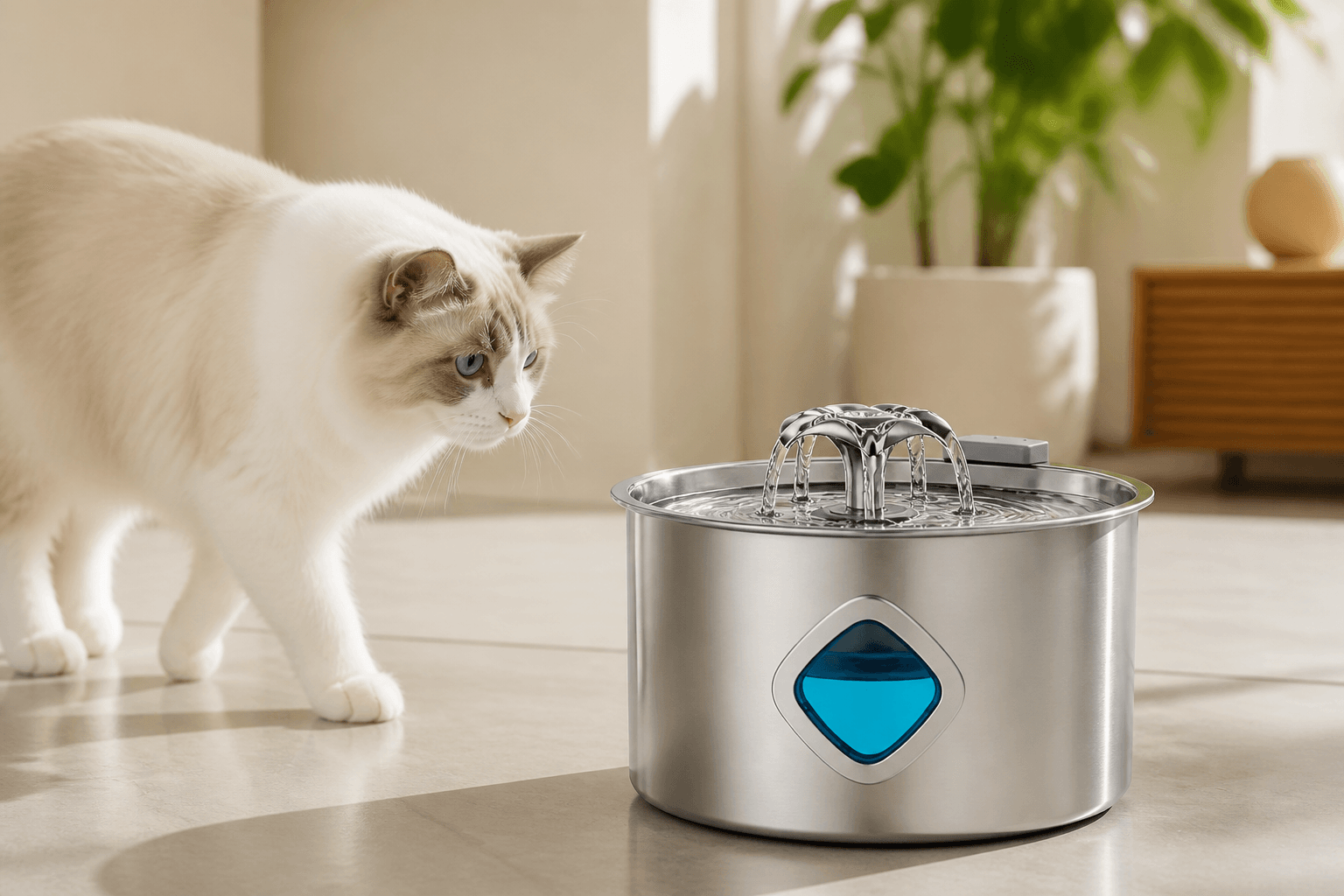
What B2B Buyers Need From a Cat Water Fountain Manufacturer
Consumer-facing specifications often focus on capacity, appearance and quiet operation. A commercial buyer needs a broader view. The product must suit the target retail price, shipping method, local power standard, expected cleaning routine and ongoing supply of filters or pumps. The supplier should be able to explain which features are standard, which can be customized and which claims require model-specific confirmation.
- Product fit: capacity, footprint, flow style, materials and intended cat or multi-pet use.
- Commercial fit: sample availability, model-specific MOQ, lead time, wholesale price and payment terms.
- Brand fit: logo, color, packaging, manuals, accessories and replacement-filter strategy.
- Market fit: plug type, rated voltage, labeling and applicable test documents.
- Service fit: quality-control process, spare pumps, filters, warranty handling and reorder continuity.
Compare Cat Water Fountain Types Before Requesting a Quote
| Fountain type | Commercial advantages | Questions for the supplier |
|---|---|---|
| Stainless steel | Durable appearance and strong premium-retail positioning | Which exact components are stainless steel? Is the grade documented? Are plastic water-path parts still used? |
| Plastic | Lower weight, more color options and flexible industrial design | What resin is used? How is the surface affected by scratching, staining and repeated washing? |
| Ceramic | Premium weight and home-decor appeal | How are breakage, glaze consistency, packaging and freight risk controlled? |
| Traditional wired pump | Familiar construction and continuous operation | How are the cable, adapter and water path separated? How is the pump removed for cleaning? |
| Wireless or inductive pump | Easier bowl removal and cleaner disassembly on some designs | How sensitive is pump positioning? Are the base and pump paired? What happens at low water level? |
| Sensor or smart model | Additional feature differentiation for online and specialty retail | Which functions work without an app? What radio module, platform and documentation apply? |
Do not select a model from the category name alone. Ask for drawings, component descriptions, packaging data and an operating sample. The phrase “stainless steel pet water fountain” may describe a stainless top plate, a stainless bowl or a larger stainless water-contact structure. Specify the exact construction you expect.
Material and 304 Stainless Steel Claims
Stainless steel pet water fountain wholesale buyers commonly search for 304 stainless steel because it is familiar to consumers and retailers. However, the commercial specification should identify each component rather than apply one material claim to the entire product. Ask whether the tray, reservoir, spout, pump housing, filter holder and internal tubes use stainless steel or another material.
For sample approval, inspect edges, seams, surface finish, fingerprints, water spots and the way parts contact each other. Request material evidence appropriate to the project and sales market. Product-page wording, packaging and manuals should match the documented construction; broad claims that cannot be supported create unnecessary retailer and compliance risk.
Capacity, Flow Design and Splash Control
Capacity influences refill frequency, product size and freight cost, but the advertised reservoir volume is not the only useful measure. Buyers should also review the recommended operating level, minimum level, usable volume before pump interruption and visibility of the water-level indicator.
Flow style affects noise, drinking access and splash behavior. A raised stream can attract cats but may splash if the receiving surface is too small. A low bubbling flow can be quieter but should remain visible and accessible. During sampling, test the product on a level floor at full, half and low water levels. Check for droplets around edges, condensation, movement caused by pets and water returning outside the intended path.
Pump Noise, Service Life and Low-Water Protection
“Quiet” is an important consumer keyword, but noise depends on water level, assembly, surface, pump condition and measurement method. Instead of approving a sample based only on an informal claim, define a repeatable comparison: same room, same distance, same water level and the same operating time. Listen for motor vibration, resonance from the lid, intermittent rattling and increased noise as water drops.
Ask the supplier about the pump model, rated power, cleaning method, expected maintenance and replacement availability. Confirm whether the selected model has dry-run or low-water protection and how that function behaves. A private-label program also needs a clear plan for spare pumps, since a low-cost replaceable component can prevent an entire fountain from becoming unusable.
Filter System and Replacement Supply
Filter design affects water flow, ongoing revenue and customer satisfaction. Depending on the model, a filter may include non-woven fabric, activated carbon, foam or ion-exchange material. Do not assume every filter uses the same media or makes the same performance claim. Request a section drawing or component description and ensure marketing language is appropriate to the actual filter.
For wholesale planning, confirm:
- filter dimensions, media structure and orientation;
- how water can bypass the filter if it is installed incorrectly;
- recommended replacement interval and the basis for that recommendation;
- individual or multipack packaging options;
- filter MOQ, lead time and compatibility across fountain models;
- whether the filter design is likely to remain available for future reorders.
Include filter supply in the first quotation. A competitive fountain price can become less attractive if replacement consumables require a separate high-MOQ shipment.
Cleaning, Hygiene and Everyday Maintenance
Easy cleaning is a major product-conversion factor and a major source of reviews. Count the parts a customer must remove, identify narrow corners and check whether the pump can be opened without tools. Review which parts can be submerged, hand washed or placed in a dishwasher; these instructions must be model-specific.
During sample testing, assemble and disassemble the fountain repeatedly. Check whether the lid seats correctly, the filter remains flat and the pump or tube can be reconnected without guesswork. Look for trapped water, difficult grooves and surfaces that show residue quickly. Clear cleaning diagrams in the manual can reduce avoidable customer-service cases.
Power, Cable and Water Separation
An automatic cat water dispenser combines electricity and circulating water, so buyers should examine the complete power system—not only the adapter shown in a photo. Confirm input and output ratings, plug type, cable length, connector design, pump voltage and the way electrical connections are protected from routine splashes.
For wireless-pump designs, verify what “wireless” means. It may describe power transfer between the base and removable pump rather than battery operation or Wi-Fi connectivity. Test pump positioning, bowl removal, error indication and restart behavior after power interruption. Product descriptions should use terminology that customers will not misinterpret.
Smart and Sensor Functions
Sensor, timer or app functions can help a brand differentiate, but they also add software, radio and support requirements. Ask which modes are stored locally, what happens without internet access, whether shared-family access is supported and how firmware or app compatibility is managed. If the product uses Wi-Fi or Bluetooth, identify the exact module and target-country requirements early.
For many buyers, a reliable non-connected fountain with strong consumable supply is commercially better than a complex feature set. Choose functions that support the sales channel and customer promise rather than adding technology only for a specification list.
Private-Label and OEM Customization Options
A private label cat water fountain project can range from applying a logo to developing a new appearance or water-flow structure. Separate requests into levels so the supplier can quote accurately:
- Branding: logo location and method on the product, adapter, filter pack and carton.
- Color and finish: existing colors, custom color matching, stainless finish and color tolerance.
- Packaging: printed box, inserts, barcode, warning labels and shipping carton marks.
- Content: manual language, quick-start guide, cleaning diagrams and product photography.
- Accessories: extra filters, cleaning brush, spare pump or alternate adapter.
- Product change: tooling, reservoir, top plate, pump, electronics or software modifications.
Use the private-label MOQ and customization guide to distinguish standard branding from changes that may require engineering work, tooling or a different order quantity.
MOQ, Wholesale Price and Cost Drivers
There is no useful universal MOQ for every fountain. It changes with the selected model, inventory status, color, logo process, packaging, adapter and filter configuration. Ask for separate quotations for an in-stock sample, a standard bulk order with neutral packaging and the intended private-label version.
Important cost drivers include stainless-steel content, pump type, sensor or smart electronics, adapter certification, filter quantity, printed packaging, accessories and carton volume. Compare total landed value rather than unit price alone. A slightly higher unit price may be commercially stronger if it includes retail-ready content, stable consumables and fewer separate component orders. For project-structure decisions, see the OEM vs ODM guide for smart pet products.
Sample Approval Tests for Pet Water Fountains
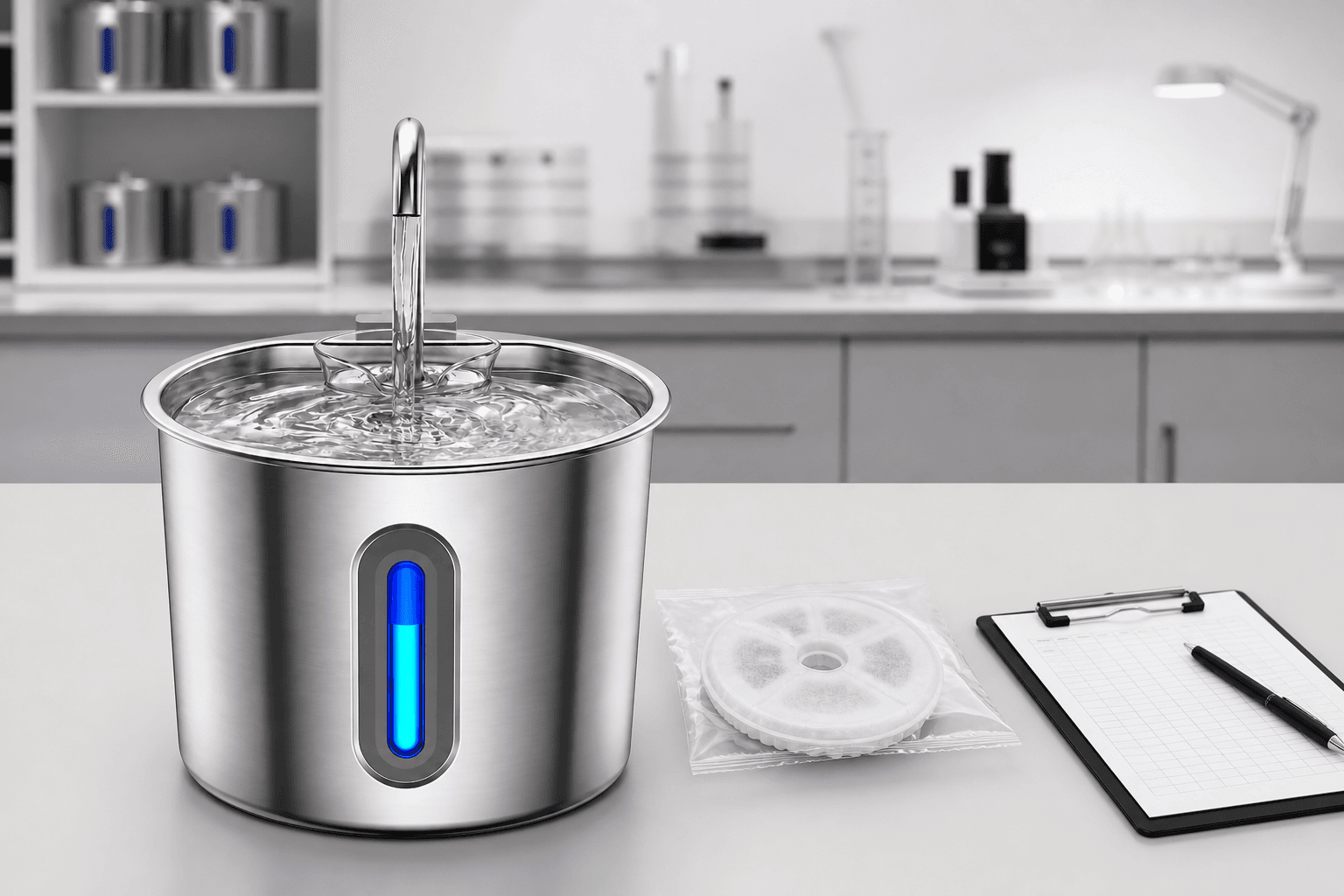
Create a written sample record with photos, videos and test conditions. A practical evaluation can include:
- Run the fountain continuously for 24–72 hours under normal use conditions.
- Compare sound at full, half and low water levels using the same room and distance.
- Observe flow stability, vibration, splash and filter bypass.
- Check water-level visibility and low-water behavior.
- Disassemble, wash, dry and reassemble every serviceable component.
- Introduce a realistic amount of hair or debris, then follow the stated cleaning process.
- Inspect the cable, connector and adapter after repeated handling.
- Test spare filters and a replacement pump for fit.
- Review carton protection, printed content, barcode location and accessory count.
Approve the final pre-production sample—not only an early generic sample. Record the approved color, logo, packaging version, component list and firmware or pump revision where applicable.
Compliance and Documentation for the Destination Market
Documentation depends on destination country, power system, materials, radio functions and sales-channel requirements. Before ordering, tell the manufacturer where the product will be sold and whether it will be marketed as a connected device. Potential review areas include electrical safety, electromagnetic compatibility, radio requirements for connected models, restricted substances, adapter documentation, material declarations, labeling and packaging rules.
A certificate name alone does not prove that it covers the exact ordered model, adapter or configuration. Compare applicant, manufacturer, model numbers, ratings, test standard and report scope. Our smart pet product certification guide for US and EU buyers provides a preparation checklist, but final requirements should be confirmed with a qualified testing organization or compliance adviser.
Packaging and Logistics
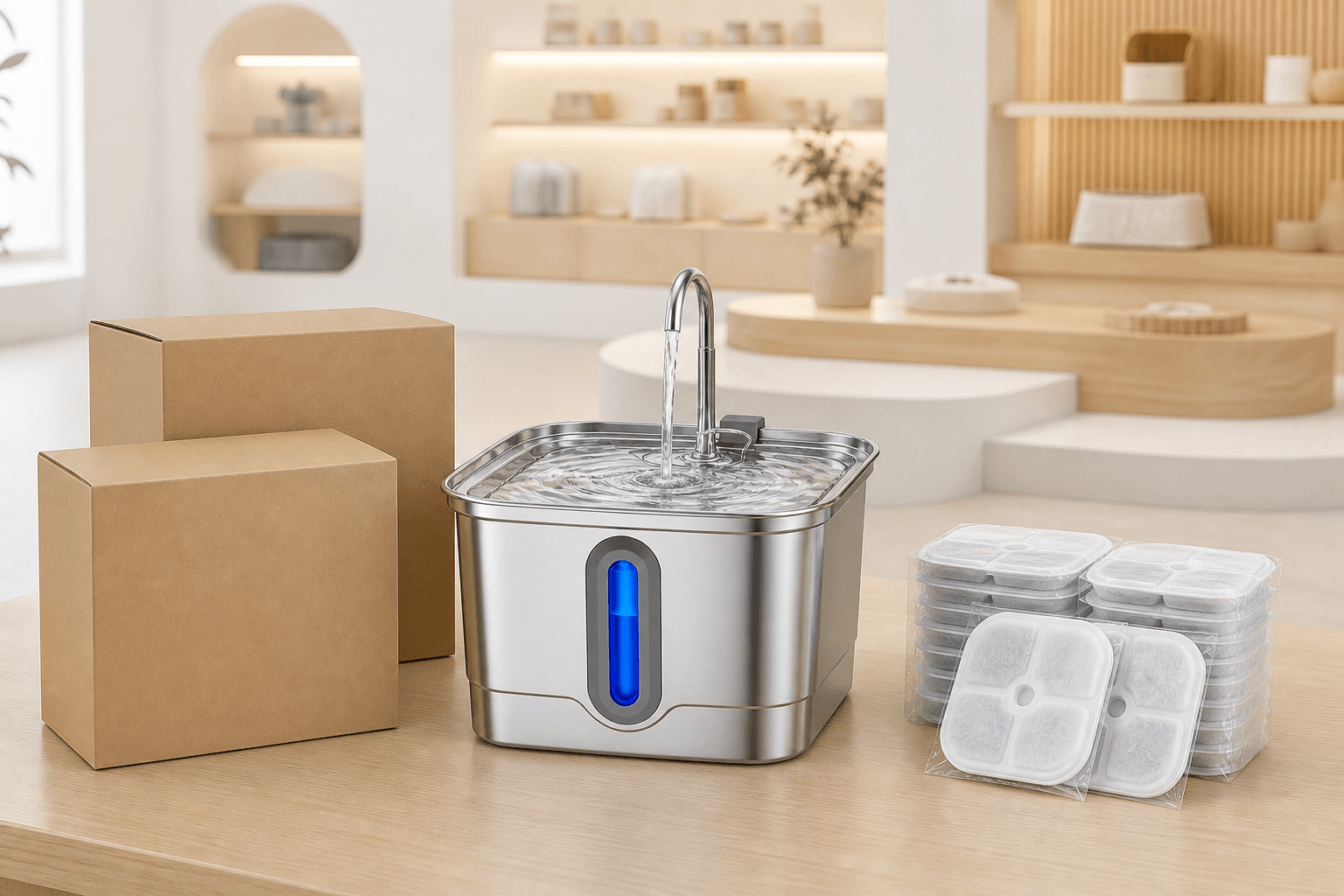
Water fountains can combine a rigid bowl, pump, adapter and loose accessories. Packaging should prevent cosmetic damage, movement and pressure on fragile parts. Request packed-product dimensions, net and gross weight, master-carton quantity and carton marks before calculating freight.
Test retail-box presentation and shipping protection separately. Confirm whether stainless surfaces need protective film, whether filters are sealed and how the manual or accessories are prevented from scratching the product. If ceramic is selected, define drop-test expectations and breakage handling with special care.
Quality Control and Production Approval
A model-specific inspection checklist is more useful than a generic statement about quality. It can cover appearance, logo position, material and color, pump startup, flow, sound, leakage, sensor or app functions, adapter and plug, accessory count, filter fit, packaging, labels and carton marks.
Agree on inspection timing and defect classification before production is complete. Keep a signed or digitally approved reference sample. For a broader supplier review—including communication, engineering response and traceability—use the guide on how to choose a smart pet product manufacturer in China.
After-Sales Planning: Filters, Pumps and Spare Parts
After-sales planning begins before the purchase order. Ask which parts can be replaced by the end customer and which require technical service. Establish part numbers, packaging, MOQ and lead time for filters, pumps, adapters, lids, seals and other model-specific items.
Estimate the quantity of consumables and service parts required for the first sales period. Agree on how production issues will be documented and resolved, including photos, videos, batch information and sample return where necessary. This makes warranty discussions more objective and helps protect retailer relationships.
Supplier Comparison Scorecard
| Area | Evidence to request | Buyer decision |
|---|---|---|
| Product construction | Drawings, component list and material details | Does the actual design support the marketing position? |
| Pump and flow | Pump specification, sample tests and spare-part plan | Is performance stable through expected water levels? |
| Filtration | Filter construction, fit and reorder quotation | Can consumables be supplied consistently? |
| Cleaning | Disassembly test and manual instructions | Can customers maintain it without confusion? |
| Customization | Artwork template, packaging sample and change list | Are cost, MOQ and lead-time impacts clear? |
| Compliance | Model-specific reports and rating-label draft | Does the evidence match the sales market and configuration? |
| Quality and service | Inspection checklist, reference sample and spare list | Is there a workable process after shipment? |
RFQ Checklist for a Cat Water Fountain Bulk Order
Send the following information to receive a more comparable quotation:
- destination country and sales channel;
- preferred fountain type, material, capacity and flow style;
- estimated sample quantity and first bulk-order quantity;
- logo, color, packaging and manual-language requirements;
- plug type, voltage and any channel-specific compliance request;
- required filters per unit and replacement-filter packs;
- spare-pump or accessory requirement;
- target delivery window and shipping method;
- required inspection, testing or documentation.
Frequently Asked Questions
What is the MOQ for a private-label cat water fountain?
MOQ is model-specific and depends on color, logo method, packaging, adapter, accessories and structural changes. Request separate quantities for a standard model and the intended private-label configuration.
Can I order a stainless steel pet water fountain wholesale?
Stainless steel models may be available for wholesale or private-label projects. Confirm which exact parts use stainless steel, the documented grade, surface finish, pump design, filter supply and packaging before approval.
Can the logo, box and manual be customized?
Logo application, printed packaging and multilingual manuals are common project requests, but feasibility, MOQ and lead time depend on the selected model and artwork. Confirm every item on a customization checklist.
Should I buy replacement filters with the first order?
Usually it is sensible to plan filter inventory at launch. Calculate it from expected sales, recommended replacement guidance and reorder lead time, then verify filter compatibility and packaging.
How should I compare pump noise?
Test samples in the same room at the same distance and at multiple water levels. Record vibration, lid resonance and sound after extended operation instead of relying only on a single “quiet” claim.
Which certifications are required?
Requirements depend on the destination market, electrical configuration, materials and whether radio functions are included. Confirm the exact model and adapter with a qualified laboratory or compliance adviser.
Start a Cat Water Fountain OEM or Wholesale Project
A strong sourcing decision connects product performance with retail execution and after-sales supply. Prepare your target market, model preferences, quantity, branding, filters, plug type and launch schedule, then compare samples against one written checklist.
Contact Haolinchen about cat water fountain OEM, private-label and wholesale options. We can review model availability, customization scope, sample arrangements and model-specific commercial requirements for your project.