The 28th Pet Fair Asia was held at the Shanghai New International Expo Centre from August 19–23, 2026. According to the official show information, the exhibition covered more than 320,000 square metres, brought together more than 2,600 exhibitors and attracted 130,000 trade visitors from 95 countries. These figures make the event a useful snapshot of what global buyers are evaluating now—not merely what is being discussed as a future concept.
Post-event reporting also highlighted facial-recognition feeders, integrated feeding, drinking and elimination data, and increasingly diverse tracking devices. Shanghai’s official post-event summary reported more than 2,000 product debuts. For a B2B buyer, the important question is not which feature looks most impressive on a booth. It is which technology can become a reliable, compliant and profitable product line.
| Trend | Buyer Opportunity | What to Verify Before Ordering |
|---|---|---|
| Pet identification | Personalised feeding and controlled access | Recognition accuracy, tag compatibility, response time and failure handling |
| Health data | Higher-value connected products | Sensor accuracy, useful alerts, data ownership and privacy |
| Reliability | Lower returns and better reviews | Power loss, offline mode, jam tests, battery life and durability |
| Multi-cat care | Premium, problem-led positioning | Food stealing, individual records and household usability |
| Hygiene | Stronger daily-use experience | Food-contact parts, disassembly, cleaning and odour control |
| Ecosystems | Cross-selling and higher customer lifetime value | App integration, account management and device compatibility |
| OEM and compliance | Faster private-label launch | MOQ, artwork, packaging, certification scope and quality documents |
1. Pet Identification Is Becoming a Core Smart-Feeding Function
Automatic feeding originally focused on schedules and portion control. The next step is identifying which animal is approaching the bowl. This matters in homes where one cat steals another cat’s food, where pets eat different formulas or where a veterinary diet must be protected.
RFID and facial recognition solve related but different problems. RFID can provide consistent controlled access through a collar tag or compatible identifier. Facial recognition can reduce dependence on a collar, but buyers should examine lighting conditions, recognition speed, similar-looking animals and the manufacturer’s error-handling logic. Neither technology should be judged by a demonstration alone.
2. Health-Related Data Is Becoming More Useful—but Only When It Supports Action
The value of connected pet products is shifting from remote control to longitudinal observation. Feeding frequency, portion changes, drinking behaviour, litter-box visits, body weight and activity patterns can help owners notice changes earlier. Xinhua’s 2026 Pet Fair Asia technology report described products that connect feeding, drinking and elimination data to build a broader view of pet health.
For B2B buyers, more data is not automatically better. Ask what is measured directly, what is estimated, how often sensors are calibrated, which alerts are genuinely useful, and how data is stored. A product that produces confusing graphs but no practical action can increase support costs rather than strengthen the brand.
3. Reliability Still Matters More Than Feature Count
Research on pet technology adoption consistently points to practical barriers such as reliability, battery life, durability and unclear value. The William Blair and FTI pet technology report also emphasises the importance of data integration while noting these adoption challenges.
For feeders, reliability means repeatable portion output, resistance to food jams, secure food storage, operation during network interruptions and an appropriate backup-power strategy. For litter boxes, it means dependable sensing, anti-pinch protection, motor protection, safe entry dimensions and accessible cleaning. Buyers should request written test standards rather than accept a long feature list as evidence of maturity.
- Run continuous dispensing or cleaning cycles with the intended consumables.
- Test power failure, network failure, sensor obstruction and abnormal loading.
- Record the fault, user notification, recovery process and any manual intervention.
- Compare the approved sample with pre-production and mass-production units.
4. Multi-Cat Care Creates Stronger Premium Use Cases
Multi-pet households create problems that conventional timed devices cannot fully solve: food stealing, unequal access, different diets and difficulty knowing which animal produced which record. Products that identify individual pets can translate technology into a clear consumer benefit and a stronger premium selling proposition.
That makes multi-cat care especially relevant to specialist retailers, veterinary channels and premium pet brands. However, the sales claim must match the tested configuration. Buyers should verify the number of supported pets, the process for adding or removing identifiers, shared app access, record separation and what happens when two animals approach simultaneously. See our detailed guide to RFID smart feeders for multi-cat homes.
5. Hygiene Design Is a Commercial Feature, Not a Minor Detail
Products used for food, water and waste are judged every day. Removable food-contact parts, smooth internal paths, stainless-steel contact surfaces where appropriate, accessible pumps and filters, and easy litter-bin cleaning affect reviews, returns and repurchase behaviour.
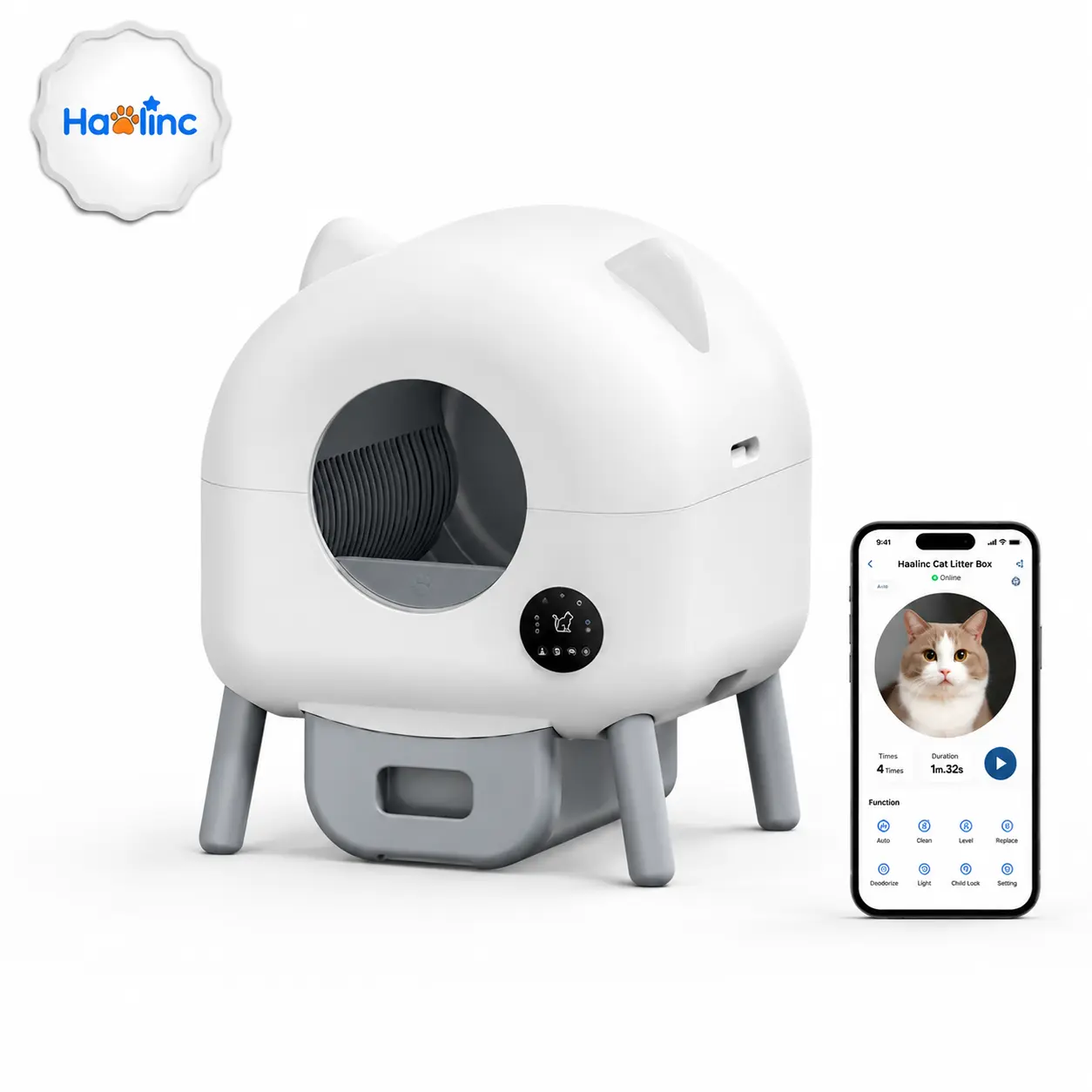
During sampling, ask an unfamiliar tester to disassemble, clean and reassemble the product without help. Record the time, tools required, inaccessible corners and likelihood of incorrect reassembly. For water products, review the TY10 stainless-steel pet water fountain; for waste management, compare the automatic cat litter box range.
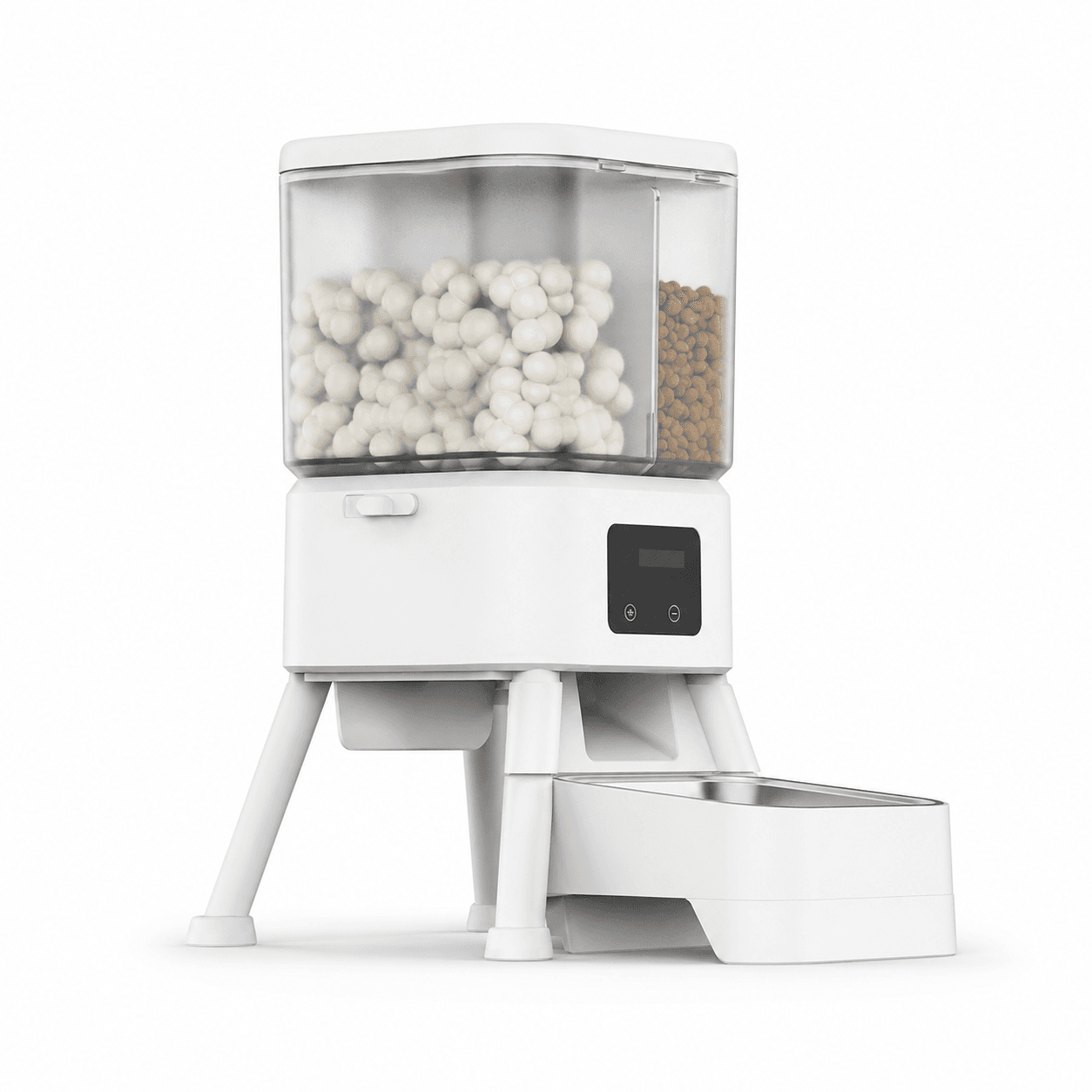
PTM-20A1/20A3 Dual-Grain Feeder
A dual-hopper platform for buyers exploring main-food, treat or mixed-feeding concepts.
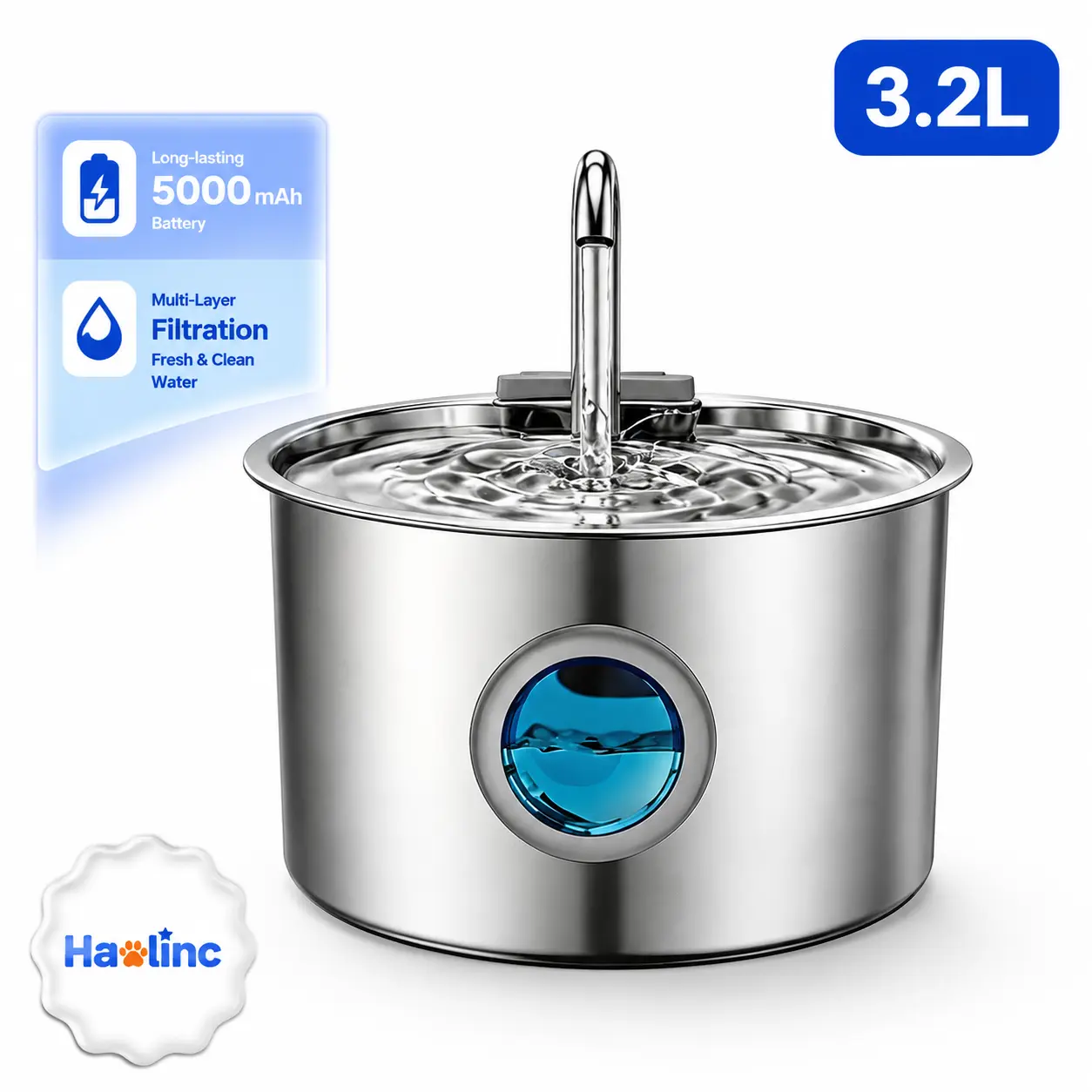
TY10 Pet Water Fountain
A stainless-steel drinking solution that can complement a broader smart pet-care assortment.
6. Product Ecosystems Are Replacing Isolated Devices
Feeders, fountains, litter boxes and trackers are increasingly evaluated as parts of one household-care system. The commercial advantage is not simply that every device has an app. It is that products share coherent account management, useful records, consistent industrial design and reliable after-sales support.
An ecosystem can raise average order value and improve cross-selling, but only if app ownership, server responsibility, firmware maintenance and privacy obligations are clear. Ask whether the app is manufacturer-owned, based on a third-party platform or available for private-label customisation. Confirm ongoing costs, supported regions, account migration and responsibility for future updates.
| Product Line | Core Buyer Value | Recommended Evaluation Focus |
|---|---|---|
| Automatic pet feeders | Scheduled, portioned or pet-specific feeding | Dispensing consistency, access control, offline operation and food compatibility |
| Automatic litter boxes | Cleaning automation and elimination records | Safety logic, sensing, odour management, litter compatibility and cleaning |
| Pet water fountains | Convenient access to circulating water | Pump access, filters, noise, materials and maintenance |
| Pet GPS trackers | Location and activity visibility | Coverage, battery life, subscription model, app regions and attachment security |
7. OEM Readiness and Compliance Decide Whether a Trend Can Scale
A promising sample is only the beginning. Private-label buyers also need stable production, packaging execution, market-specific plugs and manuals, firmware control, traceability, inspection standards, certification documents and a workable after-sales plan. Ask whether certificates apply to the exact model and configuration you intend to purchase; a report for a related product is not automatically sufficient.
When assessing a manufacturer, use the automatic pet feeder manufacturer checklist, review OEM/ODM capabilities, and understand the supplier’s factory and quality-control process.
| Project Area | Questions for the Supplier | Evidence to Request |
|---|---|---|
| Product maturity | Is the model in stable mass production? | Production history, test plan and approved reference sample |
| OEM scope | Which branding, packaging, app and firmware changes are available? | Itemised scope, lead time, cost and approval milestones |
| Compliance | Which documents cover the exact model and target market? | Valid reports, certificates, labels and bill of materials |
| Quality control | Which checks occur at incoming, production and shipment stages? | Inspection criteria, records, AQL agreement and defect handling |
| After-sales | How are failures, spare parts and warranty claims handled? | Warranty terms, response process and spare-parts plan |
A 10-Step Post-Show Sourcing Process
- Define the target country, channel, customer and retail price band.
- Write the user problem before choosing the technology.
- Shortlist mature platforms, not only visually attractive prototypes.
- Request specifications, test reports, certification scope and OEM options.
- Order samples in the final intended voltage, plug and software configuration.
- Run normal-use, fault, cleaning, packaging and multi-pet tests.
- Record acceptance criteria and keep an approved reference sample.
- Confirm MOQ, tooling, artwork, packaging, app and recurring service costs.
- Approve a pre-production sample and define pre-shipment inspection.
- Prepare manuals, support scripts, spare parts and launch content before mass delivery.
Final Takeaway for Pet Product Buyers
Pet Fair Asia 2026 confirms that the smart pet category is moving toward individual identification, actionable health data and connected care. Yet the products most likely to succeed are not necessarily those with the most features. They are the ones that turn a clear household problem into a dependable, easy-to-maintain and well-supported product.
For brands and distributors, the best response is a disciplined sourcing process: define the use case, compare suitable product platforms, test real failure scenarios, confirm OEM and compliance details, and build after-sales support before launch. That is how an exhibition trend becomes a scalable product line.