
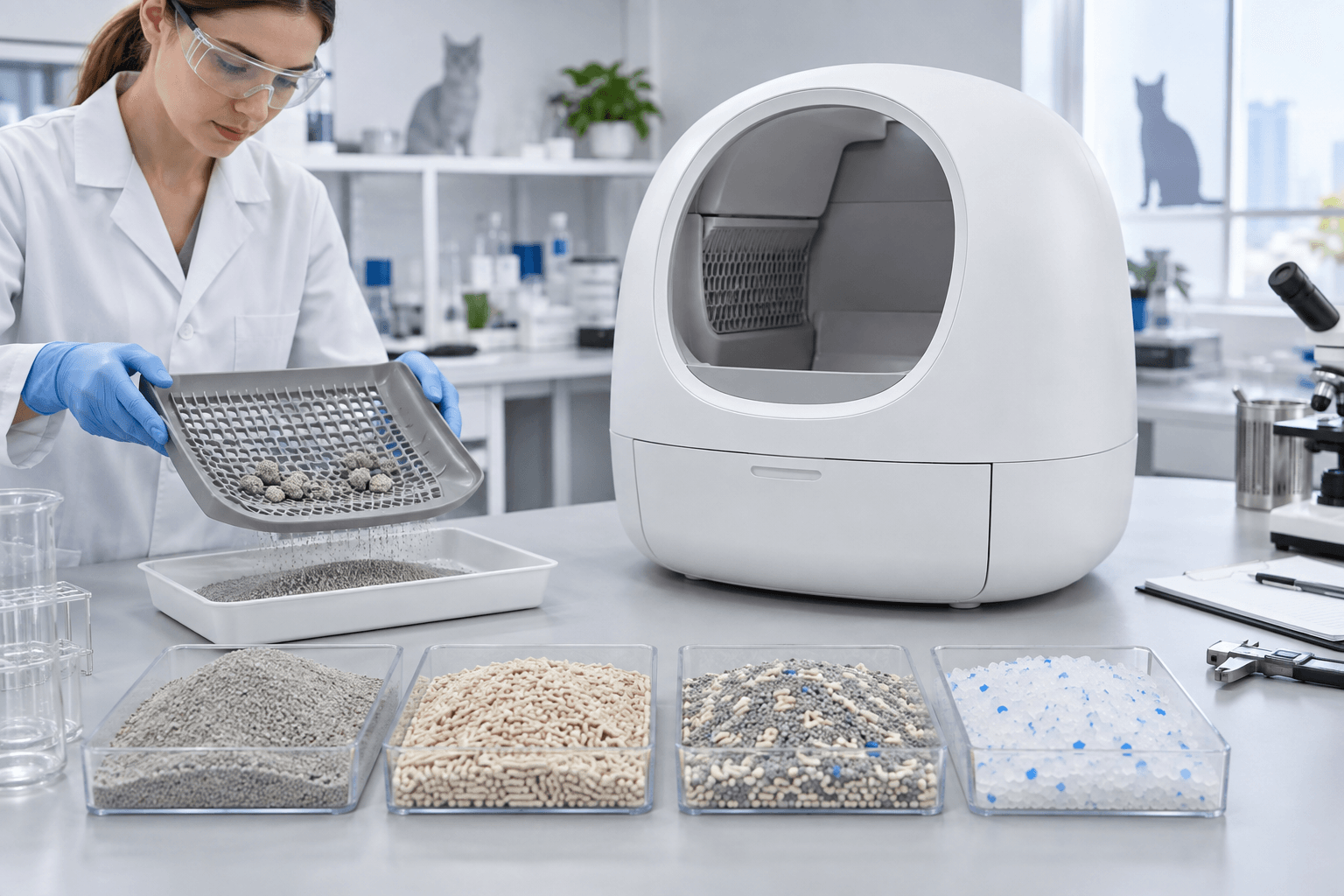
“Can customers use bentonite, tofu, mixed or crystal litter?” sounds like a simple sales question. For a distributor, however, the answer affects clean-litter loss, residue, odor, sensor reliability, support tickets and returns. Two bags both labeled “tofu litter” may have different pellet length, hardness and clumping speed. Two mineral litters may produce very different dust and wet-clump behavior.
This guide shows how brands and importers can evaluate automatic litter box compatibility in a way that can be repeated during sample approval and production. It complements the broader automatic cat litter box sample-test guide and the returns-reduction guide for pet brands.
| Litter family | Typical sourcing attraction | Main compatibility risk | What to validate |
|---|---|---|---|
| Bentonite / mineral | Common, fast clumping and widely available | Fine dust, heavy clumps, sticking and clean-litter loss | Mesh loss, clump breakage, torque, residue and sensor contamination |
| Tofu | Lightweight, low-dust positioning and easy consumer recognition | Long pellets, variable hardness, fractured particles and soft clumps | Sifter opening, pellet orientation, breakage, waiting time and drawer transfer |
| Mixed litter | Balances clumping and tracking performance | Formula and particle distribution vary by brand and batch | Test the actual commercial formula, not a generic “mixed litter” substitute |
| Crystal / silica | Absorption and odor-control positioning | Clumping behavior, hard particles and optical or weight-sensing effects vary | Exact product, granule size, moisture behavior, separation and sensor readings |
| Wood / paper pellets | Natural-material and low-tracking positioning | Often non-clumping, large or designed to disintegrate | Do not assume compatibility; validate mechanism and waste-separation principle first |
The descriptions above are general tendencies, not universal claims. Compatibility must be confirmed by model and litter specification.
1. Compatibility Is a System Question, Not a Material Label
A bag label gives only a broad material category. The machine interacts with individual particles and clumps. The same litter may work differently after absorbing urine, after several days of dust accumulation, at high humidity or when the fill level changes.
Start by freezing four items: the exact litter SKU, the exact machine hardware, the exact sifter or screen and the exact firmware or cycle delay. If one of these changes, the previous result may no longer represent the final product. This is why a statement such as “works with all clumping litter” creates unnecessary commercial risk.

2. Measure the Properties That Drive Separation
Buyers do not need a full materials laboratory to create a useful specification. They do need consistent sample identification and a few measurements that explain why performance changes.
| Property | Simple B2B test | Why it matters |
|---|---|---|
| Particle size distribution | Sieve and weigh representative samples | Predicts clean-litter pass-through, retention and screen blockage |
| Shape and aspect ratio | Photograph particles against a scale | Long tofu pellets can bridge or align differently from rounded granules |
| Bulk density | Weigh a fixed filled volume | Affects motor load, fill-level assumptions and shipping expectations |
| Clump time and wet strength | Use a fixed liquid volume and timed delays | Weak or early-cycled clumps can smear, break and leave residue |
| Dust and breakage | Compare mass and visible residue before and after cycles | Dust can accumulate on optical areas, seals and moving surfaces |
| Adhesion | Score residue on the liner, drum and screen | Sticking increases odor, cleaning time and incomplete waste transfer |
Record room temperature, humidity, fill depth, delay time and the simulated waste recipe. Without these, suppliers and buyers can repeat the “same” test and obtain incompatible results.
3. Bentonite and Mineral Litter: Strong Clumps, Different Risks
Fine mineral litter is common in many markets and can form firm clumps quickly. That does not automatically make every formula suitable for every automatic mechanism. Very fine particles can increase dust and pass through unintended gaps; heavy wet clumps can challenge the drive system; sticky formulas can coat the liner or screen.
- Measure clean-litter loss after a fixed number of cycles.
- Test fresh clumps at several delay times instead of using only fully cured clumps.
- Run the machine at minimum, normal and maximum fill marks.
- Inspect the sensor areas, motor sound, waste entrance and drawer after repeated cycles.
- Repeat with the target market’s actual best-selling formulas where possible.
For connected and sensor-rich products, combine litter testing with the automatic litter box safety-sensor checklist. Dust resistance and safety logic are separate questions, but both may be affected by accumulated litter residue.

4. Tofu and Mixed Litter Need Their Own Sifter Review
Tofu litter often uses elongated pellets rather than rounded granules. Length, diameter, brittleness and swelling behavior affect how pellets meet a screen. A screen that retains one tofu formula can discard another or allow fractured fines to accumulate.
Mixed litter adds another variable: the percentage and size distribution of each component. Its behavior cannot be inferred from a supplier’s test using only one ingredient. Request the formula category and particle distribution, then test the commercial product that will appear in customer instructions.
Evaluate clump formation before and after pellet breakage, and examine how many unused pellets enter the waste drawer. If a model offers alternative screens, each screen should have its own compatibility list and part number.

5. Crystal, Wood and Paper Litter Require Careful Claims
Crystal litter varies widely. Some products are non-clumping absorbent crystals; others are marketed as clumping silica. Granule hardness, translucency, particle size and moisture behavior may affect separation, liner wear, fill-level interpretation or optical sensing. Test the exact SKU and do not transfer results from one crystal product to another.
Large wood or paper pellets are frequently designed around a different waste-management principle. Some absorb and swell; some disintegrate into sawdust; many do not create the firm clump expected by a rotating screen system. Unless the mechanism is specifically designed and tested for that behavior, avoid a broad compatibility promise.
Product pages should clearly separate “not tested,” “not recommended” and “incompatible.” This is more useful than hiding exclusions and later absorbing avoidable returns. The automatic litter box returns guide explains how expectation mismatch becomes an after-sales cost.
6. Sifter Geometry and Cleaning Mechanism Decide the Outcome
Sifter opening size is only one variable. Opening shape, wall thickness, angle, travel speed, rotation direction, vibration and distance to the waste inlet all influence separation. A clump may fit through a static gauge but break during real movement.
Compare alternative screens with the same litter and machine. Record clean-litter loss, retained waste, cycle time, noise, motor behavior and residue. When the supplier offers separate sifters for mineral and tofu or mixed litter, treat the sifter as a controlled bill-of-material item rather than an interchangeable accessory.

The choice between open and closed structures also affects customer fit, cleaning access and visible litter behavior. Review the open vs closed automatic litter box guide before comparing only feature counts.
7. Test Sensors, Dust Accumulation and the Waste Path Together
A compatibility test should continue after the first successful cycle. Dust can build gradually. Small particles can enter drawer rails or optical windows. A translucent crystal may produce a different level reading from an opaque mineral formula. Wet fragments can collect at the waste inlet and change later cycles.
- Record the clean baseline for sensor readings, motor current or cycle time where available.
- Run repeated dry-litter cycles to evaluate breakage and migration.
- Add controlled clumps at defined locations and delays.
- Inspect the screen, liner, entrance, sensor areas and drawer without cleaning between every cycle.
- Repeat after the normal maintenance interval stated in the manual.
- Clean and reassemble the unit using only customer instructions, then verify the baseline again.

Consumables and waste bags also influence the path after separation. Include them in the test and use the automatic litter box consumables guide to plan ongoing wholesale costs.
8. Compare Platforms by Test Requirement, Not a Universal Claim
The examples below identify where a buyer should focus the compatibility review. They do not replace the final quotation, approved sample or model-specific specification. Confirm the litter, sifter, firmware, voltage, accessories and packaging for the intended order.
V20 Open Automatic Cat Litter Box
Review exposed litter behavior, screen separation, tracking, UV-cycle logic, app settings and repeated waste transfer with the chosen material.
Mini-F Open Cat Litter Box
Check usable litter depth, pellet or granule retention, drawer transfer, cleaning access and performance after repeated cycles.
NEO-AE Closed Automatic Cat Litter Box
Connect sifter performance with gravity calculation, dual infrared sensing, fault recovery and the final production firmware.

High-End Automatic Cat Litter Box
Test litter residue and dust around detachable washable sections, waste storage and fresh-air or deodorization components.

Buyers can compare the full automatic cat litter box range, review the self-cleaning automatic cat litter box, and use the OEM and private-label guide to connect platform selection with market requirements.
9. Use a Repeatable Sample Protocol Before Bulk Order
Step 1 — Freeze samples and conditions
Record machine serial number, hardware, firmware, screen part number, litter brand/SKU, batch, particle sample, room conditions, fill mass and cycle delay.
Step 2 — Establish dry separation
Run clean litter at low, normal and high levels. Weigh clean litter incorrectly discarded and inspect migration into rails, seals and sensor areas.
Step 3 — Test controlled clumps
Use a fixed liquid volume and location. Run several waiting periods to establish the minimum reliable delay. Record breakage, sticking, retained waste and drawer transfer.
Step 4 — Run accumulation cycles
Do not clean after every run. Repeated use reveals dust, adhesion, carryover, changing motor sound and waste-path blockage that one-cycle demonstrations miss.
Step 5 — Repeat cleaning and reassembly
Use final customer instructions. Verify that the machine returns to the same performance after washing, drying and reassembly.
Step 6 — Confirm the packed production unit
Repeat critical checks after the approved drop and vibration test. Transport movement can change alignment even when the litter itself has not changed.
10. Put Compatibility Claims and Change Control Into the Purchase Order
The purchase order or technical agreement should identify the approved model, screen, firmware, compatible litter specification, test method and pass/fail limits. It should also state who may approve a change to the screen material, motor, liner, sensor, firmware or supplier.
| Acceptance item | Example evidence | Commercial purpose |
|---|---|---|
| Approved litter list | Exact SKU or measurable particle and clump criteria | Supports accurate product-page and manual claims |
| Clean-litter loss | Mass or percentage after defined cycles | Controls consumable waste complaints |
| Waste removal | Retained clumps, fragments and drawer transfer score | Controls odor and “does not clean” claims |
| Residue and dust | Photos and scored inspection locations | Controls sensor, cleaning and maintenance risks |
| Change notification | List of components and software requiring buyer approval | Prevents a passed sample from becoming a different production system |
Connect these criteria with the supplier’s quality and compliance process, factory controls and smart litter box customization plan. Buyers entering a new private-label project should also use the MOQ, samples and customization guide and confirm model-specific information in the Haolinc FAQ.
Conclusion: Publish Only What the Exact System Has Passed
Bentonite, tofu, mixed, crystal and pellet litter cannot be approved by category name alone. The defensible answer is a compatibility matrix based on the actual material, screen, mechanism, sensors, timing and production configuration. This gives sales teams a clear answer, gives customers better setup guidance and gives quality teams a repeatable basis for change control.
For wholesalers, the strongest compatibility claim is not “works with everything.” It is a specific, tested statement that tells the buyer what works, what has not been tested and what should not be used.
