
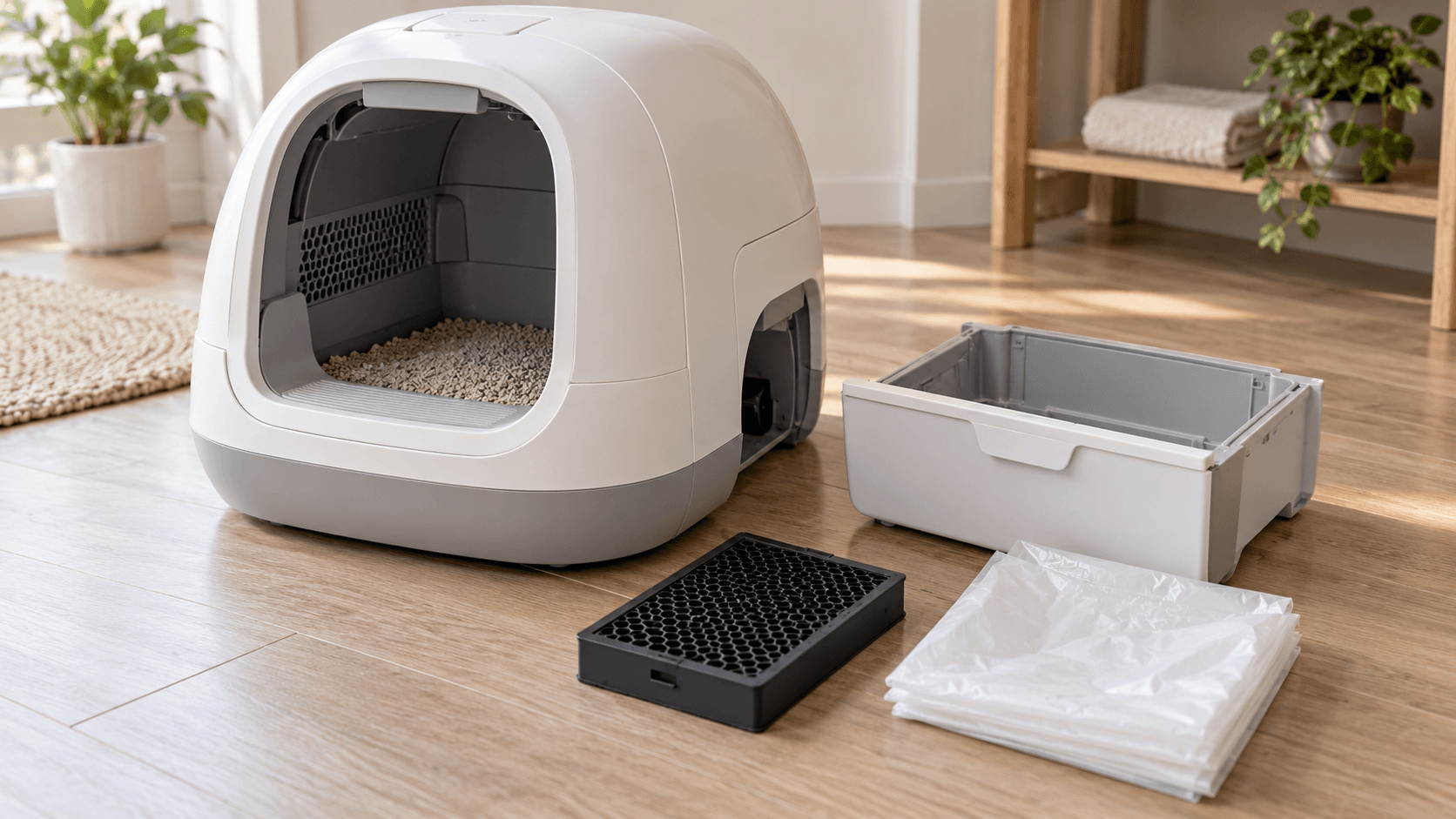
Buyer takeaway: Automatic litter box odor control is a system claim, not the name of a cartridge, for any wholesale program. Waste separation, drawer closure, airflow, litter, cleaning access and the replacement supply chain all affect what an owner smells. Approve the exact production configuration under a repeatable use and maintenance protocol, then price the consumables and support workload before promising a low-maintenance experience.
Distributors, private-label pet brands and Amazon sellers often compare “deodorizing” features on a specification sheet. The better procurement question is whether the box stays acceptable between realistic drawer changes and whether the buyer can sustain the parts, instructions and complaint response after launch. This guide turns automatic litter box odor control into a measurable sample decision and an after-sales plan.
| Buyer decision | Evidence to request | Acceptance approach |
|---|---|---|
| Odor pathway | Waste route, drawer seal, airflow and service diagram | No untested absolute “odor-free” claim |
| Real-use performance | Repeated-use protocol with litter, climate and cleaning schedule | Meet the agreed sensory and maintenance limits |
| Consumable economics | Part numbers, replacement triggers, pack logistics and quoted costs | Cost per owner-year and reorder continuity accepted |
| After-sales exposure | Fault codes, spare parts, cleaning instructions and escalation owner | Support team can diagnose without unsafe workarounds |
1. Map the Complete Odor Path Before Choosing a Feature
Waste begins in the litter bed, then travels through a separation path to a bin or drawer. Each transfer point can retain residue. A drawer that looks closed may have a bag fold over its rim, a contaminated gasket, or a gap at the waste inlet. Air may then escape during a cleaning cycle, when a user opens the drawer, or simply between visits. A filter placed elsewhere in the housing cannot compensate for every leak. Ask the supplier to walk the sample through this path with covers removed and the machine safely disconnected where required.
Record where damp litter touches the screen, drum, liner, chute, drawer lip and removable panels. Mark surfaces that cannot be reached during routine cleaning. Test the waste bag installed by someone who has not seen a demonstration; installation errors are part of the customer experience. The existing bag and liner compatibility guide covers fit in detail. Here the decision is whether that fit preserves the odor-control path and the service promise.
Separate four sources of complaints: retained waste, escaped air, dirty hard-to-clean surfaces and a consumable that is missing or installed incorrectly. Each needs a different corrective action. Calling every complaint a “filter issue” may lead a service team to send parts that do not solve the cause.
2. Compare Deodorization Methods by Mechanism and Burden
Automatic litter box deodorization may rely on waste isolation, passive media, active airflow, ventilation or a combination. Each method should be described by what it actually does in the selected model. Waste isolation depends on separation timing, a properly seated drawer and maintenance frequency. Passive adsorption media can help with some air passing through it, but buyers need the media specification, location, replacement trigger and proof that air follows the intended path. Active airflow adds a fan, duct, control logic and a possible noise or power burden. Fragrance can change perceived smell without removing the source; assess pet acceptance and local labeling before making claims.
Ask whether any consumable is required for the advertised function or merely optional. Confirm that the product still works safely if it is absent, saturated, installed backward or replaced with an incompatible item. Do not assume that a UV feature is an odor-control feature: the V20 product page lists UV functionality, while its odor performance still needs a separate test. Avoid treating broad terms such as “fresh air” as a quantified removal rate without model-specific data.
For a wholesaler, the simplest system is not automatically the cheapest. A low-cost cartridge that is hard to buy locally may trigger abandoned units, refunds or negative reviews. A more elaborate system may justify its complexity if the factory can document parts, maintenance and support. Compare the full ownership experience, not just a feature icon.
3. Run a Repeatable Automatic Litter Box Odor Test
Write the sample protocol before choosing a winner. Use the intended production hardware, firmware, waste bag, deodorizing component and power configuration. Record room temperature, relative humidity, ventilation, litter brand and type, fill mass, cleaning delay, number of simulated visits and drawer-empty schedule. Run the same scenario on each candidate. A single freshly cleaned demonstration cannot support a between-changes claim.
- Baseline: clean and dry each unit as instructed; document the empty-room condition and the installed consumables.
- Repeated use: add a controlled, safe test load or use an approved real-use study; count visits and cleaning cycles. Do not expose cats to an unapproved stress test.
- Time points: inspect shortly after a cycle, after the bin has accumulated waste and just before the planned emptying point.
- Positions: assess near the entrance, drawer seam and normal standing distance. Note any odor burst when the drawer opens.
- Service challenge: repeat after a routine bag change and after a cleaning/reassembly by an unfamiliar operator.
- Failure checks: test a creased bag, full-bin indication and interrupted cycle according to the manufacturer’s safe procedures.
Use a small blinded panel with a fixed rating scale, or a qualified lab method when quantitative claims are planned. Define the rating anchors in advance, randomize order and include a reference condition. Record observations and photographs, not just a pass/fail checkbox. An ammonia reading alone cannot stand for every odor that customers notice, and an uncalibrated handheld reading should not be presented as a certified removal result. Repeat any disputed outcome under the same conditions.
The bulk-order sample checklist can cover safety, cleaning and packaging alongside this odor-specific protocol. Keep the odor test independent enough that a change in litter, bag or cartridge can be traced.
4. Convert Results Into Purchase Acceptance Criteria
Before sampling, agree what counts as an acceptable odor score, maximum cleaning time, visible residue, drawer closure, reassembly error and consumable change interval for the target customer. These thresholds are project decisions, not universal specifications. They should reflect the intended household, climate, litter and maintenance schedule. A premium product marketed for a multi-cat home may need a different protocol from an entry-level single-cat offering.
Require a complete bill of materials and revision identity for the tested unit. Photograph the drawer seal, cartridge position, bag installation and service access. Log any part substitution, firmware change or packaging change between approved sample and production. For inspection, specify critical failures such as an unsafe workaround or mechanism obstruction separately from major issues such as a drawer that repeatedly fails to close. Cosmetic variation belongs in another category.
Do not approve a model solely because a panel preferred its scent. Check whether the user can clean the surfaces causing odor, whether instructions match the test schedule and whether the service team can supply the necessary parts. The quality and compliance process and factory information are starting points for discussing production controls; obtain project-specific evidence for the final configuration.
5. Calculate Cost Per Owner-Year and Reorder Risk
For each consumable, ask for the exact part number, dimensions, material, pack quantity, shelf-life guidance if applicable, replacement trigger, unit cost at the agreed order tier, packaging volume and lead time. Include bags, liners, filters, deodorizing cartridges and cleaning accessories only where the chosen configuration actually uses them. Do not use a generic “monthly filter” assumption unless the supplier has verified that schedule for the use case.
Build a scenario sheet: expected changes per year multiplied by landed cost per change, plus local fulfillment, damaged-pack allowance, customer-service time and the cost of carrying safety stock. Calculate a low-use and high-use case. Compare the cost with realistic retail pricing and whether customers can obtain replacements in the market. A consumable with no dependable replenishment route creates a warranty problem even if its factory price is low.
Ask whether alternative bags or media are approved, untested or expressly incompatible. A vague “standard bags” claim invites support tickets when local bag dimensions vary. If a proprietary part is necessary, disclose that before sale and agree availability and end-of-life support in writing. Our consumables cost guide provides a deeper bag-fit worksheet; the purchasing decision here is how that recurring cost interacts with the odor promise.
6. Translate Odor Complaints Into After-Sales Work
Odor is a subjective complaint with several possible causes, so a distributor needs a short diagnostic tree. First confirm litter type and fill, cleaning delay, drawer-empty frequency and installed consumables. Next check whether the waste path and drawer are correctly seated. Then inspect accessible residue and ask for a safe cleaning photo or video. Only after those checks should the support team suspect a damaged gasket, fan, sensor or other component. Never ask a customer to bypass a safety sensor or operate exposed moving parts.
Estimate support cost as contacts per unit multiplied by handling time and local labor cost, plus part shipment, refunds and return freight. Segment tickets by cause and batch. A spike after a replacement-media change may point to a supply issue; a cluster after delivery may point to packaging or assembly. The returns-prevention guide explains broader return drivers, while the wholesale risk analysis helps frame landed margin and service reserves.
Before launch, obtain a cleaning video, illustrated manual, replaceable-part list, troubleshooting codes, repair authorization process and warranty responsibility split. For an Amazon listing, align the headline, comparison chart, consumable bundle and instruction card with the same tested maintenance schedule. Customer support cannot rescue an absolute “never smells” promise that the sample protocol never established.
7. Compare Haolinchen Platforms Without Assuming Equivalent Odor Systems
Use the automatic cat litter box category to shortlist the form factor, then inspect the exact product page and sample. Published features identify what to ask about; they do not supply a cross-model odor ranking.
| Platform | Published information relevant to review | Odor and service question |
|---|---|---|
| V20 open | Open entry, automatic operation, UV function, 9 L waste bin and app control are listed. | How does the open architecture contain waste odor between drawer changes? |
| Mini-F open | Open design, 10.5 L waste bin and a specified trash-bag size are listed. | Can local bags preserve closure, and what maintenance schedule is realistic? |
| NEO-AE enclosed | Review current product information with the supplier for the ordered configuration. | Inspect enclosed waste path, service access and consumable list on the sample. |
| High-End | The page lists fresh-air deodorization, 14 L waste capacity and detachable washable maintenance. | What media, airflow path and replacement schedule support the deodorization claim? |


8. Write Product Claims That Survive Customer Use
A defensible claim states the tested conditions and the owner’s required actions. Replace “100% odor-free” with a description of the actual waste handling and deodorization features, followed by the required litter, bag, cleaning and replacement instructions. If a claim depends on a specific cartridge or setting, name it. If it has not been tested across climates or multi-cat demand, do not imply that it has.
Keep a claim evidence file: sample identity, test method, results, approved copy, product photos, instruction version and the person who signed off. Local advertising rules and platform policies should be reviewed for each destination market. Avoid implying antimicrobial, air-purification or health outcomes from a generic odor-control test. A product page should tell owners when to empty, wipe and replace parts, not obscure ordinary maintenance.
9. Put Consumables and Service Into the RFQ
Send one requirement sheet to all shortlisted suppliers. Include the destination country, channel, target customer, open or enclosed preference, cat and litter scenario, expected use intensity, acceptable cleaning effort, desired odor-control method and app needs. Ask for a model-specific configuration list, exploded service view, media and bag specifications, replacement availability, sample protocol, quotation by item and warranty process.
Request two quotes: hardware with all required starter consumables, and a replenishment pack with spare-part and freight terms. State who owns manuals, translations, customer support, firmware escalation and corrective action for recurring faults. The OEM/ODM service page describes customization routes; confirm what the chosen platform supports before using any feature in a private-label brief.
10. Approve the System, Then Approve the Selling Promise
Shortlist by cat access and safety first, then run the same odor-path and maintenance protocol on each candidate. Reject configurations that rely on an unsafe workaround, cannot be cleaned as instructed, or lack a credible supply route for required consumables. For the remaining options, compare landed hardware cost, owner-year consumables, likely service workload and the evidence behind customer-facing claims.
The final approval should name the model, hardware and firmware revision, litter and bag range, deodorization parts, packaging, manual, test results, approved claim wording and support owner. Re-test when any of those inputs changes. That record protects the distributor, the brand and the end customer more effectively than a generic “deodorizing” badge.
