
| Customized projects | The brand needs to confirm | Impact on the project |
|---|---|---|
| Target Market | Sales countries, sales channels, target customers and retail price range | Determine product configuration, plug, language, certification, and packaging requirements. |
| Product Type | Timer, WiFi, camera, dual bowl or RFID automatic feeder | Determine product positioning, core functions, cost, and development cycle. |
| Suitable pets | Cats, dogs, cat and dog compatible, single pet or multi-pet households | Affects product capacity, bowl structure, recognition function, and feeding method |
| Food types | Dry food, freeze-dried food, wet food, or mixed feeding | Factors affecting the food dispensing structure, sealing design, bowl material, and cleaning method |
| Product capacity | 3L, 4L, 5L, 8L or other capacities | Affects lifespan, product size, packaging volume, and shipping costs. |
| Feeding function | Timed and measured feedings, supplementary feedings, feeding records, and power outage memory. | Determines the control system, operating logic, and user experience. |
| Smart functions | Remote control via app, WiFi, camera, voice, and fault alerts. | Impact on hardware costs, software development, servers, and after-sales maintenance |
| Pet recognition | Do you need RFID, pet tags, or separate permissions for multiple pets? | Determines whether the product can prevent food competition and support individualized feeding. |
| Power supply scheme | Power adapter, spare dry cell batteries or rechargeable batteries | Impact on power outage protection, target market plugs and certification requirements |
| Exterior Customization | Logo, color, surface finish, buttons, display, and housing structure | Impacts MOQ, prototyping costs, mold costs, and development time. |
| App Solution | General App, White Label App, or Brand-Specific App | Impact on brand control, development costs, data management and maintenance costs |
| Customized Packaging | Color box, instruction manual, label, barcode, accessories and shipping carton | Impact on retail display, platform listing, compliance, and logistics security |
| OEM/ODM range | Adding a logo to existing products, or modifying their structure, functions, or developing custom molds. | Determine the complexity of the project, development costs, and mass production cycle. |
| MOQ and Budget | First order quantity, annual purchase volume and target purchase price | Impacts product design, tiered pricing, and customization feasibility. |
| Certification Requirements | CE, FCC, RoHS, RED and food contact material testing | Determines whether a product can be sold legally in the target market. |
| Sample testing | Food dispensing, grain jamming, power outage, internet outage, noise, app and transportation testing | Helping brands identify design and quality issues before mass production |
| Quality control | Incoming material inspection, production inspection, aging test and outgoing sampling inspection | Impact on batch product consistency and after-sales failure rate |
| After-sales plan | Warranty period, spare parts, handling of defective products and software maintenance | Impact on brand reputation, customer experience, and long-term operating costs |
With the continuous upgrading of technology in the pet market, pet feeders are no longer simple timed food dispensing devices, and users’ demands for feeders are increasing. Features such as pet chip recognition and customized feeding for different cats in multi-cat households are all requiring pet feeder manufacturers to continuously improve their product technology.
Different markets have varying needs regarding capacity, appearance, camera, app, and pet recognition functionality. Customization requirements are also diverse. Product customization is no longer simply about rebranding; it involves deeper considerations, including product positioning, feature combinations, certifications, packaging, and after-sales service. This article will follow a real OEM/ODM project process to explain how to customize an automatic feeder. It provides a complete and detailed explanation of product customization for pet dealers with customization needs. The wider category of auto animal feeders includes timed, App-controlled, camera, dual-bowl and RFID platforms, but each product should be selected around a defined market and buyer requirement.
Define the target market and user needs
The first step in customizing an automatic feeder is not choosing a color or appearance, but rather clarifying who the product is intended for, through which channels it will be sold, and what problems the product needs to solve. Similarly, whether the product meets the requirements of the local market, and a host of other factors, must be considered. For shoppers evaluating a cat with automatic feeder setup, practical issues such as noise, bowl height, food compatibility and dispensing reliability often matter more than the number of headline features.
1. Identify target countries and regions
Different markets have different requirements for automatic feeders.
The brand owner first needs to clarify where the product is mainly sold:
- United States and Canada
- EU countries
U.K.
- Australia and New Zealand
- middle East
- Japan, South Korea, or Southeast Asia
- Other countries and regions
The target market will have a direct impact:
- Power adapter and plug specifications
- Input voltage and frequency
- Wireless communication requirements
- Product Certification Standards
- Packaging and instruction manual language
- App Privacy Policy
- After-sales service methods
For example, automatic feeders with WiFi or cameras involve more wireless communication, software maintenance, server requirements, and data privacy considerations than basic timed feeders. Therefore, brands should identify their target market before product selection and pricing. Distributors should also thoroughly understand these requirements from the factory before customization. You can visit our customization page for more detailed customization requirements:
2. Identify the main sales channels
Different channels have different requirements for products.
If your products are primarily sold on Amazon, independent websites, or other e-commerce platforms, you need to pay close attention to the following:
- Product search keywords
- Image and video display
- Packaging size and delivery cost
Is it easy for users to install and use?
- Food jams, network outages, noise and cleaning issues
Are spare parts and after-sales replacements convenient?
If the product is sold in physical pet stores, supermarkets, or pet supply chain stores, then it needs to be taken seriously:
- Selling points displayed on the front of the color box
- Shelf display effect
- Barcodes and Labels
- Anti-theft and damage protection packaging
- Dealer pricing margin
- Sustained supply capacity
If the target customers are distributors, importers, or large retailers, tiered pricing, regional sales policies, sample support, spare parts, lead times for repeat orders, and bulk supply capabilities should also be confirmed in advance.
3. Clearly define the pet type and usage scenario.
Brand owners need to confirm the primary target audience for their products:
- Cat or dog
- Small pet or medium to large pet
- Single pet or multi-pet family
Dry food, freeze-dried food, or wet food?
Regular feeding or weight management?
Do we need to prevent pets from stealing our food?
Do you need to check your pet’s status remotely?
If the product is targeted at multi-cat households, RFID identification and independent feeding permissions may be more important than food bin capacity. If it’s targeted at pet owners who frequently travel, operation without power or internet access and remote alerts may be more important selling points.
Choose an automatic feeder type that suits the brand's positioning.
A brand may build an automatic cat feeder, an automatic dog feeder, or a broader automatic pet feeder range. The best platform depends on pet size, feeding habits, retail price and the level of smart functionality required.
Different types of automatic feeders cater to different user needs, price ranges, and development difficulties. Brands should choose the appropriate product platform based on their target market and product positioning.
1. Basic timed automatic feeder
Basic timed feeders typically allow you to set feeding schedules via buttons or a display screen, without relying on a mobile app. A straightforward cat feeder with button control can therefore be the right choice for value-focused channels.
It is suitable for:
- Entry-level product line
- Price-sensitive markets
- Brands entering the smart pet products industry for the first time
- Users who do not need internet access
- Consumers who value ease of use and stability
When selecting a model, the following should be confirmed:
How many meals can be set each day?
How many servings can be prepared per meal?
- single serving weight
Does it support extra meals on short notice?
Does it have a button lock?
Does the feeding schedule remain after a power outage?
Does it support backup batteries?
While the basic functions of the product are relatively simple, it is still necessary to focus on checking the food dispensing accuracy, anti-jamming ability, motor life, and ease of cleaning.
2. WiFi Smart Automatic Feeder
WiFi automatic feeders allow users to set feeding schedules, add extra meals, and view feeding records via their mobile phones.
It is suitable for:
- Smart pet product brand
- Mid-range or mid-to-high-end product lines
- Brands with an existing app ecosystem
- Users who need remote feeding functionality
The brand needs to confirm:
- Supported WiFi bands
Is the WiFi setup process simple?
Can the local feeding plan continue after the internet connection is lost?
Does it support family members sharing devices?
Does the app support multiple languages?
Does it provide reminders for low food intake, food shortages, and offline access?
Who maintains the app and servers?
The user experience of a smart feeder’s app is just as important as the hardware quality. Unstable device connections, complex app operation, or outdated software can easily lead to numerous after-sales issues.
3. Automatic feeder with camera
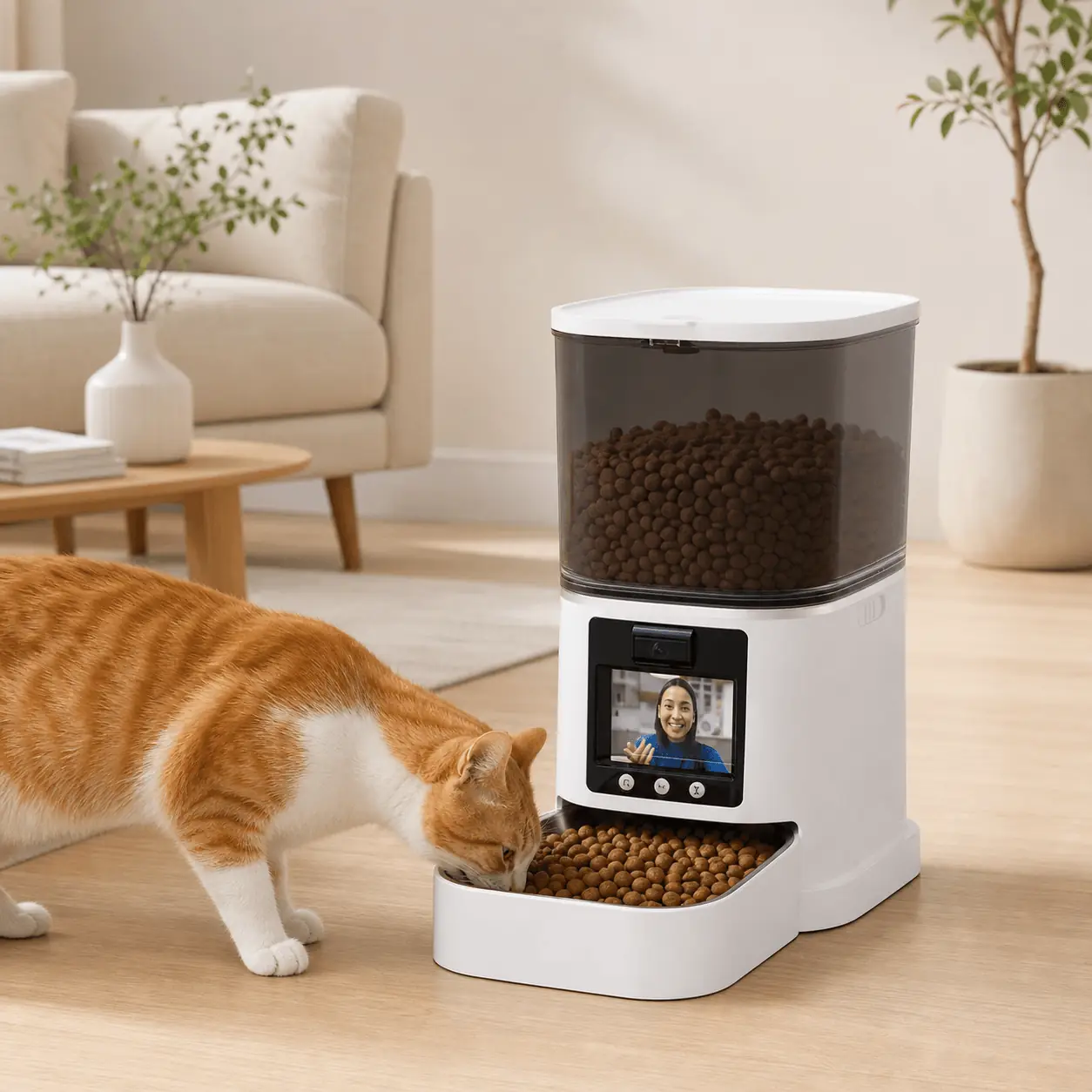
Feeders with cameras combine timed feeding with remote monitoring, making them ideal for users who want to check on their pets’ condition at any time.
Brands can choose based on product positioning:
- Camera pixels
- View range
- Night vision function
- Two-way voice
- Screenshots and videos
- Local storage or cloud storage
- Motion detection
- Camera privacy mode
It is also necessary to confirm whether cloud storage is charged, where the servers are located, how long the video data is stored, and what features consumers can still use after they stop subscribing.
Cameras can increase product value, but they also increase requirements for software maintenance, servers, and privacy compliance.
4. Double-bowl automatic feeder

Double bowl feeders are suitable for feeding two pets at the same time and can also be a differentiated product for brands targeting families with multiple pets.
Key tests required:
Is the food evenly distributed on both sides?
Is the grain distribution structure prone to blockage?
Is the spacing between the bowls reasonable?
Can the food bowl be disassembled for cleaning?
Is it crowded when two pets eat at the same time?
Is it possible to control the amount of food on each side?
If the food portioning structure is poorly designed, one side may have too much food and the other side too little. Therefore, brands should not only consider the product’s appearance but also conduct actual tests to ensure the food portioning is effective.
5. RFID Smart Pet Feeder

RFID feeders identify authorized pets by tags worn by the pets, making them suitable for solving the problem of food competition in multi-pet households.
It is especially suitable for:
- Multi-cat families
- Families who need to control their pets' food intake
- Pets using prescription food
- Pets with special dietary requirements
- Scenarios requiring personalized feeding
The key customization points for RFID feeders include:
- RFID identification methods and frequencies
- Recognition distance and recognition speed
- Tag size and wearing method
- Number of pets supported
- The closing logic when an unauthorized pet approaches
Is the process of opening and closing the cover safe?
Does the lid have a sealing and food-preserving effect?
Does it support both wet and dry food?
For RFID products, identification accuracy and lid opening/closing logic directly impact the user experience. Testing should involve pets of different sizes and with different eating habits; desktop testing alone is insufficient.
Determining the core hardware specifications of the automatic feeder

After selecting the product type, the brand needs to further confirm the capacity, pet food compatibility, food dispensing structure, and power supply solution.
1. Choose a suitable food hopper capacity.
Common automatic feeder capacities include 3L, 4L, 5L and 8L.
Larger capacity does not necessarily mean a more competitive product. Brands need to consider a comprehensive approach:
- Size of the target pet
- Pet daily food intake
- Frequency of pet food replenishment by users
- Product space occupied
- Retail packaging size
- International shipping costs
- E-commerce warehousing costs
Small-capacity products are generally suitable for cats and small dogs, and are also easier to control in terms of packaging and shipping costs. Large-capacity products are suitable for medium to large dogs or users who need to store food for extended periods, but the product volume and logistics costs are usually higher.
2. Confirm the range of pet food pellet size.
Different pet foods vary in terms of pellet diameter, shape, hardness, and oil content.
The brand owner should confirm with the manufacturer:
- Supported particle diameter range
Does it support irregular particles?
Does it support freeze-dried food?
Can different particles be mixed?
Will high-oil pet food stick to the dispensing components?
Are grains that are too large prone to getting stuck?
Do small particles affect portion accuracy?
When testing samples, you should not use only one type of standard pet food. It is best to select multiple brands and different shapes of food that are common in the target market for testing.
3. Evaluate the feed dispensing and anti-guttering design.
The feed dispensing system is one of the most important mechanical structures of an automatic feeder.
Brands need to understand:
- Motor type and service life
- Impeller or rotary table structure
- Food outlet channel size
Does it have a food-jam detection function?
Does it support motor reversal for jam recovery?
Does the feeder retry automatically after a dispensing failure?
Does it provide fault alerts?
Is continuous food output stable?
- Error range for each food dispensing
If the product malfunctions, causing food to get stuck or running empty, users may mistakenly believe that their pet has eaten normally. Therefore, anti-jamming design and malfunction alerts are very important.
4. Power supply planning and power outage protection
Automatic feeders typically use an external power source and are equipped with a backup battery.
Confirmation required:
- Input and output specifications of the power adapter
- Plug types in different markets
- Type and quantity of backup batteries
How long can the battery last?
Will the feeding plan be retained after a power outage?
Does it remind you when the battery is low?
Which functions are limited when powered by battery?
For products with cameras, the backup battery may only be able to maintain basic feeding functions and cannot sustain video playback. Brands should clearly state this in the product page and instruction manual.
5. Inspect food contact materials and cleaning structures.
Components that come into direct contact with pet food should be made of food-safe materials and be easy to disassemble and clean.
The brand needs to check:
Can the food bowl be disassembled?
Can the food hopper be removed?
Which parts can be washed?
Which parts can only be wiped?
Are there any unsanitary corners where food may easily remain?
Do stainless steel or plastic bowls fit the product positioning?
Can the sealing ring be replaced?
Is the food outlet easy to clean?
An easy-to-clean structure can reduce odors, grease residue, and bacterial growth, which will directly affect consumer reviews.
Designing Product Function Combinations
More features are not necessarily better. Pet brands should combine features around the core needs of their target consumers, avoiding adding costs that consumers are unwilling to pay.
1. Feeding at regular times and in measured amounts
Basic feeding functions need to be confirmed:
How many meals can be set up per day?
How many servings can be prepared per meal?
- Reference weight of a single serving
Does it support extra meals on short notice?
Is it possible to skip a meal?
Are planned and actual food output results recorded?
Should the plan continue to run after the device is disconnected from the network?
It’s important to note that different pet food pellets can affect the actual weight of a single serving. The instruction manual should advise users to measure according to the specific pet food they are using.
2. Voice interaction
Some automatic feeders can play a recording of the pet owner’s voice before feeding.
The brand can confirm:
- Voice recording length
- Number of times voice playback
- Volume adjustment
Can the voice be turned off?
Can the recordings be updated via the app?
Does it support two-way voice communication?
The voice function should be simple and stable, avoiding issues such as excessive volume or repeated playback.
3. Low grain and fault alerts
The smart feeder can be configured with:
- Food shortage warning
- Food shortage reminder
- Food dispensing failure reminder
- Device offline reminder
- Network interruption alert
- Low battery warning
- Food hopper lid not closed reminder
- Feeding plan not followed reminder
The notification mechanism should not be too frequent, otherwise users may simply turn off notifications. Brands should distinguish between necessary and optional notifications.
4. Personalized feeding for multiple pets
Products targeting multi-pet households can be included:
Each pet has its own independent feeding plan.
- RFID identification
- Independent eating rights
- Feeding records of different pets
- Food intake management
- Prescription food protection
These features can help brands move from the general timed feeder market into more professional pet health management scenarios.
Confirm the App, server, and data management solutions
For smart automatic feeders, brands must confirm the software solution early in the project and cannot wait until the hardware is completed before discussing the app.
1. Choose a general app, a white-label app, or a standalone app.
| App Solution | Main advantages | Note |
|---|---|---|
| Universal App | Fast time to market, low upfront costs | Limited brand display and functional control |
| White Label App | You can add brand name, logo, and visual elements. | The scope of customization and maintenance costs need to be confirmed. |
| Independent Brand App | Strong brand control allows for the establishment of its own user system. | Higher development costs, longer development cycles, and higher maintenance requirements |
Brands entering the market for the first time can first use a mature app to validate the market. Once sales and user base have stabilized, then consider a white label or a standalone app.
2. Clearly define the ownership and maintenance responsibilities of the App.
The following should be confirmed before signing the contract:
Who owns the app account?
Who is the entity behind the app store listing?
Is the software source code deliverable?
Who will be responsible for subsequent version updates?
Who will adapt the phone’s operating system after the upgrade?
- Bug handling response time
How are server costs calculated?
Will the equipment still be usable after the cooperation ends?
If these issues are not written into the contract in advance, long-term risks may arise after the product is launched.
3. Prioritize user privacy and data security.
Smart feeders may collect:
- User registration information
- Equipment and network information
- Pet feeding plan
- Pet feeding record
- Camera and voice content
- Cloud recording
Brands need to clarify:
- Data storage location
- Data retention time
- Methods for users to delete accounts and data
Can third parties access the data?
Does the camera have a privacy-disabling function?
Does the app comply with the data protection requirements of the target market?
Even if the server is temporarily unavailable, the device should retain basic local feeding capabilities as much as possible.
Complete the appearance, logo, and brand customization.
The appearance of an automatic feeder can influence consumers’ perception of brand positioning and product value.
1. Logo Customization
Common logo techniques include:
- screen printing
- Pad printing
- Laser engraving
- Metal nameplate
- In-mold marking
- App launch page logo
- Packaging and instruction manual logo
Brands should provide a vector-format logo file and confirm the size, position, color, and abrasion resistance requirements.
2. Product color customization
Color customization needs to be specified:
Use manufacturer’s standard color or brand’s special color?
Do you provide Pantone color codes?
- Plastic raw material coloring or surface spraying
Does small batch production support custom colors?
- Acceptable color difference range
Do you need scratch resistance, stain resistance, or a matte finish?
Color customization often affects MOQ and production cycle, so it needs to be confirmed as early as possible.
3. Customized product structure and industrial design
Automatic feeders can be customized in five levels:
- Add logo to existing products
- Change product color and packaging
- Adjust local structure or software functions
- Redesign the product casing
- Develop new private mold products
For brands entering the market for the first time, starting with mature, mass-produced models carries less risk. Once a product achieves stable sales, developing products with independent designs and custom molds is more conducive to cost control.
Customized packaging and multilingual instruction manuals
Product packaging is not only used to protect equipment, but also an important medium for conveying brand value and functional selling points.
1. Retail packaging design
Color boxes usually need to be displayed:
- Brand Logo
- Product Name
- Product main image
- Core Functions
- Capacity and Specifications
- App download QR code
- packing list
- Certification Mark
- Brand contact information
- Warnings and compliance information
Brands should avoid using unverified claims, such as “it will not cause food clogging” or “it is suitable for all pet foods”.
2. Transport Packaging Design
International transportation needs to consider:
- Single product packaging size
- Outer box packing quantity
- Gross weight and net weight of outer carton
- Internal buffer structure
- Packaging drop test
- Transportation vibration test
- Moisture protection for sea freight
- E-commerce express delivery requirements
Packaging size affects transportation, warehousing, and platform delivery costs, so it should be optimized during the product development phase.
3. Multilingual instruction manual
Brands should prepare instruction manuals in English, German, French, Spanish, or other languages, depending on the market.
After the translation is completed, it should be checked:
Are the button names consistent with the device?
Is the app page name accurate?
Are the operation steps complete?
Does the warning comply with local requirements?
Do the images and text correspond?
Can the QR code be used normally?
Confirm certification and target market compliance requirements
Common certifications and tests may include:
- CE
- FCC
- RoHS
- RED
- EMC
- LVD
- Food contact material testing
- Battery transportation related documents
- Packaging Environmental Protection Requirements
Brand owners should not only confirm whether the manufacturer “has a certificate,” but should also verify further:
- Product model corresponding to the certificate
- Test standards and versions
- Certificate holder
Is the power adapter included in the report?
Is the wireless module within the certification scope?
Is the customized model still applicable?
Can the document be used in the target sales channel?
After modifications to the power supply, wireless module, product structure, or key materials, existing certifications may no longer be applicable. Specific details should be confirmed before mass production.
Understand MOQ, pricing, and additional fees
The minimum order quantity for automatic feeders depends on the level of customization.
Generally speaking:
- Neutral products have a relatively low MOQ
Adding a logo may require a higher quantity.
Custom color boxes are related to the minimum printing quantity.
Custom colors involve raw materials and production scheduling.
White-label apps may incur development and maintenance costs.
Custom-made products require mold fees and a longer development cycle.
If you require detailed information on our pet feeder products, Haolinc offers the latest RFID feeders and feeders with camera capabilities. We also support OEM customization. Please feel free to contact our sales staff for the latest product pricing and information.
What information should be provided before requesting a quote?
To obtain an accurate quote, the brand should provide:
- Target product type
- Target sales countries
- Main sales channels
- Expected first order quantity
- Annual Procurement Plan
- Target purchase price
- Logo file
- Packaging requirements
- App Requirements
- Certification Requirements
- Expected delivery time
You can't just compare the price of a single unit.
The total project cost may also include:
- Sample fee
- Logo fee
- Cost of color box and instruction manual
- App customization fees
- Cloud server costs
- mold fee
- Certification Fees
- Spare parts cost
- International Transportation
- Import taxes and fees
- After-sales replacement costs
Therefore, brands should compare the total cost of the entire project, rather than just comparing the price of a single product.
Conduct sample testing and product verification.
Before mass production, it is recommended to test the standard sample first, and then confirm the customized sample.
1. Standard Sample Testing
Key checks during the standard sample stage:
- Product dimensions and appearance
- Materials and workmanship
Is the operation simple?
Is the food dispensing accurate?
- motor noise
- App connection
- Operation during power outages and network outages
Is it easy to disassemble and clean?
Will the pet be willing to use it?
2. Customized sample confirmation
Customized samples require further inspection:
- Logo placement, size, and color
- Product Color
- Packaging Design
- Instruction manual content
- Plugs and accessories
- App Brand Information
- Software Functions
- Barcodes and Labels
All confirmation results should be documented in writing and used as the basis for mass production and shipment inspection.
3. Recommended tests to perform
Recommended test:
- Different types of pet food
- Food output accuracy
- Continuous operating life
- Food-jam and motor-reversal testing
- Power outage recovery
- Running offline
- Battery life
- App connection stability
- Camera and voice
- RFID identification
- Packaging dropped
- Transportation vibration
- Real-world use by multi-pet families
Real-world pet home testing can uncover issues that are difficult to detect in a laboratory setting, such as pets being afraid of motor sounds, pets knocking over equipment, or unauthorized pets snatching food from the side.
Confirm the quality control process for mass production
Before approving bulk production, review the supplier’s factory quality and compliance process for the selected model and destination market.
A successful sample does not guarantee that every mass-produced product will automatically meet the same standards. Brands need to understand how manufacturers ensure batch consistency.
1. Incoming material inspection
Key materials include:
- Food contact materials
- plastic casing
- motor
- PCB
- RFID module
- camera module
- power adapter
- sealing ring
- food bowl
- Packaging materials
2. Production process inspection
During the production process, the following should be checked:
- Assembly process
- Circuit connection
- Buttons and Display
- motor operation
- Food dispensing function
- Food-jam detection
- App pairing and network setup
- Camera and voice
- RFID identification
- backup battery power
3. Finished product and shipment inspection
Before shipment, the following should be confirmed:
- Appearance Defect Standards
- Functional testing ratio
- Aging test time
- Sampling inspection standards
- Packaging integrity
- Number of parts
- Barcode scan results
- Outer box markings
- Outgoing Inspection Report
For initial orders or important projects, the brand can also arrange for third-party inspection.
Planning after-sales service, spare parts and software maintenance
Automatic feeders consist of mechanical, electrical, and software systems, and after-sales service plans should be determined before the product is launched on the market.
1. Establish a clear warranty policy
The brand needs to confirm with the manufacturer:
- Warranty period
- Warranty start date
Which issues are covered under warranty?
What situations are not covered by the warranty?
How to determine defective products
- Replacement, refund or payment deduction methods
Do I need photos or videos as proof of after-sales service?
How to handle batch quality issues
2. Prepare commonly used spare parts
Common spare parts may include:
- food bowl
- power cord
- power adapter
- Grain buckets and grain bucket lids
- sealing ring
- Desiccant box
- RFID tags
- Food dispensing components
Preparing a certain number of spare parts is usually more cost-effective than replacing the entire product and can also shorten the waiting time for consumers.
3. Confirm the long-term maintenance of the software.
Smart feeders should also clarify:
- App update frequency
- Mobile system compatibility
- Bug handling cycle
- Server maintenance responsibility
- Cloud service fees
- Software support period after product discontinuation
- Mechanism for handling cybersecurity issues
How long does it take to customize an automatic feeder?
The timeline for different projects depends on the level of customization, certifications, materials, and order quantity.
| Project Phase | Reference time |
|---|---|
| Needs communication and product selection | 3 to 7 days |
| Standard sample preparation | 3 to 10 days |
| Sample testing and feedback | 1-3 weeks |
| Logo and Packaging Design | 1-2 weeks |
| Custom sample production | 2-4 weeks |
| App or feature adjustments | Determined based on the level of customization. |
| Certification and Testing | 4-10 weeks |
| First batch of mass production | 30-60 days |
| Outbound inspection and transportation | Determined based on order and shipping method. |
Adding a logo and packaging to an established product is usually faster than redesigning the structure or developing a custom mold. Brand owners should allow sufficient time for sample modifications, certification, and shipping.
Common Mistakes When Customizing Automatic Feeders
1. Compare only the unit price.
The lowest-priced option doesn’t necessarily have the lowest total cost. Issues like food jams, app malfunctions, damaged packaging, and after-sales replacements can all increase long-term costs.
2. No clearly defined target market.
Failure to determine the sales countries and channels in advance may result in plugs, certifications, packaging language, and app privacy requirements not meeting market regulations.
3. Test using only one type of pet food.
Different kibble types, shapes, and oil content can affect the final product. Brands should conduct tests using a variety of pet foods commonly found in the target market.
4. Ignore power outage and network outage scenarios.
Even when the network fails, the device should still try to execute the local feeding plan to avoid affecting the pet’s normal eating.
5. Failure to confirm responsibility for the app and server.
If the ownership of the app, server costs, and responsibility for software maintenance are unclear, the product may face long-term risks after its launch.
6. Choose high customization for your first order.
Brands that haven’t yet validated their market presence may increase inventory and development risks by directly developing entirely new structures and custom molds. A more prudent approach is to first validate sales with mature products and then gradually add differentiation.
How to choose a suitable automatic feeder manufacturer?
Brands can evaluate manufacturers from the following aspects:
Do they have mature mass-produced models?
Does it have stable production and quality control capabilities?
Does it support OEM and ODM?
Can you provide samples?
Can it be combined with target market certification?
Do you have experience in smart hardware and app projects?
Are the MOQ, price, and additional fees clearly stated?
Does it support logos, packaging, and multilingual instruction manuals?
Can you provide test and shipment reports?
Does it have a clear warranty and spare parts plan?
Can you guarantee delivery time for repeat orders?
Can technical and after-sales issues be handled promptly?
Brand owners should also request manufacturers to provide information on specific models, rather than simply looking at company promotional materials or certificates for other products.
Buyer FAQs
| Serial Number | Frequently searched or asked questions by buyers | Suggested key points for answering |
|---|---|---|
| 1 | What are the minimum order quantity and wholesale price for custom automatic feeders? | Different MOQs for standard products, logos, color boxes, colors, Apps, and custom molds; sample prices, tiered pricing, and additional fees. |
| 2 | What features can be customized for an automatic feeder? | Logo, color, packaging, instruction manual, capacity, camera, RFID, app, voice, functions, and casing structure |
| 3 | What are the differences between OEM, ODM, and Private Label automatic feeders? | Differences, costs, and timelines of OEMing mature products, modifying existing platforms, and developing entirely new products. |
| 4 | Can I purchase a sample first? What tests are required for the sample? | Sample fees, preparation time, shipping costs, food dispensing, food jams, power outages, network outages, App, RFID, and packaging testing. |
| 5 | Which type of automatic feeder is more suitable for our target market? | The timer, WiFi, camera, dual-dish, and RFID models are suitable for different users, channels, and price ranges. |
| 6 | Which pet foods does the automatic feeder support? Is the food dispensing accurate? | Particle size, freeze-dried grains, compatibility between dry and wet grains; portion weight, anti-jamming structure, and feed error. |
| 7 | What certifications and test reports can be provided for the product? | CE, FCC, RoHS, RED, food contact materials, etc.; the specific model and target market must be verified. |
| 8 | Can we use a standalone brand app? Who owns the app and the user data? | General Apps, White Label Apps, Standalone Apps, Source Code, Servers, Privacy, Software Updates and Long-Term Maintenance |
| 9 | What is the cycle time for prototyping, production and delivery of an automatic feeder? | Timeline for standard samples, custom samples, packaging, certification, initial production, and repeat orders. |
| 10 | How do manufacturers control quality and handle after-sales issues? | Incoming material inspection, production testing, aging testing, outgoing sampling inspection, warranty, spare parts and defective product handling. |
Conclusion: Start with mature products and gradually build brand differentiation.
Customizing an automatic feeder is a complex undertaking involving the market, hardware, software, packaging, certification, and supply chain.
Brands should first clearly define their target users, sales channels, and price range, and then select automatic feeders with features such as timer, WiFi, camera, dual bowls, or RFID. Once the product model is determined, it’s also necessary to confirm the capacity, pet food compatibility, food dispensing mechanism, app, packaging, certifications, sample testing, quality control, and after-sales support.
For new brands or first-time procurement projects, starting with mature mass-produced products with added logos and packaging usually allows for faster market validation and risk control. Once sales stabilize, exclusive colors, features, a dedicated app, and custom mold designs can be gradually added to establish a more distinct brand differentiation.
When choosing an automatic feeder manufacturer, price should not be the only factor considered. Manufacturing capabilities, quality control, software maintenance, certification support, after-sales response, and the stability of repeat orders also determine a product’s long-term success.
If you are looking for an OEM/ODM solution for automatic feeders for your pet brand, please provide us with your target market, sales channels, expected purchase quantity, and required features. We can assist in comparing automatic feeders with timers, WiFi, cameras, dual bowls, and RFID, and provide samples, logos, packaging, and bulk purchasing solutions based on project requirements.
Related Automatic Pet Feeder Resources
Ready to Customize an Automatic Pet Feeder for Your Brand?
Share your target market, sales channel, estimated quantity and required functions. Our team can help you compare timed, WiFi, camera, dual-bowl and RFID feeder platforms, then review samples, branding, packaging, compliance documents and bulk-production requirements.
