
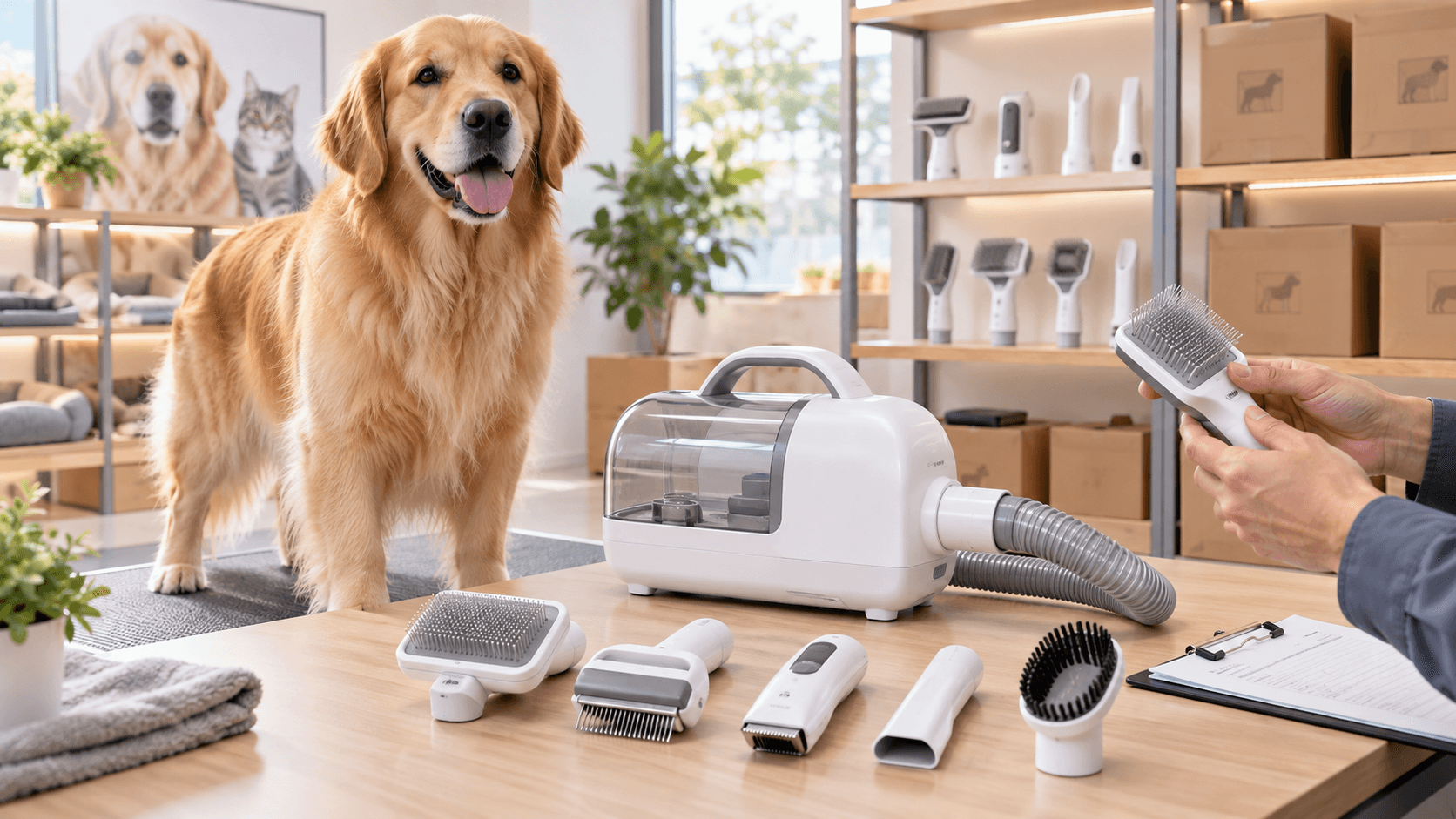
Pet grooming vacuums sit between a grooming tool, a small appliance and a pet-care accessory. That combination creates an attractive demonstration product, but it also creates return risks that a short supplier video rarely reveals. This guide is written for importers, distributors, retail chains and private-label brands comparing a pet grooming vacuum manufacturer for a new product line.
| Wholesale decision | What the buyer must verify | Commercial impact |
|---|---|---|
| Channel fit | Target coat types, owner skill, pet tolerance and use scenario | Conversion rate and review quality |
| Complete set | Vacuum, hose, brushes, clipper, nozzles, cable/adapter and manuals | Comparable unit cost and fewer “missing item” claims |
| Performance | Hair pickup, noise, airflow, runtime and dust handling under defined tests | Defensible listings and lower expectation mismatch |
| After-sales | Replacement attachments, filters/screens, battery policy and diagnostics | Warranty reserve and resolution time |
| Private label | Logo, color, package, language, compliance and MOQ by workstream | Launch cash requirement and lead time |
| Logistics | Retail/master carton, dimensional weight, drop/vibration result and pallet plan | Landed cost and transit damage |
1. Start With Margin After Returns—not Factory Price
A low ex-factory price does not guarantee a healthy margin. Build a contribution model that includes the product, branding, packaging, inspection, freight, duty, local fulfillment, marketplace fees, marketing, customer support, replacement accessories and warranty handling. Use a conservative return reserve until pilot-order data becomes available.
| Cost layer | Questions for the supplier | Buyer control |
|---|---|---|
| One-time project cost | Artwork, tooling, color matching, test work and documentation | Allocate across a realistic first-order volume |
| Per-unit configuration | Which attachments, charging items and printed materials are included? | Compare quotations on the same bill of materials |
| Landed logistics | What are final carton dimensions, gross weight and pallet quantity? | Quote freight with packed—not product—dimensions |
| Support reserve | Which parts can be replaced locally and how are claims approved? | Model part, labor and two-way freight cost |
The private-label MOQ and customization guide helps separate project costs from repeat-order costs. Ask for an itemized quotation through the request-a-quote page rather than comparing one headline number.
2. Define the Retail Channel and Intended User
A cordless grooming vacuum may be positioned for home coat care, loose-hair collection, quick cleanup or travel-friendly use. The chosen promise should match the product’s demonstrated workflow. Long-coat dogs, dense undercoat, short-haired cats and nervous pets present different handling, attachment and noise requirements.
- Marketplace listing: needs clear included-accessory photography, accurate claims and simple setup content.
- Pet specialty retail: benefits from live demonstration, attachment explanation and replacement-part access.
- Grooming channel: expects repeatable handling, cleaning and durability evidence rather than lifestyle images alone.
- Private-label DTC: needs strong onboarding, video guidance and a support script to reduce preventable returns.

3. Freeze the Exact Product Platform Before Quotation
Use one signed configuration for sample, quotation, artwork and production. For the BBY-115 four-in-one cordless pet grooming vacuum, buyers should verify the exact color, accessory set, battery and charging configuration, packaging and market documents. Current product information lists 50 W rated power, 4500 Pa suction, a 2600 mAh battery, Type-C 5 V/2 A charging and a 126 ml dust container; each commercial claim still needs confirmation on the final sample and destination-market configuration.

Use the detailed pet grooming vacuum sample-test guide to validate performance. The purpose is not to repeat a laboratory number; it is to understand how the complete set performs for the intended retail promise.
4. Reduce the Return Drivers a Specification Sheet Misses
Many returns are expectation or workflow failures rather than a visibly broken product. The pet rejects the sound, hair stays in the brush, the owner expects a full-size vacuum, the container releases hair during emptying or an attachment is used incorrectly. These issues can be reduced through product selection, listing language, onboarding and packaging.
| Likely complaint | Validation before order | Prevention after launch |
|---|---|---|
| “My pet is afraid” | Mode-specific sound and supervised acclimation trials | Gradual introduction instructions; no universal acceptance claim |
| “It does not collect hair” | Defined coat samples, fixed strokes and container fill states | Match brush/nozzle to coat and show correct angle |
| “Battery is too short” | Runtime by mode, attachment, load and temperature | State the test condition and realistic session scope |
| “Hair spills when emptied” | Loaded-bin removal, filter/screen and cleaning workflow | Clear emptying sequence and fill guidance |
| “An accessory is missing” | Final pack-out inspection and weight control | Package contents panel and unboxing diagram |
5. Turn the Attachment Set Into a Clear Retail Story
Multiple attachments increase value only when buyers understand their jobs. The BBY-115 platform is presented with four functions covering combing, thinning, directed airflow and narrow-area cleaning. Confirm which tools are included in the quoted set and give each one a safe, realistic use case.
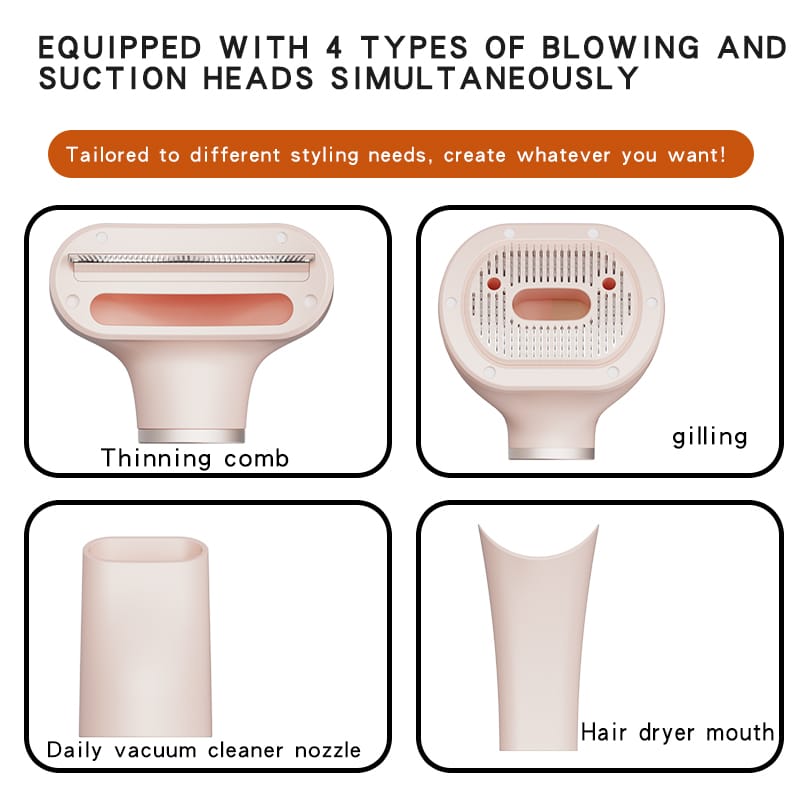
Fit, retention and labeling
Cycle every accessory, inspect wobble and release force, and use markings that match the manual and packaging.

Function-specific evidence
Verify airflow direction, temperature behavior and safe distance on the exact production-equivalent sample.
Replacement brushes and nozzles should have model-specific part numbers, compatibility labels, reorder prices and lead times. A wholesale buyer should also decide whether accessories are sold separately, included in warranty stock or reserved for service centers.
6. Plan Battery and Charging Support Before Launch
Runtime is a system result, not a battery-capacity promise. Test standard and strong modes with defined attachments and realistic airflow restriction. Record initial charge state, temperature, warning behavior, shutdown condition and performance after repeated cycles.

For Type-C charging, approve the cable and any regional adapter, confirm whether use while charging is allowed, and document support for damaged ports or reduced runtime. Ask whether the battery is field replaceable, service-center replaceable or handled through whole-unit exchange. Do not promise a battery lifetime without a defined test and warranty policy.
7. Evaluate Cleaning, Hair Disposal and Service Parts
The dust container, screens or filters, brushes and hair-contact parts determine daily convenience. Ask which parts are washable, how long they must dry, how hair is released and what happens when the container becomes partially filled. Verify that users cannot easily reinstall parts incorrectly.

- Create a model-specific exploded service list with photos and part numbers.
- Separate normal consumables, customer-replaceable accessories and technical repair modules.
- Confirm reorder MOQ, normal lead time and engineering-change notification.
- Include a launch stock buffer based on pilot evidence, not an arbitrary universal percentage.
Connect service-part availability with the supplier’s quality and compliance process and factory controls.
8. Verify Claims, Compliance and Final Packaging Together
Noise, suction, runtime, “four-in-one,” pet comfort and filtration language should each have a defined source. Avoid turning one test condition into a universal claim. Certifications must match the exact model, battery, charging accessory, destination and private-label information—not merely the supplier name.
Use the US and EU smart pet product certification guide as a planning checklist, then ask a qualified compliance professional or laboratory to confirm the applicable scope. Review the supplier through the smart pet product manufacturer checklist and company profile.
Packaging tests should use the final retail carton with all attachments restrained. Check drop, vibration and compression requirements for the intended route, then repeat power, suction, attachment fit and charging checks. Dimensional weight can materially change landed cost, so obtain confirmed carton and pallet data before approving margin.

9. Price MOQ and Customization by Workstream
Do not ask only for “the OEM MOQ.” Request separate minimums and fees for a standard neutral unit, logo printing, custom color, retail packaging, manual languages, accessory changes and any structural modification. Each workstream can have a different supplier, setup cost and lead time.
Use the OEM/ODM service page and OEM versus ODM buyer guide to define project ownership. Freeze artwork only after the product sample, included set, claims and compliance labeling are approved. Record who owns tooling and source files, how changes are approved and what happens to printed-material inventory after a revision.
10. Use a Weighted Scorecard for the Final Supplier Decision
| Score area | Suggested evidence | Why it matters |
|---|---|---|
| Workflow performance | Defined hair pickup, noise, runtime and cleaning results | Reduces expectation mismatch |
| Product consistency | Golden sample, inspection standard and batch traceability | Protects repeat orders |
| Commercial fit | Complete quote, MOQ layers, lead time and carton data | Shows true cash and margin requirement |
| Compliance readiness | Configuration-matched reports, labels and change control | Reduces launch and listing risk |
| After-sales support | Diagnostic process, parts list, warranty terms and response owner | Controls total support cost |
Weight the score for your channel instead of choosing the lowest quote automatically. A distributor with local service capability may value replaceable parts; a marketplace seller may prioritize simpler onboarding and whole-unit resolution. More sourcing checklists are available in the Haolinc resource center.
