

Short answer: neither system is automatically better for every multi-cat home. A collar-tag RFID pet feeder is usually easier to deploy, replace and support across different cats. An implanted-microchip feeder may offer a more seamless daily experience when the cat already has a compatible chip. For brands and distributors, the better choice depends on chip compatibility, recognition reliability, access-control safety, target-market expectations and after-sales complexity. For a buyer sourcing an automatic pet feeder for cats, this distinction should be confirmed before sample approval.

Quick Navigation
1. First, Clarify the Terminology
There is one important detail that many product pages overlook: an implanted pet microchip is also a form of radio-frequency identification. In everyday market language, however, buyers often use RFID pet feeder to describe a feeder activated by a wearable collar tag, while microchip feeder usually means a feeder designed to read a compatible implanted identification chip. Some microchip feeders also accept a separate collar tag.
In supplier specifications, the phrase pet feeder RFID system should always be followed by a clear description of the tag type, operating frequency and supported standards.
This difference matters because the words on a product page do not guarantee interoperability. A supplier should state the operating frequency, supported protocol or standard, reading distance, enrollment method and maximum number of authorized IDs. Buyers should never assume that every implanted chip, collar tag or regional registration system will work with every feeder.
2. How Do the Two Feeder Systems Work?
Collar-tag RFID feeder
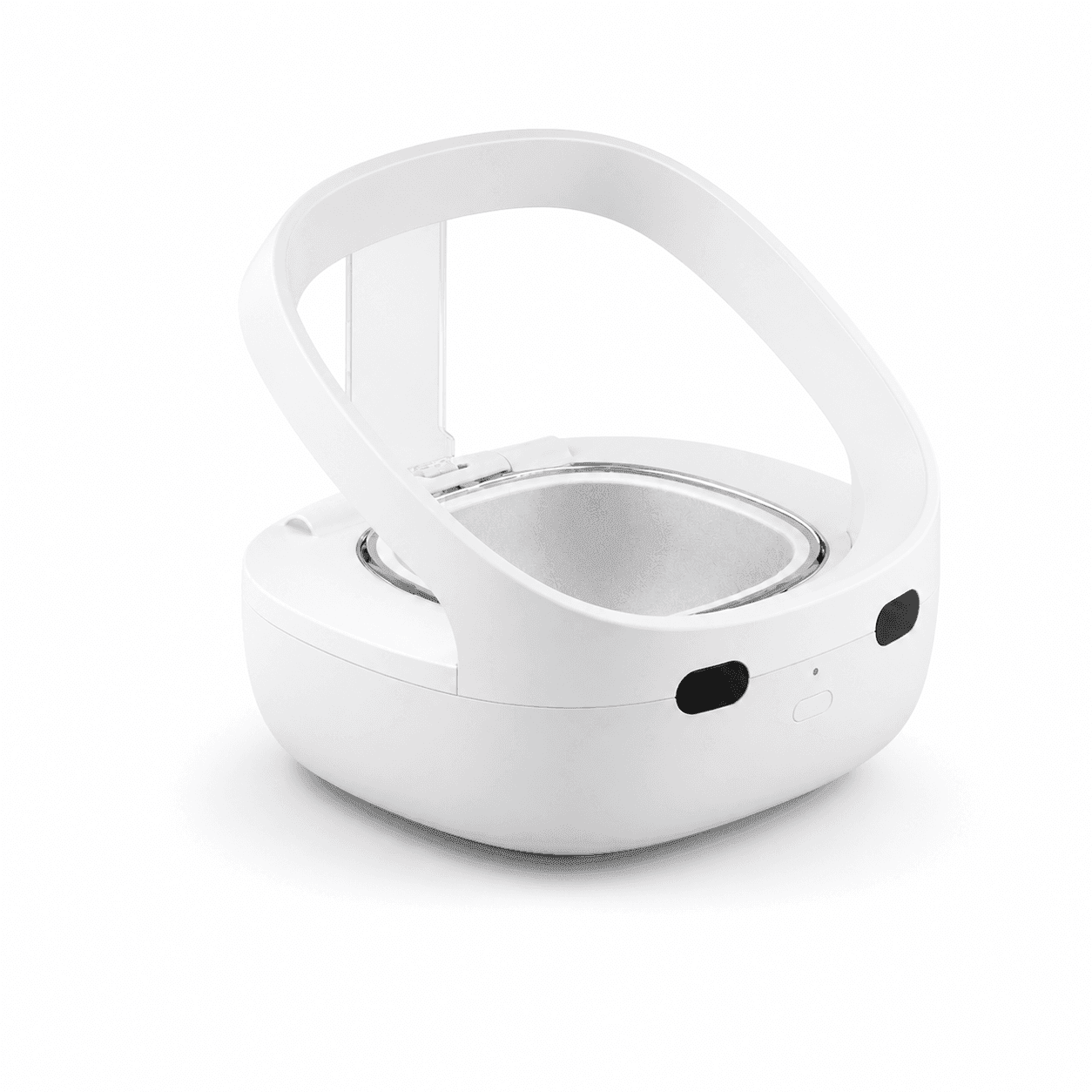
The cat wears a small authorized tag on its collar. When the tag enters the reader zone, the feeder verifies the stored ID and opens the access lid. After the cat leaves, the lid closes. A platform such as the current RFID Smart Pet Feeder can be evaluated as a 13.56 MHz collar-tag solution; the final frequency, accessories and configuration should always be confirmed on the approved order specification.
Implanted-microchip feeder
The feeder attempts to read the identification chip already implanted under the cat’s skin. Once the chip ID is enrolled, the access lid opens for that animal. The cat does not need to wear a collar, but reliable reading depends on compatibility, antenna design, body position and the distance between the chip and the reader.
Both approaches answer the same commercial problem: which pet should be allowed to reach this food? They are different from a standard timed automatic pet feeder, whose main purpose is controlling when and how much food is dispensed.
3. RFID Collar Tag vs Implanted Microchip: Side-by-Side Comparison
| Decision factor | Collar-tag RFID feeder | Implanted-microchip feeder |
|---|---|---|
| Pet setup | Requires the cat to wear an enrolled tag and collar. | Can use an existing compatible implanted chip. |
| Compatibility | More controllable when feeder and tags are supplied as one tested system. | Must verify supported chip standards; compatibility can vary by model and market. |
| Replacement | Lost or damaged tags can normally be replaced and re-enrolled. | The implanted chip is not a user-replaceable accessory. |
| Cat comfort | Some cats dislike collars or lose them during play. | No collar is required if the implanted chip is supported. |
| Recognition position | Tag location is relatively predictable near the reader zone. | Reading can be influenced by chip position and how the cat approaches. |
| Retail explanation | Easy to demonstrate: tag approaches, lid opens. | Requires clear compatibility instructions and customer education. |
| After-sales risk | Tag loss, collar fit and accessory availability. | Compatibility disputes and inconsistent reading are major risks. |
| Private label scope | Feeder, tag, packaging, manual and accessory packs can be branded together. | Claims must be carefully controlled around supported chip types. |
Practical verdict: collar-tag RFID is often the lower-risk route for a new private-label program, while implanted-microchip access can be attractive for a mature market where compatible chips are common and the supplier has strong validation data.
4. When Is a Collar-Tag RFID Feeder the Better Choice?
For an importer or online seller, this predictability can reduce support tickets. Demonstration videos are also straightforward because the opening action can be triggered with the included tag. Brands can offer replacement-tag packs, multi-pet enrollment instructions and visual troubleshooting guides.
Collar-tag RFID is especially suitable when the target customer prioritizes food separation but does not expect veterinary or national registry integration. It can also be a practical option for indoor cats, foster homes and multi-pet households where cats enter or leave the household over time.
5. When Is an Implanted-Microchip Feeder the Better Choice?
An implanted-chip system can provide a cleaner daily routine because the identification stays with the animal. There is no tag to catch, jingle, become wet or disappear. For owners whose cats already carry a supported chip, enrollment may feel more natural than adding a collar.
This approach can be valuable for:
- Cats that cannot safely or comfortably wear collars.
- Homes where collars are frequently removed or lost.
- Markets where implanted pet identification is widely used and buyers understand compatibility requirements.
- Premium retail programs able to provide detailed onboarding and after-sales support.
The tradeoff is validation. A buyer needs more than a supplier statement. Request a compatibility matrix, test samples across several chip types, observe recognition from different approach angles and define how non-compatible customers will be handled.
6. Match the Technology to the Real Multi-Cat Problem

One cat steals another cat’s food
Either identification method can help, but the closing sequence is as important as recognition. Test whether an unauthorized cat can push in beside the authorized cat, reach the bowl before the lid closes or trigger repeated opening by following closely.
One cat eats a different formula
A selective-access feeder can reserve assigned food for one cat. This supports household organization, but it does not determine the correct diet. Prescription or medical feeding plans should follow veterinary guidance.
A timid or slow eater needs uninterrupted access
Recognition should be fast enough to avoid frustrating the cat, and the lid motion should be quiet and predictable. The entrance geometry must allow the cat to eat comfortably without feeling trapped.
The owner wants scheduled portion control
Do not confuse access control with automatic dispensing. If the use case requires timed portions, the buyer may need a different architecture or a combined system. Review the broader automatic pet feeder range before selecting the product platform.
7. What Should a B2B Buyer Test Before a Bulk Order?
A showroom demonstration proves only that the lid can open. A commercial sample test should reproduce real household behavior for several days. The following checklist helps distributors compare suppliers using measurable criteria.
| Test | Method | What to record |
|---|---|---|
| Recognition range | Approach from the front and both sides at different head positions. | Activation distance, failed reads and unintended reads. |
| Authorized access | Repeat opening with every enrolled tag or supported chip. | Success rate and response time. |
| Unauthorized pet test | Allow a second pet to approach alone and beside the authorized cat. | Any food access, tailgating or false opening. |
| Lid safety | Place a safe test object in the closing path according to supplier instructions. | Stopping force, reversal behavior and closing delay. |
| Noise and adaptation | Use the feeder during normal meals for cautious and confident cats. | Startle reactions and time needed to adapt. |
| Battery endurance | Operate at a defined number of cycles per day. | Battery life, low-power alert and behavior during weak power. |
| Cleaning | Remove, wash, dry and reinstall food-contact components. | Time, tool requirements, water traps and assembly errors. |
| Durability | Run repeated open-close cycles and inspect hinges and gears. | Abnormal sound, looseness and recognition drift. |
For a wider sourcing framework, use our automatic pet feeder manufacturer evaluation guide. Buyers should also review the supplier’s incoming inspection, functional testing and shipment controls on the factory and quality page.
8. OEM and Private-Label Implications
The identification method affects far more than the electronics. It changes the packaging promise, instruction manual, accessory plan, customer-support scripts and return-risk profile.
For a collar-tag RFID project
- Confirm the number of tags included in each retail box.
- Define replacement-tag availability and packaging.
- Specify enrollment, deletion and reset instructions.
- Test collar attachment size, weight and durability.
- State the frequency and maximum enrolled IDs accurately.
For an implanted-microchip project
- List supported standards and exclusions prominently.
- Avoid universal-compatibility wording unless validated.
- Prepare a pre-purchase compatibility checklist.
- Define the support process for chips that cannot be read.
- Test recognition across representative chip locations and pet sizes.
In both cases, buyers should lock the approved sample, bill of materials, firmware version, artwork, food-contact materials, packaging drop-test requirements and acceptance criteria before mass production. Our automatic pet feeder OEM and private-label guide explains how to structure these decisions, while the OEM/ODM service page outlines available customization support.
9. Questions to Ask an RFID Pet Feeder Manufacturer
- Is the product based on a collar tag, an implanted chip, or both?
- What frequency, protocol or chip standards are supported?
- How many pet IDs can be enrolled?
- What are the measured recognition range and response time?
- How does the feeder prevent tailgating and unauthorized access?
- What anti-pinch, obstruction and slow-closing protections are built in?
- What happens when battery power is low or lost?
- Which food-contact parts are removable and what materials are used?
- What life-cycle, recognition and shipment tests are performed?
- Can logo, color, packaging, manual and accessory packs be customized?
- What are the MOQ, sample lead time and mass-production lead time?
- How are replacement tags, spare parts, warranty cases and defective units handled?
10. Frequently Asked Questions
Are all implanted pet microchips compatible with a microchip feeder?
No. Compatibility depends on the feeder reader and the chip standard. Ask for the exact supported specifications and validate them in the target market before making marketing claims.
Can a collar-tag RFID feeder work for several cats?
Many systems can enroll multiple authorized tags, but the maximum number and access logic vary. Confirm whether all enrolled cats share one food bowl or whether separate feeders are needed for different diets.
Will selective access completely stop food stealing?
It can reduce unauthorized access, but household behavior matters. Test tailgating, side access, lid closing speed and whether one cat can intimidate another near the feeder.
Is an RFID feeder the same as a timed automatic feeder?
Not necessarily. RFID primarily controls who can access food; timed feeders primarily control when food is dispensed. Some advanced products may combine both functions, so evaluate the actual specification rather than the product name.
What makes the best RFID pet feeder for a multi-cat home?
The best RFID pet feeder is not simply the model with the longest feature list. It is the feeder that recognizes the authorized cat consistently, blocks unauthorized access, closes safely, cleans easily and has replacement tags and support available in the target market.
Which option is easier for private-label sellers?
A matched collar-tag system is often easier to explain and support, while an implanted-chip system may command premium interest in markets with established chip usage. The best option is the one your team can validate, describe accurately and support after the sale.
Conclusion: Choose the System You Can Prove
For multi-cat homes, both collar-tag RFID and implanted-microchip feeders can create more personalized food access. The most important distinction is not the marketing label; it is whether the identification system works reliably with the intended pets, prevents unauthorized access safely and can be supported throughout the product life cycle.
Brands entering this category should begin with the target-market compatibility requirement, then test recognition, lid safety, battery behavior, cleaning and real multi-pet interactions. A lower-cost feeder with vague compatibility can create expensive returns, while a well-validated platform can become a strong premium product with clear customer value.
Planning an RFID Pet Feeder Project?
Share your destination market, expected order quantity, preferred identification method, branding requirements and packaging plan. Haolinc can review the RFID feeder configuration, sample-testing scope, private-label options and bulk-production requirements.
