


1. The Real Buyer Decision Is Access Control, Not Just a Hole in a Door
For a distributor, pet retailer or private-label brand, a pet door is a compact product with a surprisingly large support burden. Customers must understand which pets can use it, how it fits the installation surface, what each lock position means and whether the access-control promise matches the version they purchased.
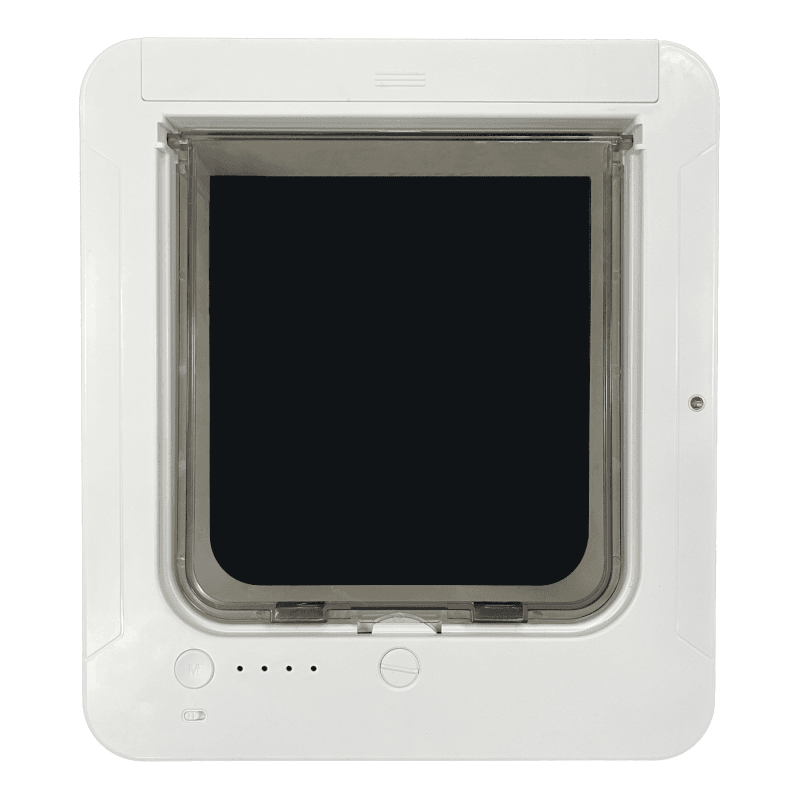
The Smart Pet Door M1 product page presents two commercial directions: a standard four-way locking configuration and an optional RFID collar-tag access configuration. These versions solve different customer problems and should not be described with the same claims.
2. Confirmed Smart Pet Door M1 Specifications
| Item | Confirmed Product Information | What the Buyer Should Verify |
|---|---|---|
| Model | M1 Smart Pet Door | Exact standard or RFID configuration on quotation and sample label |
| Overall size | 263 × 298 mm | Finished product tolerance and required installation clearance |
| Door opening | 205 × 190 mm | Pet chest width, body height and comfortable passage |
| Packing size | 269 × 89 × 302 mm | Final accessories, carton protection and master-carton data |
| Recommended pet | Under 25 lb / 11.3 kg; chest width under 7.1 in / 18 cm | Breed/body-shape guidance and customer-facing size chart |
| Access modes | Free, Locked, Out Only and In Only | Icon clarity, direction logic and lock engagement |
| RFID option | Optional RFID collar-tag access version | Recognition range, supplied tag quantity and pairing instructions |
| Colors shown | White, brown and black | Available MOQ, finish sample and color tolerance |

3. How the Four Access Modes Change the Customer Experience
The M1 uses four access settings. They appear simple, but unclear icons or instructions can cause immediate returns. A retail listing should explain the direction of travel in plain language:
- Free: the pet can enter and leave.
- Locked: movement is blocked in both directions.
- Out Only: the pet can leave but cannot re-enter through the door.
- In Only: the pet can enter but cannot leave again through the door.
Use scenarios rather than icons alone. “In Only” can help bring a pet inside before night, while “Out Only” may be used during a controlled transition. Retailers should avoid implying that any mode replaces owner supervision or local animal-safety practices.

4. Standard 4-Way Locking vs Optional RFID Access
| Decision Point | Standard Four-Way Version | Optional RFID Collar-Tag Version |
|---|---|---|
| Primary benefit | Manual control of entry and exit direction | Selective access for the intended tagged pet |
| Best-fit customer | Households focused on convenience and routine control | Customers concerned about unwanted animals entering |
| Customer education | Explain four lock positions and pet sizing | Also explain tag pairing, recognition and operating procedure |
| Sample priority | Flap movement, lock strength, mode clarity and installation | Add recognition, tag position, repeat access and failure behavior |
| After-sales parts | Confirm mechanical and installation parts | Also confirm replacement collar tags and relevant electronic parts |
| Listing claim | Four-way locking pet door | RFID collar-tag access, subject to confirmed configuration |
The RFID version can support a higher-value position, but only if the recognition process is repeatable and the customer instructions are clear. Do not choose it simply because “smart” sounds more marketable. Choose it because selective access solves a documented buyer problem.

5. Pet Sizing Must Be Easy to Understand Before Purchase
The confirmed guidance recommends pets under approximately 25 lb / 11.3 kg and chest width under 7.1 in / 18 cm. Weight alone is not enough because pets with the same weight can have different chest width, shoulder height and body shape.
- Provide the clear opening dimensions: 205 × 190 mm.
- Show customers how to measure the widest part of the pet’s body.
- Explain that the pet must pass comfortably without squeezing.
- Test representative body shapes in the target market.
- State that the size guidance is a selection aid, not a universal breed guarantee.
A good size chart reduces wrong purchases before they become returns. If the channel sells to both cat and small-dog owners, use separate lifestyle examples but keep the same confirmed dimensional limits.
6. Resolve Installation Questions Before Printing the Carton
Before bulk order, ask the manufacturer for the installation template, required cutout, compatible thickness range, fixing method and surface limitations for the exact configuration. These details were not all stated in the confirmed summary above, so they must be documented rather than assumed.
- Will the product be installed in wood, a screen, a wall or another surface?
- Does installation into glass or metal require a specialist?
- What finished cutout tolerance is acceptable?
- Are tunnel extensions or additional fasteners required?
- Can the customer identify indoor/outdoor orientation?
- What sealing or weather-exposure guidance is approved by the supplier?
7. Test the Sample Like a Customer and a Quality Inspector
One smooth demonstration is not enough. Build a repeatable sample report and record the unit, configuration, test condition, result and evidence.
| Test | Method | What Failure Looks Like |
|---|---|---|
| Flap cycles | Run repeated opening and closing from both directions | Sticking, scraping, incomplete return, abnormal noise or loose parts |
| Four modes | Verify every direction in every lock position | Wrong direction allowed, weak engagement or confusing indicator |
| Pet passage | Observe representative pets at a safe, supervised setup | Hesitation, body contact, trapped tail/collar risk or unstable frame |
| RFID recognition | Repeat approaches with the supplied tag at realistic positions | Missed reads, inconsistent access, slow response or unclear failure state |
| Unwanted access | Test an unpaired tag or defined non-authorized condition | Access granted contrary to the approved logic |
| Controls | Change modes repeatedly with the intended controls | Unclear feedback, unresponsive input or lost setting |
| Installation | Install using only the final template, hardware and manual | Missing steps, wrong dimensions, poor alignment or loose fit |
| Final package | Run agreed drop/vibration checks, then retest operation | Cracks, deformation, displaced parts or functional failure |
Retain an approved golden sample and connect it to the purchase specification and inspection checklist. The broader smart pet product manufacturer evaluation guide explains how to compare factory, sample and quality evidence before committing to a supplier.
8. Build Two Clear Retail Stories Instead of One Confusing Listing
Four-Way Routine Control
Lead with freedom for pets and owner control through Free, Locked, Out Only and In Only modes. Make size and installation information visible near the purchase button.

Selective Collar-Tag Access
Lead with access for the intended tagged pet and reduced unwanted entry. Explain exactly what tag and accessories are included in the purchased configuration.
For marketplaces, keep variant names explicit: “M1 Standard 4-Way” and “M1 RFID Collar-Tag.” Do not place RFID imagery on a standard-version SKU. Channel accuracy matters more than keyword density because incorrect expectations create refunds and poor reviews.
9. Define OEM and Private-Label Scope Before the Sample
The confirmed product information allows qualified projects to discuss logo, color, packaging, manuals and selected market configurations. Convert each request into a controlled specification:
- logo artwork, position, color and durability method;
- white, brown, black or another approved color with tolerance sample;
- retail box, insert, barcode, warnings and master carton;
- manual language, terminology, diagrams and installation template;
- standard or RFID version, supplied remote and tag quantity;
- market-specific compliance and documentation scope;
- sample, MOQ, tooling, artwork and repeat-order assumptions.
Use Haolinc’s OEM/ODM service and private-label MOQ and customization guide to prepare a complete project brief instead of requesting a vague “custom pet door.”

10. Packaging and Instructions Are Part of Product Quality
The confirmed package direction includes the smart pet door, remote control, screws and user manual. An RFID configuration can include two RFID tag keys and a collar, subject to the confirmed order. The final bill of materials must state every accessory and quantity.
Ask a new staff member to install and operate the sample using only the manual. If that person cannot choose the correct mode, identify orientation, pair the RFID tag or understand pet sizing, the end customer may have the same problem. Correct the manual before mass printing.
Run the agreed carton tests using the final retail package. Then inspect the frame, flap, lock, controls, remote, RFID accessories and installation hardware, and operate the same unit after transport simulation.
11. Convert the Approved Sample Into Bulk-Order Controls
Approval should produce measurable controls, not a message saying “sample looks good.” The purchase order and quality plan should identify:
- model and standard/RFID configuration;
- dimensions, opening, color and appearance limits;
- mode logic and functional inspection method;
- RFID tag quantity and recognition test, if applicable;
- remote, screws, manual and all other accessories;
- installation template revision and manual revision;
- logo, packaging and barcode approved files;
- sampling standard, critical defects and acceptance criteria;
- required compliance documents for the destination market;
- spare parts, warranty and nonconforming-product process.
Review Haolinc’s factory and quality-control information and the US/EU smart pet product certification guide when building the order-specific evidence list. Certification must always be verified for the exact model, configuration and destination—not borrowed from a similar product.
12. Questions to Ask Before Requesting a Quote
- Is the quotation for the standard M1 or RFID collar-tag M1?
- What tag, collar, remote, screws and manual are included?
- What is the exact installation cutout and compatible thickness range?
- What surfaces and environments are covered by the approved instructions?
- How are four-way lock functions tested in production?
- How is RFID recognition verified, and what happens when recognition fails?
- Can replacement RFID tags and other service parts be supplied?
- What are the MOQ and sample terms for each color/configuration?
- Which logo, packaging and manual customizations are available?
- Which reports or declarations apply to this exact configuration and market?
- What are the production lead time and inspection arrangement?
- How are defects, warranty claims and repeat-order consistency handled?
Buyers evaluating a new relationship can also use the site’s resource center and contact page to share product, market and channel requirements.
13. Final Recommendation
The Smart Pet Door M1 standard version is the cleaner choice for a straightforward four-way locking product. The optional RFID collar-tag version is more suitable when selective access is central to the customer’s problem and the brand is prepared to explain pairing, accessories and operating behavior.
For both versions, the safest purchasing path is the same: confirm fit, installation, version-specific claims and package contents; test a real sample; turn the result into written acceptance criteria; and approve the final artwork only after the functional specification is locked.
