
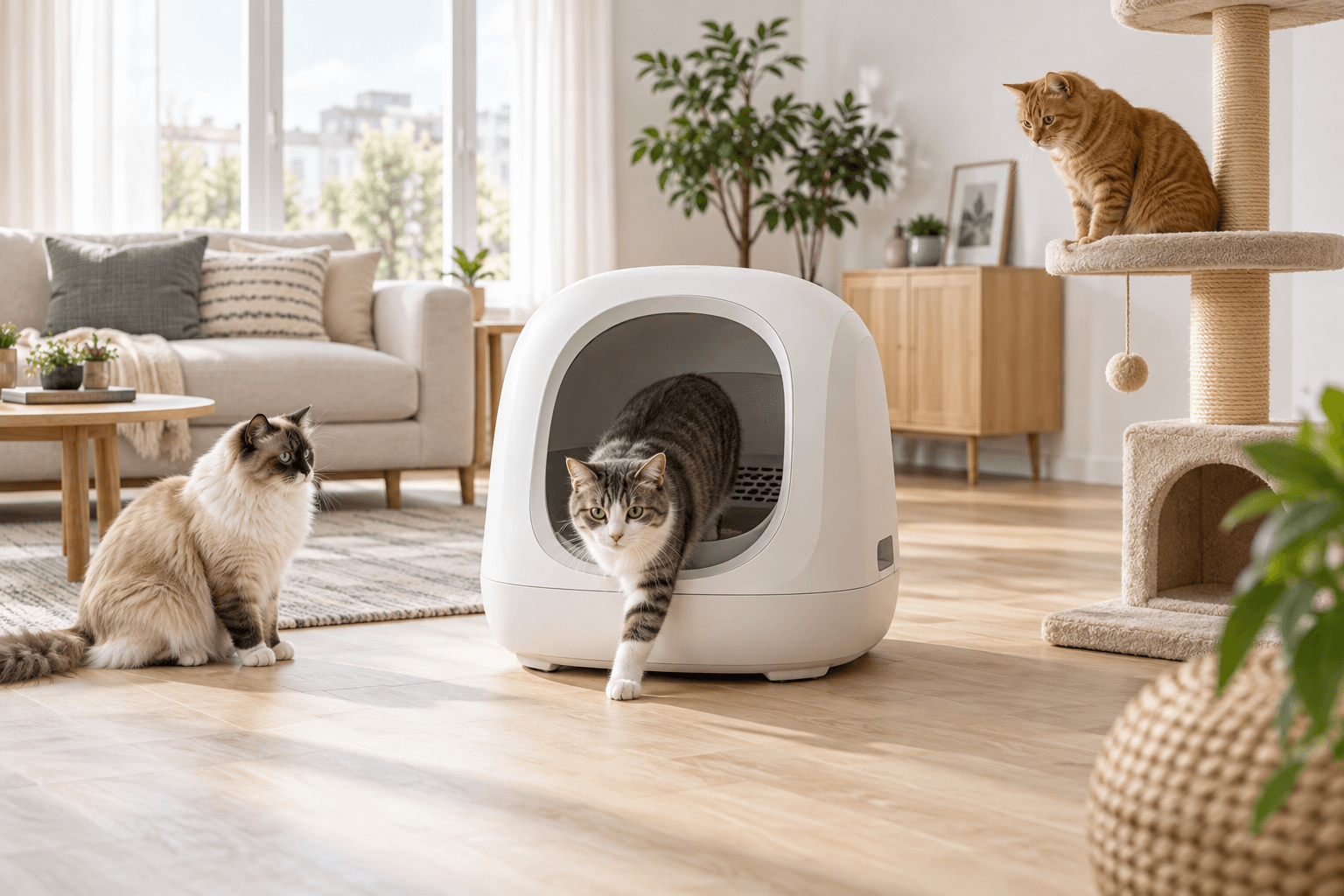
“How many cats can use one automatic litter box?” is one of the most attractive questions on a product page—and one of the easiest to oversimplify. A household with two relaxed cats can be less demanding than a household with two territorial cats, a large cat and an older cat, or a cat that visits frequently. The number printed in a feature list does not describe these differences.
For distributors and private-label brands, the useful question is: under which test conditions can one unit support the intended number and profile of cats? This guide turns that question into measurable sample tests, product-page wording and after-sales planning.
| Capacity factor | Why cat count is not enough | Evidence to request |
|---|---|---|
| Visit demand | Cats differ in daily frequency and timing | Visits per cat, peak clustering and repeat-use test |
| Cleaning-cycle availability | The unit may be unavailable, moving or waiting after a visit | Cycle delay, cycle duration, interruption logic and queue behavior |
| Waste storage | Drawer duration falls as household use rises | Usable drawer volume and measured emptying interval under the test profile |
| Physical fit | Equal body weight does not mean equal length or mobility | Entrance, step, turning area and observed behavior |
| Individual acceptance | One cat may avoid a structure accepted by the others | Cat-by-cat transition and access observation |
| Identification | Similar weights can confuse weight-only profiles | Recognition method, confidence limits and exception handling |
| Backup plan | Maintenance or faults can remove the shared toilet | Household guidance for cleaning, outages and gradual transition |
1. Why There Is No Universal “Cats per Unit” Number
An automatic litter box is a shared service system. Each visit creates demand for entry space, clean litter, a waiting period, a cleaning cycle and waste storage. Capacity fails when one of those resources is unavailable, even if the motor can complete many cycles per day.
A manufacturer’s stated household capacity is useful only with its conditions: cat size range, waste assumptions, litter type, drawer-emptying target, cycle settings and required supervision. Treat the headline number as a screening point, then reproduce the intended use case on the exact sample.

2. Calculate Daily Demand and Peak Demand Separately
Average daily visits help estimate waste storage, but peak timing determines whether cats encounter a busy unit. If several cats visit after meals or during the same morning period, the unit may still be waiting, cleaning or recovering when another cat approaches.
Create a simple demand profile for the sample test. Give each cat an anonymous identifier and record visit start, visit end, cleaning start, cleaning end, interrupted cycles and attempts made while the unit is unavailable. The goal is not to diagnose health; it is to verify service capacity and access.
| Metric | What to record | Why it matters |
|---|---|---|
| Visits per cat per day | Individual and household total | Estimates litter use, cycles and drawer fill |
| Peak-hour visits | Highest number of approaches in one hour | Reveals queue and availability risk |
| Cycle occupancy | Delay plus cleaning and recovery time | Shows how long the unit is unavailable |
| Interrupted cycles | Cause, stop behavior and recovery | Tests safety and whether cleaning falls behind |
| Rejected approaches | Cat approaches but does not enter | May reveal motion, odor, social or fit barriers |
3. Size the Waste Drawer and Litter System for Real Use
Multi-cat convenience is limited by the smallest maintenance interval. A large litter bed does not help if the waste drawer requires frequent attention; a large drawer does not help if clean litter falls below the operating level first. Track both.
Measure the usable—not geometric—drawer capacity with the approved bag and waste-distribution pattern. Record the number of visits or days until the full indication, odor threshold or manual limit is reached. Repeat after the bag has been installed by a user unfamiliar with the product.
- Weigh litter added during the test and litter discarded with waste.
- Check whether clumps distribute evenly or build under the waste inlet.
- Confirm that drawer-full sensing works with the approved liner.
- Inspect seals, deodorization parts and contact surfaces.
- Set a conservative emptying instruction for warmer or more humid markets.
Use the automatic litter box litter-compatibility guide to validate the selected material and the consumables and bag-cost guide to plan recurring supply.

4. Check Physical Fit and Social Access Cat by Cat
One confident cat using the sample does not prove multi-cat acceptance. Evaluate every cat’s approach, step-up, entry, turning, digging and exit. Large cats, senior cats and timid cats may respond differently to the same opening and movement.
Placement matters. A unit in a narrow corner can create a social bottleneck because another cat controls the approach or exit. Multi-cat guidance should recommend stable flooring, clear escape routes and enough surrounding space for a cat to approach without being trapped.

Compare the access trade-offs in the open versus closed automatic litter box guide. Open structures may reduce visual and entry barriers for some households; closed structures may offer containment benefits. Neither format is automatically right for every group of cats.
5. Cleaning-Cycle Queues Are a Safety and Availability Problem
Automatic cleaning normally begins after a safety delay. In a busy household, a second cat may enter during the delay, approach during movement or interrupt a cycle. The product should detect that event, stop safely and recover without leaving waste unprocessed indefinitely.
Challenge the sample with controlled entry and obstruction fixtures before animal observation. Test approaches during the delay, at cycle start, during movement and during recovery. Verify that the status shown on the panel or app matches the physical state.
Log missed or delayed cleanings. A system that repeatedly postpones cycles may present a dirty bed to the next cat even though every individual safety interruption works correctly.
6. Individual-Cat Recognition Needs an Exception Policy
Smart litter boxes may distinguish cats by weight, camera, profile logic or a combination. Recognition is useful for household monitoring, but it is not the same as clinical diagnosis. Similar-weight cats, partial entry, two cats near the unit, growth and weight change can reduce confidence.
Ask the supplier to explain the recognition method, minimum differences or image conditions, how unknown visits appear, whether owners can correct a record and what happens offline. During sample testing, compare the system’s result with a separate observation log.
| Scenario | Expected product behavior | Buyer check |
|---|---|---|
| Two cats of clearly different weights | Separate profiles consistently | Measure identification accuracy across repeat visits |
| Two cats of similar weight | Show confidence limits or use another signal | Verify that the app does not create false certainty |
| Partial entry or quick exit | Record or classify the event appropriately | Compare event log with video observation |
| Unregistered cat | Preserve the event as unknown or request assignment | Test profile setup and correction workflow |
| Network unavailable | Maintain safe core operation | Confirm data synchronization and lost-event handling |

7. Know When One Unit Is Not Enough
A second toilet option may still be necessary when cats have territorial conflict, different accessibility needs, a long or multi-floor home, very high peak demand or a product that must be offline for deep cleaning. A responsible brand should not promise that automation eliminates every backup arrangement.
- Recommend a backup during the transition period.
- Explain what to do during cleaning, power interruption or a fault.
- Use household layout—not just cat count—to discuss placement.
- State minimum cat weight, age or mobility limitations for automatic mode where applicable.
- Provide guidance for kittens, pregnant cats and cats needing close supervision.
Honest fit guidance can reduce returns even when it lowers the apparent “maximum cats” claim. The returns-reduction guide shows why accurate targeting protects margin and after-sales capacity.
8. Compare Platforms by Household Requirement
The following product examples show where to focus a multi-cat review. Confirm final specifications, firmware, app functions, voltage, accessories and packaging on the quotation and approved sample.

V20 Open Automatic Cat Litter Box
Evaluate visible access, usable litter area, the 9 L waste-bin information shown on the page, cycle interruptions, litter tracking and app setup for the target household.

Mini-F Open Cat Litter Box
Review entrance and step access, footprint, usable interior, the 10.5 L waste-bin information shown on the page, stability and placement in smaller homes.
NEO-AE Closed Automatic Cat Litter Box
Test entry fit, manual and automatic cleaning, gravity-related readings, dual infrared sensing, app profiles and fault recovery with the planned cat mix.

High-End Automatic Cat Litter Box
Review the 14 L waste-compartment information shown on the page together with entry fit, fresh-air deodorization, detachable cleaning and premium finish protection.
Browse the complete automatic cat litter box range and the self-cleaning automatic cat litter box for additional platform comparison. Product selection should follow the cat profile, household layout and support promise—not only the longest feature list.
9. Run a 14-Day Multi-Cat Sample Test
Days 1–2: Freeze the configuration
Record the model, hardware, firmware, screen, litter, fill mass, cycle delay, waste bag, app and cat profiles. Define the target household claim before testing.
Days 3–5: Establish a safe mechanical baseline
Test sensors, interruption, recovery, litter separation, drawer-full indication and offline operation with controlled fixtures. Do not use cats to discover basic safety faults.
Days 6–9: Introduce cats gradually
Observe each cat separately before shared use. Record approach, use, exit, identification and rejected attempts. Keep a familiar backup available during transition.
Days 10–12: Measure shared demand
Track peak visits, cycle queues, interrupted cleaning, drawer fill, litter top-up, odor and cleaning time. Verify the app against independent observation.
Days 13–14: Review maintenance and claims
Have an unfamiliar tester empty, clean and reassemble the unit using the final instructions. Compare all evidence with the proposed maximum-cat, maintenance and identification wording.
Use the complete automatic litter box sample-testing checklist and repeat critical functions after the final packaging test.
10. Write Claims That Sales and Support Can Defend
A supportable multi-cat statement includes the tested profile and maintenance conditions. Replace “perfect for any number of cats” with specific guidance on cat size, waste servicing, litter, cycle settings, identification limitations and backup arrangements.
| Claim area | Risky wording | Better content |
|---|---|---|
| Household capacity | Works for all multi-cat homes | State the tested cat profile, servicing interval and conditions |
| Identification | Always knows which cat used it | Explain the method, correction workflow and known limits |
| Maintenance | Hands-free for weeks | Separate drawer emptying, litter top-up, wiping and deep cleaning |
| Safety | Completely risk-free | Describe sensing, delay, interruption and supervised setup requirements |
| Health data | Diagnoses illness | Describe trend information and advise veterinary consultation for concerns |
Connect the approved claim set with the smart litter box wholesale risk analysis, quality and compliance process, factory controls and custom smart litter box guide. The OEM and private-label guide, MOQ and customization guide and FAQ can help buyers prepare the final RFQ.
Conclusion: Capacity Is a Tested Household Scenario
One automatic litter box can serve multiple cats only when the physical space, cleaning throughput, waste storage, litter system, safety logic and individual cat behavior support the claim together. A maximum-cat number without these conditions is a marketing shortcut, not a product specification.
For B2B buyers, the best evidence is a repeatable sample test built around the target market’s real household profile. It produces safer product selection, more accurate content and fewer preventable returns.
