


1. Why Portion Error and Jams Become a B2B Profit Problem
An automatic pet feeder can look excellent in a listing and still create expensive after-sales problems. A small deviation repeated across several meals can change the daily food amount. A jam can become a missed meal. An uncontrolled recovery can create a double portion. For a distributor or private-label seller, those failures appear as returns, negative reviews, replacement shipments and support tickets.
The correct sourcing question is therefore not “Does it dispense food?” It is “How consistently does this approved configuration dispense the target foods under the conditions customers will actually create?” Buyers can compare current product platforms through the automatic pet feeder category page, but the final decision should be based on sample evidence.
2. Define Portion Accuracy Before You Measure It
“One portion” may describe a programmed unit rather than an exact gram weight. First establish the target output or acceptable range for the model and food used in the test. Then measure both average output and variation.
Relative error (%) = (measured mean − agreed target) ÷ agreed target × 100
Coefficient of variation (%) = standard deviation ÷ measured mean × 100
The average alone can hide risk. Ten very small portions and ten very large portions may produce an acceptable average while the customer experiences poor meal consistency. Record the minimum, maximum, standard deviation, failed cycles and any visible food damage.
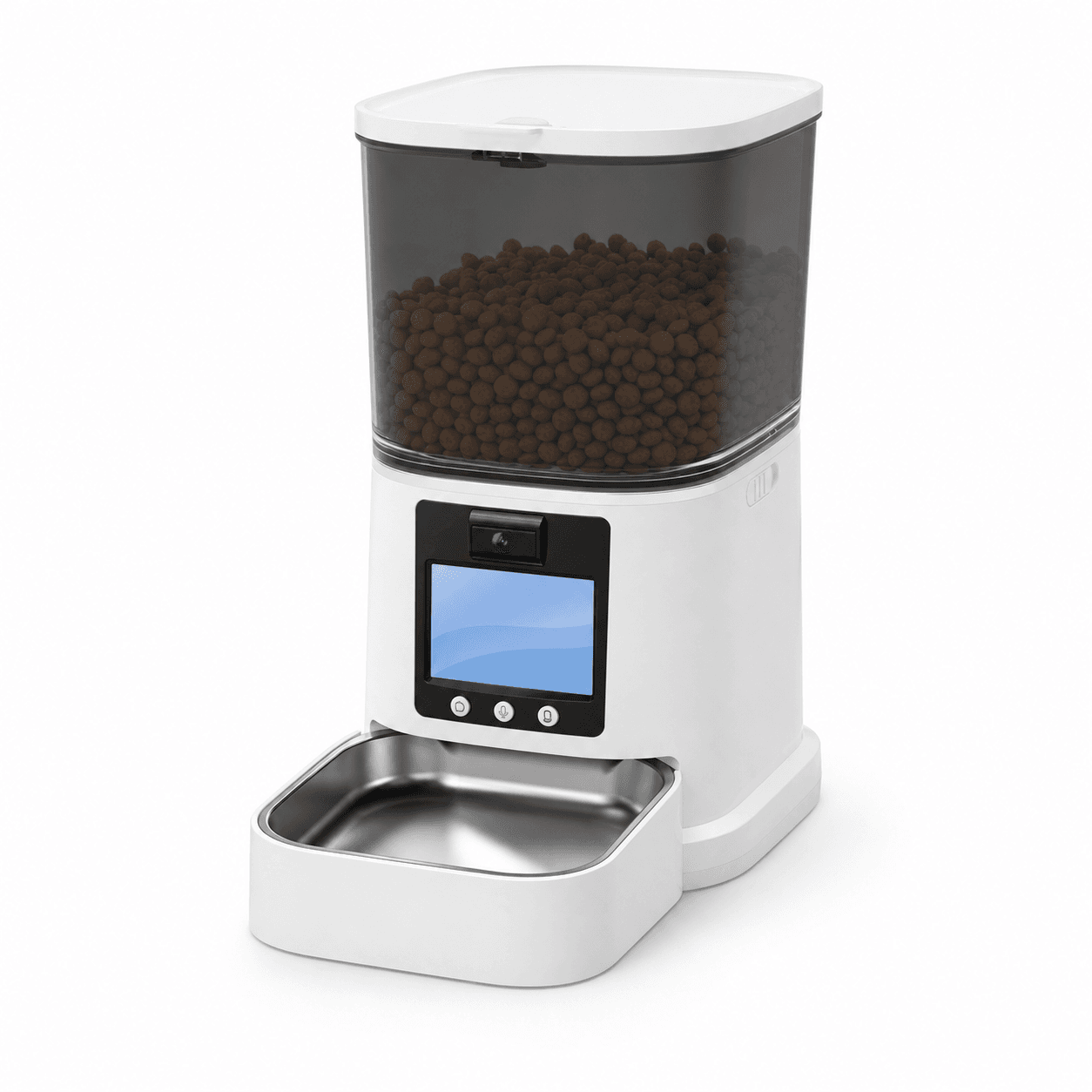
For the PFF040, the confirmed product page lists an approximate portion size of 6–10 g. That range must still be checked with the exact kibble used for sample approval; it should not be treated as a guarantee for every dry food.
3. Build a Kibble Test Matrix Instead of Testing One Easy Food
Ask the target market which dry foods customers are likely to use. Select representative foods near the intended size and shape boundaries, then document each test lot.
| Food Variable | What to Record | Why It Matters |
|---|---|---|
| Piece dimensions | Length, width, thickness and size distribution | Oversized pieces can bridge; very small pieces can leak or over-deliver. |
| Shape | Round, flat, triangular, irregular or mixed | Shape changes how pieces enter and leave the dispensing path. |
| Density | Mass per fixed volume | The same volumetric motion can produce a different gram output. |
| Surface | Dry, dusty, crumbly or oil-coated | Residue can change friction and accumulate during repeated cycles. |
| Breakage | Fines before and after testing | Crumbs may affect both portion mass and cleaning burden. |
| Storage condition | Sealed, opened duration and room conditions | Moisture exposure can change flow behavior. |
Use only foods approved for the model. The confirmed PFF015 configuration is intended for dry pet food; wet or semi-moist food should not be used unless separately confirmed.
4. Run Enough Cycles to See Variation
- Level the feeder on a stable surface and use a calibrated scale.
- Fill the hopper to the defined starting level and allow food to settle naturally.
- Program one portion, collect it, weigh it and return or discard it according to the protocol.
- Repeat at least enough cycles to observe normal variation; 30–50 cycles is a practical sample-study starting point, not a universal production standard.
- Repeat for several portion settings and scheduled multi-portion meals.
- Record zero-dispense, partial-dispense, double-dispense, abnormal noise and jam events separately.
Do not remove an inconvenient data point simply because food bridged or the motor sounded different. That observation is part of the result. If the feeder has both scheduled and manual feed functions, test them separately.

5. Repeat the Test at Full, Half and Low Hopper Levels
Food pressure and flow can change as the hopper empties. A feeder that performs well when full may become less consistent near the refill point, while a different design may be more sensitive when heavily loaded.
Define at least three levels and repeat the same food, portion setting and cycle count. Include the first portions after refilling and the last usable portions before the low-food condition. Observe bridging against hopper walls and any increase in crumbs.
For large-capacity models such as the 8 L PFF014, this step matters because customers may expect fewer refills and therefore operate across a wider range of hopper pressure.
6. Challenge the Anti-Jam System and Its Recovery Logic
An “anti-jam” mechanism can mean a food-pushing structure, reverse motion, current sensing, software retry logic or another design. Ask the supplier to define what the selected model actually does. Then test the complete system.
- Use the agreed maximum food dimension and a realistic mixed-shape load.
- Create repeatable borderline conditions without damaging the unit.
- Record detection time, retry count, motor direction and user alert.
- Verify whether recovery delivers the missing portion, a partial portion or an extra portion.
- Check the feeder after repeated recovery events for heat, wear, noise and loose parts.
- Confirm what happens if the obstruction remains.
The PFF040 and PFF015 both describe a dedicated food-pushing structure. Sample approval should translate that marketing direction into a buyer-defined pass/fail procedure.

7. Test Power Failure, Battery Switchover and Offline Feeding
Customer trust depends on what happens when the adapter is unplugged, batteries are weak, WiFi is unavailable or power returns during a scheduled meal. Build event-based tests around the exact configuration:
- disconnect power before, during and after a scheduled dispense;
- check whether the clock, schedule and portion setting are retained;
- verify adapter-to-battery and battery-to-adapter transition where dual power is supplied;
- run scheduled feeding with the app offline and the local network unavailable;
- confirm alert behavior and low-battery indication;
- look for missed, repeated or delayed meals when power returns.
PFF015 confirms an adapter plus 3 AA battery configuration. PFF014 confirms adapter plus battery dual-power mode. The battery type, expected behavior and accessory contents must be locked in the order specification rather than inferred from another model.
8. Dual-Path and Dual-Bowl Products Need Additional Measurements
“Dual bowl” and “dual dispensing” are not identical. A shared outlet that splits food into two bowls may produce left/right imbalance. Independent food paths may require two separate accuracy and jam tests.
For every dual configuration, weigh each output separately, calculate the distribution ratio and observe how the result changes with kibble shape and bowl installation. Verify whether one blocked path affects the other.

PFF014
Test each food path, each schedule and each hopper condition separately before evaluating the combined system.

PTM-103
Measure bowl-to-bowl distribution and check whether the layout suits the intended two-pet routine.
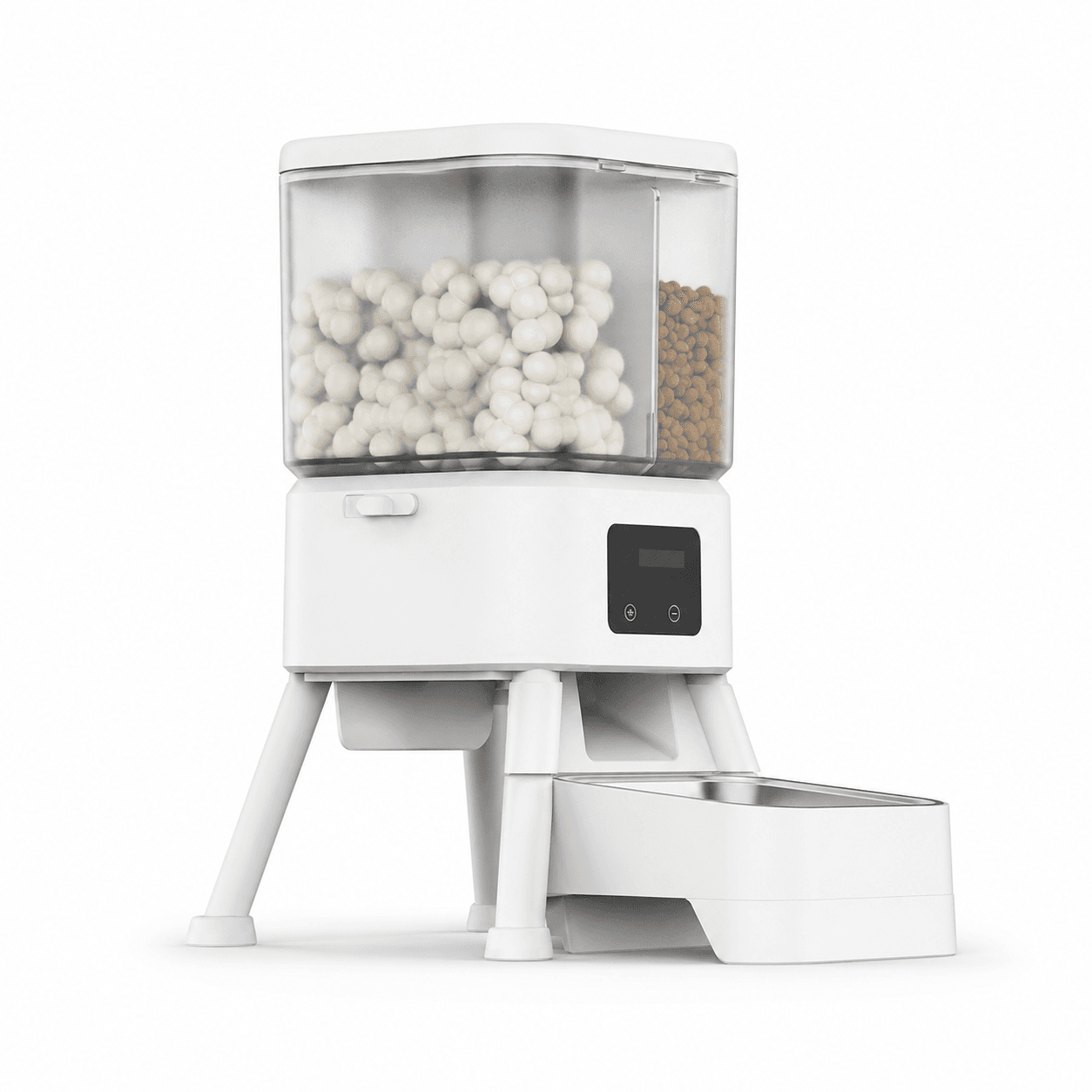
The PTM-20A1/20A3 adds another question: two 2 L compartments can hold separate foods. Test each food independently and in the intended meal combination, including cross-path residue and different food densities.
9. Connected Features Should Verify Feeding, Not Hide Mechanical Risk
An app, camera or notification can improve the customer experience, but connected features do not replace mechanical reliability. For WiFi models, test account setup, 2.4 GHz network onboarding, schedule synchronization, time-zone changes, offline behavior and event history.
For camera products such as the PT03S, verify whether the 150° adjustable view shows the actual food outlet and bowl. Test two-way video/voice and privacy language for the target market, but also confirm that visual monitoring does not become the only way a customer discovers a failed dispense.
10. Reassemble the Feeder and Repeat the Accuracy Test
Food-contact parts are removed, washed and reinstalled throughout the product’s life. A part that is slightly misaligned after cleaning can change friction, outlet clearance or bowl position.
- Disassemble the approved removable parts using only the manual.
- Time the process and identify residue traps, sharp edges and difficult clips.
- Wash and dry according to the approved instructions.
- Reassemble without factory assistance.
- Repeat portion and jam tests.
- Inspect seals, fasteners and moving parts after several cleaning cycles.
The selected configuration must make clear which parts are washable and which contain electrical components. Do not allow images or manuals to imply that the complete feeder can be immersed.
11. Which Feeder Platform Matches the Test Objective?
The comparison below uses confirmed information from current Haolinc product pages. Final food range, portion behavior, accessories, power configuration, firmware and compliance scope must match the approved sample and purchase specification.
| Model | Confirmed Direction | Priority Validation |
|---|---|---|
| PFF015 | 4 L; button control; up to 4 meals/day and 9 portions/meal; anti-jam food-pushing structure; adapter + 3 AA batteries; dry food | Basic portion repeatability, anti-jam recovery, battery switchover and compact pack-down design |
| PFF040 | Button control; up to 4 meals/day and 9 portions/meal; approximately 6–10 g per portion; dedicated food-pushing structure | Variation within the stated portion range, repeated schedules and food-pushing consistency |
| PFF014 | 8 L; independent dual dispensing; 2.4 GHz WiFi/Tuya Smart APP; up to 10 meals/day and 20 portions/meal; adapter + battery mode | Two-path output, app/offline schedule behavior, low-hopper consistency and dual-power recovery |
| PTM-20A1/20A3 | 2 L + 2 L compartments; separate food paths; button or WiFi control; 5 V/1 A; ABS + SUS304 | Two-food combinations, cross-path consistency, mixed kibble behavior and independent control |
| PTM-103 | 4 L; two serving bowls; button control; 5 V/1 A; ABS + SUS304; detachable food-contact components | Bowl distribution, crowding risk, manual feed, cleaning/reassembly and repeatable output |
| PT03S | 5 L; 150° adjustable camera; APP interaction; two-way video and voice; removable structure | Visual verification of delivery, camera framing, network behavior and cleaning around the feeding area |
12. Turn the Test Into an Acceptance Standard
Do not wait until the results arrive to decide what “good” means. Before testing, define the target food, condition, sample quantity, cycle count, measurement method, acceptable range and critical failures. Different products and channels may need different limits.
| Control Item | Record | Example Pass/Fail Structure |
|---|---|---|
| Portion repeatability | Mean, min, max, standard deviation and failed cycles | Buyer-approved range for each food and setting |
| Jam behavior | Detection, recovery, missing/extra food and alert | No unsafe stall; recovery follows approved logic |
| Power/offline | Schedule retention and dispense result for each event | No unapproved missed or duplicate meal |
| Dual output | Mass from each path/bowl and distribution ratio | Within the buyer-approved balance range |
| Cleaning | Time, residue, damage and post-assembly function | Correct reassembly and unchanged approved performance |
| Packaging | Drop/vibration result and post-test operation | No damage affecting safety, appearance or function |
Retain the signed data, food samples or food specifications, firmware identification and golden sample. The automatic pet feeder manufacturer selection guide explains how sample approval connects to quality control and mass delivery.
13. Carry the Approved Result Into Mass Production
A detailed laboratory test cannot be repeated on every production unit, so separate design validation from production screening. Critical production checks can include motor operation, one or more reference-food dispenses, controls, schedule retention, power transition, app/network function for connected versions and accessory completeness.
Define incoming component checks, process inspection, final sampling and traceability. State which defects are critical—for example, an unsafe electrical condition or a feeder that cannot deliver a scheduled meal—and which are major or minor. Confirm the inspection plan with the factory and quality-control team, and compare broader capabilities with the smart pet product manufacturer checklist.
For target-market documents, use the smart pet product certification guide as a planning resource, then verify reports for the exact model, power supply, wireless configuration and destination. Avoid treating a report for one configuration as proof for every feeder.
14. Questions Buyers Should Ask the Feeder Supplier
- Which food sizes, shapes and conditions were used in factory testing?
- How is one portion defined for this model and configuration?
- What evidence supports the stated portion range or anti-jam claim?
- What happens after a detected jam: retry, reverse, alert, stop or another action?
- Can the system create a double portion after recovery or power restoration?
- Does scheduled feeding continue without WiFi or cloud access?
- How are adapter and battery transitions tested?
- For dual products, are the outlets independent or shared?
- Which parts are removable and washable?
- What golden sample, firmware and food reference will control production?
- Which tests are performed on every unit and which use sampling?
- How are motors, rotors and other service parts supplied after launch?
After selecting a platform, review the automatic pet feeder OEM and wholesale guide, brand customization guide and Haolinc OEM/ODM service. This connects performance evidence with logo, packaging, manuals, MOQ and production planning. Buyers with an existing specification can also contact the project team directly.
