
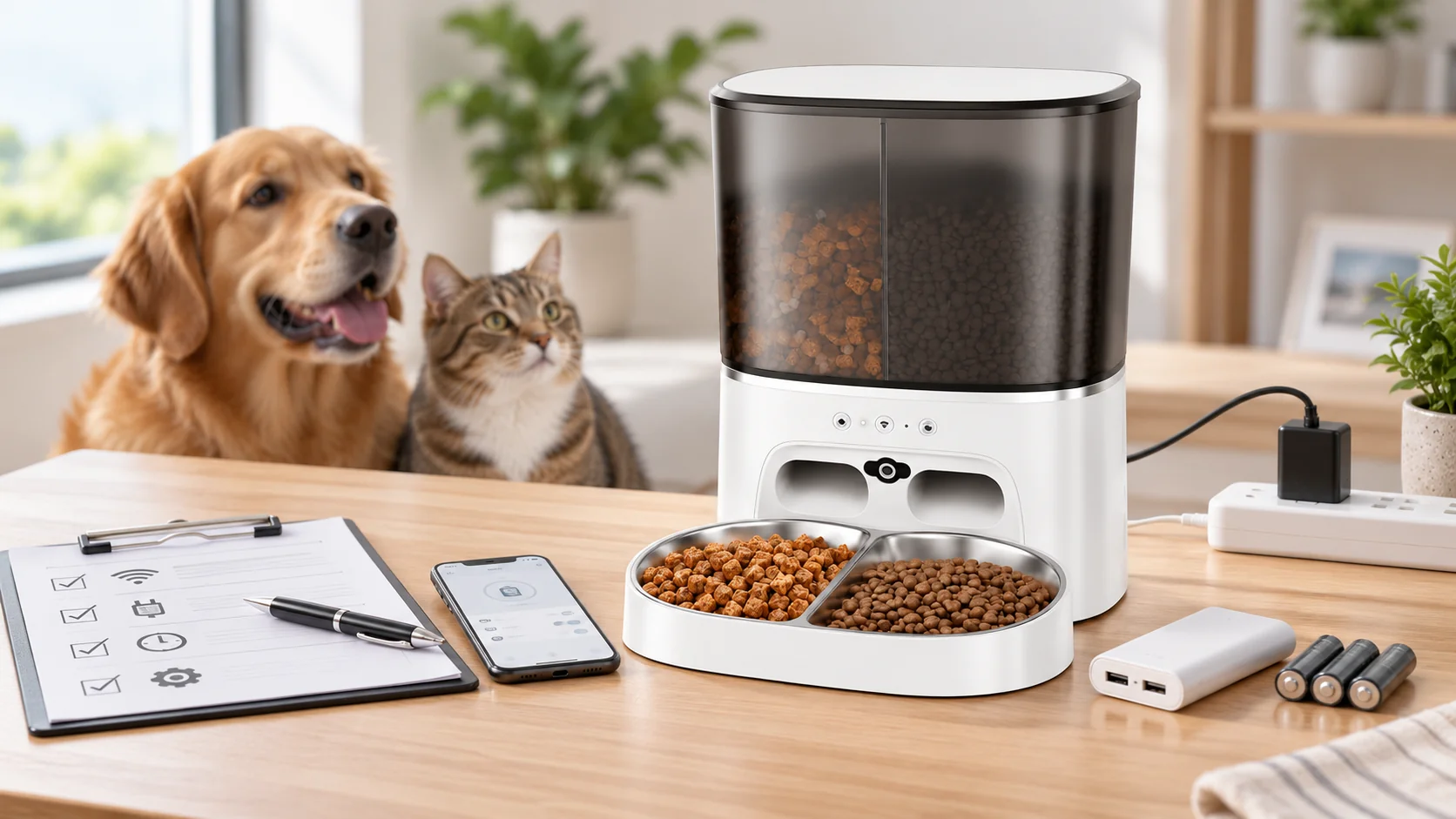
Buyer takeaway: A feeder that dispenses correctly while Wi-Fi and mains power are stable may still create support complaints when the router fails, the cloud is unavailable, or power returns just before a scheduled meal. For a wholesale order, approve the failure and recovery behavior of the specific model and firmware, not a generic promise of “offline feeding” or “battery backup.”
Automatic pet feeders are purchased for routine and reliability. Customers expect a stored feeding schedule to behave predictably even when connectivity is unreliable. Yet “supports Wi-Fi,” “dual power,” and “automatic scheduling” describe different capabilities. None, by itself, proves what happens after a network outage or a restart.
For a private-label importer, this is more than a product specification. It affects return rates, customer-service scripts, app reviews, and the evidence needed to approve a sample. This guide provides a repeatable automatic pet feeder Wi-Fi and power-failure test matrix that buyers can attach to an RFQ or sample-approval record.
What does “offline feeding” actually mean?
Ask the supplier to define each behavior separately:
| Term | What the buyer should verify |
|---|---|
| Local schedule storage | Does a saved feeding plan remain on the device after Wi-Fi is lost? |
| Local dispensing | Can the feeder execute a stored meal without cloud access? |
| Manual feed | Does the physical button still work under the stated offline conditions? |
| Power backup | What functions work on batteries, with which battery type and load? |
| Event synchronization | When connectivity returns, are missed events uploaded accurately rather than duplicated? |
| Recovery behavior | After a restart, does the device avoid releasing a second portion for the same scheduled event? |
Important: These are test questions, not universal product claims. Some models may intentionally stop certain functions when offline. The approved manual and product listing must describe the behavior actually demonstrated.
The eight-scenario sample test matrix
Use the same production-intended firmware, app version, food type, portion setting and power configuration throughout the test. Record the actual result, not simply “PASS” without evidence.
| Scenario | Setup and action | Evidence to retain | Acceptance criterion to agree before testing |
|---|---|---|---|
| 1. Baseline schedule | Set two scheduled meals online and observe both | App settings, time-stamped video, portion measurement | Timing and delivered amount meet the agreed tolerance |
| 2. Router disconnected | Save schedule, disconnect Wi-Fi before next meal | Router state, feeder video, app message | Behavior matches the published offline specification |
| 3. Internet down, local Wi-Fi present | Keep router powered but remove its internet connection | Network setup, meal video, app state | Local versus cloud dependency is clearly demonstrated |
| 4. Cloud or app unavailable | Test an agreed simulation where practical, without changing device settings | Test method, logs, meal result | Defined functions continue or fail safely as documented |
| 5. Mains adapter removed | Use an approved backup-power setup and remove mains power | Battery details, video, timing, portion | Only claimed battery-mode functions are expected and tested |
| 6. Power restored near meal time | Restore power shortly before and after a scheduled event | Time-stamped sequence, dispensed food | No unexplained duplicate portion or schedule loss |
| 7. Wi-Fi returns | Reconnect after at least one offline event | App history before/after, device logs if supplied | Events reconcile accurately without misleading “meal eaten” claims |
| 8. Repeated interruption | Repeat network and power transitions on the same unit | Number of cycles, observed failures, firmware version | Recovery behavior remains consistent across the agreed cycles |
This is a proposed buyer acceptance matrix, not a report that any particular Haolinchen model has passed these tests. The test duration, tolerances and sample size should be agreed for the selected feeder.
The difference between “scheduled,” “dispensed,” and “eaten”
A supplier's app may show a meal as complete when a timer fires or a motor runs. That does not prove the requested mass of kibble reached the bowl, and it does not prove a pet consumed the food.
Document at least three separate records where supported: (1) scheduled event, (2) dispensing outcome, and (3) app notification or history. If the feeder has no validated consumption sensor, do not label this as a verified feeding-consumption record. This distinction matters when retailers write product listings and respond to complaints.
How to make the test reproducible
A technical comparison is only useful when two people can repeat it. Your sample record should identify:
- Exact model/SKU, hardware revision and production-intended firmware.
- App name and version, mobile operating system and relevant account region.
- Router band and settings (for example 2.4 GHz where the selected model requires it), internet connection and deliberate outage method.
- Adapter, approved backup batteries, charge state and whether backup batteries are included in the retail pack.
- Kibble type and size, hopper fill level, programmed portion, time zone and daylight-saving setting.
- Measurement method (food scale, event timestamps and continuous video) and pre-agreed pass limits.
Do not substitute a video of a different model or firmware for evidence of the quoted product. If the product is offered with different regional power accessories or app configurations, validate the version intended for the buyer's market.
A simple supplier-ready result sheet
The goal is an actionable approval decision, not a long test report. Use one row for each scenario:
| Model | Firmware | Scenario | Expected behavior | Actual behavior | Evidence | Status | Follow-up owner |
|---|---|---|---|---|---|---|---|
| SAMPLE ONLY | To be filled | Wi-Fi disconnected | Buyer-defined requirement | Not yet tested | Video / log pending | OPEN | Supplier / buyer |
The companion CSV in this publication package has these columns ready to complete. No test outcomes are pre-filled or claimed. If a failure occurs, record whether it can be corrected by firmware, clearer instructions, a hardware change, or a revised product claim. Retest the changed configuration before final sample approval.
Translate test results into retail and after-sales wording
Before packaging and app screenshots are approved, write down what customer service should say when a shopper asks:
- Will tomorrow's scheduled meal run if my home Wi-Fi is disconnected?
- What happens during a power cut, and are batteries included?
- Will the feeder automatically reconnect to the app?
- Can the unit dispense twice after power returns?
- How does the app distinguish a scheduled meal from confirmed dispensing?
Only publish answers supported by the selected model's test results and approved user manual. Avoid unqualified labels such as “works offline in all circumstances” or “never misses a meal.” An automatic feeder is not a substitute for regular pet-care checks; owners should verify food supply and device operation, particularly during extended absences.
What to send with an OEM or wholesale RFQ
A useful first inquiry includes your intended market, sales channel, forecast quantity, model requirements, app and packaging language, power adapter standard, whether battery backup is essential, and which of the eight failure tests you want documented. Ask for sample availability and a model-specific test plan before committing to a bulk order.
Explore Haolinchen's automatic pet feeder range and review an example Wi-Fi dual-bowl feeder specification. Its publicly listed Wi-Fi and power configuration is a starting point for questions, not evidence that it has passed the test matrix above. For a broader introduction to models and private labeling, see the automatic feeder customization guide.
Ready to compare feeder samples? Send your model requirements and test matrix for an OEM or wholesale quotation. Include your target market, expected volume and required offline behavior so the proposed model can be reviewed against your actual buying criteria.
Frequently asked questions
Does every Wi-Fi automatic pet feeder keep feeding when the internet is down?
No universal answer is safe. Check whether the specific model stores schedules locally, what its firmware does offline, and whether any function depends on a cloud service.
Does “dual power” guarantee every scheduled meal during a power cut?
No. Battery-backup behavior can depend on the selected configuration, battery type, load and feature limitations. Request a sample demonstration with the intended setup.
Should an importer request a separate outage test if the supplier already has a product video?
Yes, if the video does not identify the model, firmware and outage conditions. A normal-operation demonstration cannot substitute for an agreed failure-mode test.
What is the most useful result to share with a retail buyer?
A short evidence-backed table showing which offline and recovery functions are supported, their limitations and the approved customer-facing instructions. The table can be shared without implying independent certification.
Editorial note: This is a practical B2B testing framework, not a laboratory report, certification statement or veterinary advice. Model-specific performance and test outcomes require supplier evidence and buyer approval.
Supporting references (editorial, not claims of tested performance):
