
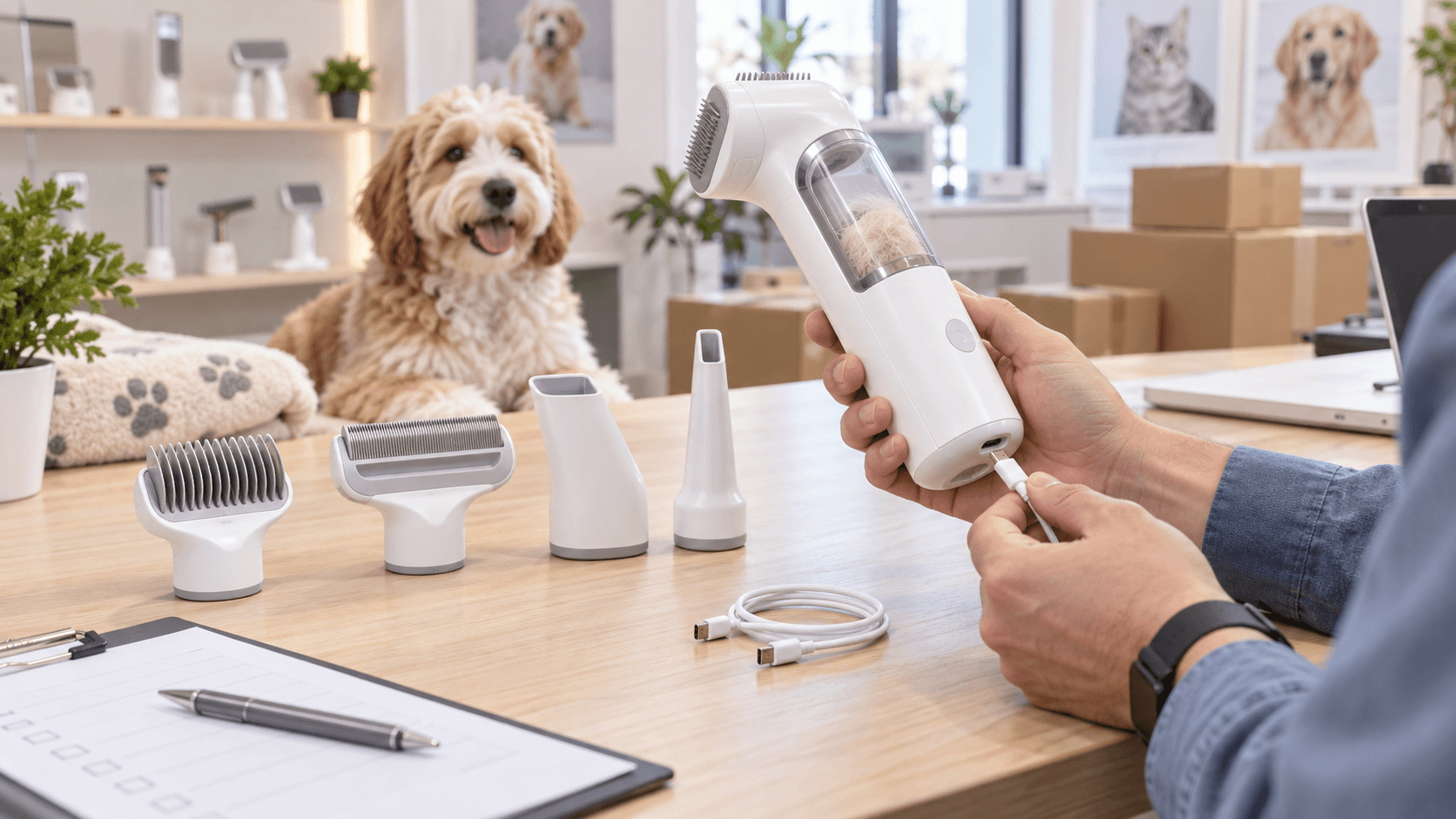
For distributors, marketplace sellers and private-label pet brands, cordless operation creates a strong convenience story. It also creates questions that do not exist on a simple corded appliance: battery aging, charging compatibility, storage state, connector wear, transport paperwork, runtime complaints and replacement policy. This guide turns those questions into a wholesale purchasing and after-sales checklist.
| Risk area | Evidence to request | Commercial decision |
|---|---|---|
| Battery configuration | Approved cell/module, protection, rating and change control | Freeze the production bill of materials |
| Runtime | Mode, attachment, load, temperature and end condition | Publish only condition-matched claims |
| Charging | Cable/adapter scope, Type-C behavior, temperature and port cycles | Define the included set and support script |
| Warranty | Diagnostic steps, evidence, responsibility and resolution route | Calculate reserve and response time |
| Accessories | Part numbers, compatibility, MOQ and replenishment lead time | Prepare local service inventory |
| Shipping | Battery documents, package configuration and route requirements | Confirm with carrier and market specialists |
1. Freeze the Exact Battery Specification
Battery capacity in milliamp-hours is only one input. The buyer should identify the complete approved battery module, voltage, protection design, charging control, connector, supplier and product revision. A silent substitution may change runtime, temperature behavior, weight, transport documentation and warranty performance even when the printed capacity remains the same.
The BBY-115 four-in-one cordless pet grooming vacuum currently lists a 2600 mAh battery and 50 W rated power. Treat those figures as a starting point for the exact sample and quotation, not permission to mix batteries or claims across revisions.

- Record the battery and protection-board identifiers.
- Require notification before changes to cell, module or charging components.
- Confirm low-voltage, over-current and temperature protection evidence.
- Retain an approved golden sample and relevant production records.
- Define whether the battery is customer-, service-center- or factory-replaceable.
2. Validate Usable Runtime by Mode and Attachment
The BBY-115 information lists approximately 30 minutes in standard mode and 20 minutes in strong mode. A buyer should verify how those results were obtained: initial charge, battery condition, attachment, airflow restriction, room temperature, continuous or intermittent duty and the point at which the test ended.
| Runtime test | Controlled condition | What the buyer learns |
|---|---|---|
| Continuous standard mode | Fully charged, defined attachment and container state | Repeatable comparison baseline |
| Continuous strong mode | Same environment and endpoint | High-load battery and temperature behavior |
| Realistic session | Start/stop cycles and planned attachment changes | Usable grooming-session experience |
| Partially filled container | Defined hair load and airflow condition | Effect of restriction on power and pickup |
| Aged sample | Documented charge/discharge cycles | Trend evidence, not an unsupported lifetime promise |

Use the pet grooming vacuum sample-test guide to connect runtime with noise, hair pickup, attachment fit and dust handling.
3. Test Type-C Charging as a Complete System
The product lists Type-C 5 V/2 A charging and an approximate 3–3.5-hour charge time. Approve the final cable and any adapter included with the order. Test supported input conditions named by the manual instead of assuming that every Type-C power source behaves identically.
- Charge from the defined low-battery state and record time to the full indication.
- Monitor the device, connector and battery-area temperature.
- Check charging indication, interruption recovery and full-charge behavior.
- Cycle cable insertion and inspect looseness, wear and intermittent contact.
- Confirm whether operation while charging is allowed or prohibited.
- Repeat charging after package transport tests and normal cleaning exposure.

4. Plan Battery Storage and Shipping Before the Purchase Order
Rechargeable products may require battery-specific documents, marks, packaging and carrier procedures. Requirements depend on cell type, configuration, route, transport mode, destination and carrier. Ask the supplier for model-matched documentation, then confirm acceptability with the freight forwarder or qualified specialist before booking.
Define storage temperature, state-of-charge guidance, carton handling, long-storage inspection and first-charge instructions based on approved supplier evidence. For slow-moving wholesale inventory, create a periodic stock-check routine rather than assuming sealed cartons can remain untouched indefinitely.

Use the smart pet product certification guide as a planning reference, while keeping transport documents separate from product compliance claims.
5. Write a Battery Complaint and Warranty Policy
“Battery problem” may describe a damaged cable, loose port, incompatible power source, incomplete charge, high-load use, storage issue or an actual module failure. Give customer support a short diagnostic process and define which evidence can be collected safely.
| Complaint | Safe first checks | Possible resolution |
|---|---|---|
| Will not charge | Approved cable/input, connector condition, indicator and temperature | Cable replacement, instruction or technical review |
| Runtime too short | Mode, attachment, load, charge completion and use condition | Expectation correction, repeat test or warranty assessment |
| Stops under load | Hair blockage, container/filter condition and strong-mode behavior | Cleaning support or controlled service case |
| Feels warm | Charging/operating condition and location of heat | Stop-use rule and escalation according to approved manual |
Write who pays freight, which conditions qualify for replacement, whether modules are repaired locally and how failed units are analyzed. Never instruct customers to open a sealed battery pack. Connect the policy to the supplier’s quality and compliance process.
6. Stock Replacement Attachments by Model and Revision
Brushes, combs and nozzles are lost, damaged or worn more often than the main appliance. They can also become separate retail SKUs. For each accessory, record the part number, compatible model/revision, color, packaging, unit cost, reorder MOQ, lead time and inspection criteria.
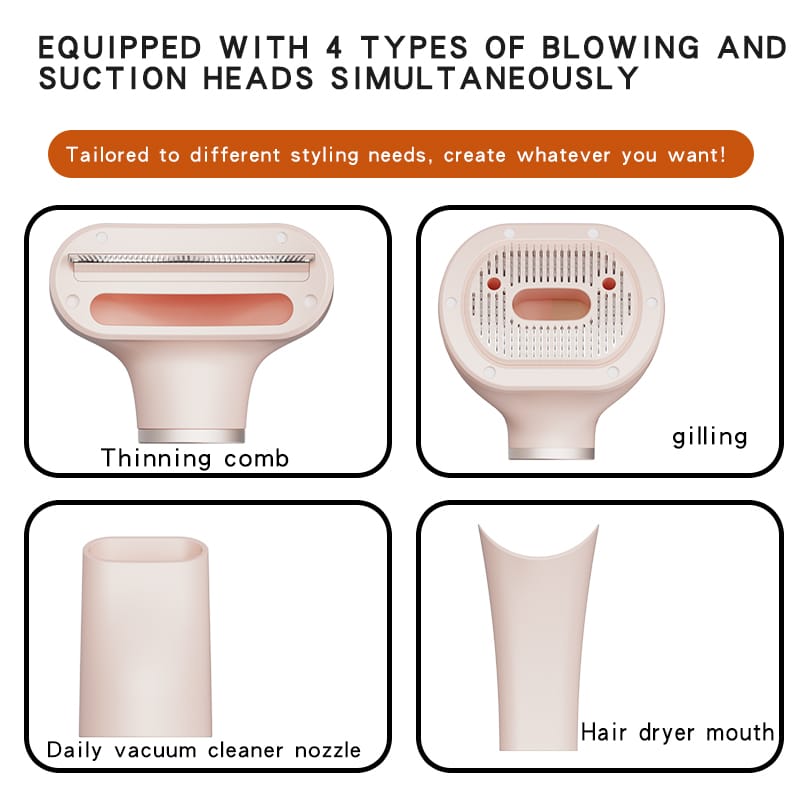
Grooming and cleaning set
Verify tooth and blade finish, attachment locking, labels, hair transfer and safe use instructions for every tool.

Function-specific service
Do not substitute a visually similar nozzle without checking fit, airflow, temperature behavior and approved use.
Build launch stock from the installed base, verified accessory demand and replenishment time; there is no universal spare-parts percentage. Ask for an end-of-life notice and final-buy option if the platform changes.
7. Support the Dust Container, Screens and Hair Path
The BBY-115 product information lists a 126 ml dust container. Practical capacity depends on hair type and compression, while airflow can decline before the container looks full. Test emptying, seals, screens or filters on the exact sample, and define which parts may be washed and how long they must dry.

- Provide visible fill and emptying guidance.
- Show how to remove trapped hair without sharp improvised tools.
- Identify washable and non-washable components precisely.
- Test suction and leakage after repeated cleaning/reassembly.
- Prepare replacement containers, screens or seals if they are service parts.
8. Build a Diagnostic Tree Before the First Shipment
A good decision tree starts with the customer symptom and avoids unnecessary whole-unit replacement. “Weak suction,” for example, may come from a full container, blocked attachment, incorrectly seated screen, low battery or a motor problem. “Short runtime” may be strong-mode use, airflow restriction or incomplete charging.
Record pilot-order cases by model, batch, symptom, root cause, part used and final resolution. Review trends with the supplier rather than sending only a return count. The broader pet grooming vacuum wholesale buyer guide explains how this data protects margin and listing quality.
9. Lock OEM, Claims and Compliance Scope
Logo, color, accessory set, cable, adapter, retail box, manual and battery label should be controlled before printing. Ask for separate MOQ and charges for each workstream. A standard-color neutral unit may have different conditions from a custom finish, printed packaging or modified accessory set.
Review Haolinc’s OEM/ODM service, private-label MOQ and customization guide and OEM versus ODM buyer guide. Verify supplier capability through the smart pet product manufacturer checklist, factory information and company profile.
Claims such as runtime, quiet operation, suction and certification must match the final configuration and test condition. Do not assume that a logo or report for another battery, cable or product revision covers the order.
10. Wholesale RFQ and Acceptance Checklist
Product configuration
Model, rated power, battery module, charging input, cable/adapter, colors, four attachments, dust components and all package contents.
Evidence
Runtime by mode, charge time/temperature, suction and hair pickup, noise, attachment fit, cleaning, durability and final-pack transport results.
After-sales
Warranty terms, diagnostic flow, replaceable parts, compatibility, replenishment lead time, engineering changes and end-of-life support.
Commercial terms
Quantity bands, Incoterm, payment, MOQ by customization, artwork/tooling ownership, production lead time and repeat-order conditions.
Retain a golden sample, signed specification, battery/charging identification, accessory list, packaging revision and manual revision. Additional sourcing checklists are available in the Haolinc resource center.
