
| Buyer question | Measure on the exact sample | Purchase decision |
|---|---|---|
| Will the fountain disturb a bedroom or living room? | Background-corrected sound observations at full and low water, with and without the approved filter | Approve only if the agreed sound limit and absence of rattles hold in each state |
| Will flow remain useful after pet hair and filter loading? | Timed output volume at baseline, loaded state, after cleaning, and after restart | Agree a minimum delivered flow and maximum permitted decline for the chosen configuration |
| Can several pets use it between refills? | Usable volume above minimum level, observed daily draw, drinking access and refill alerts | Choose a refill interval and contingency that fit the actual household trial |
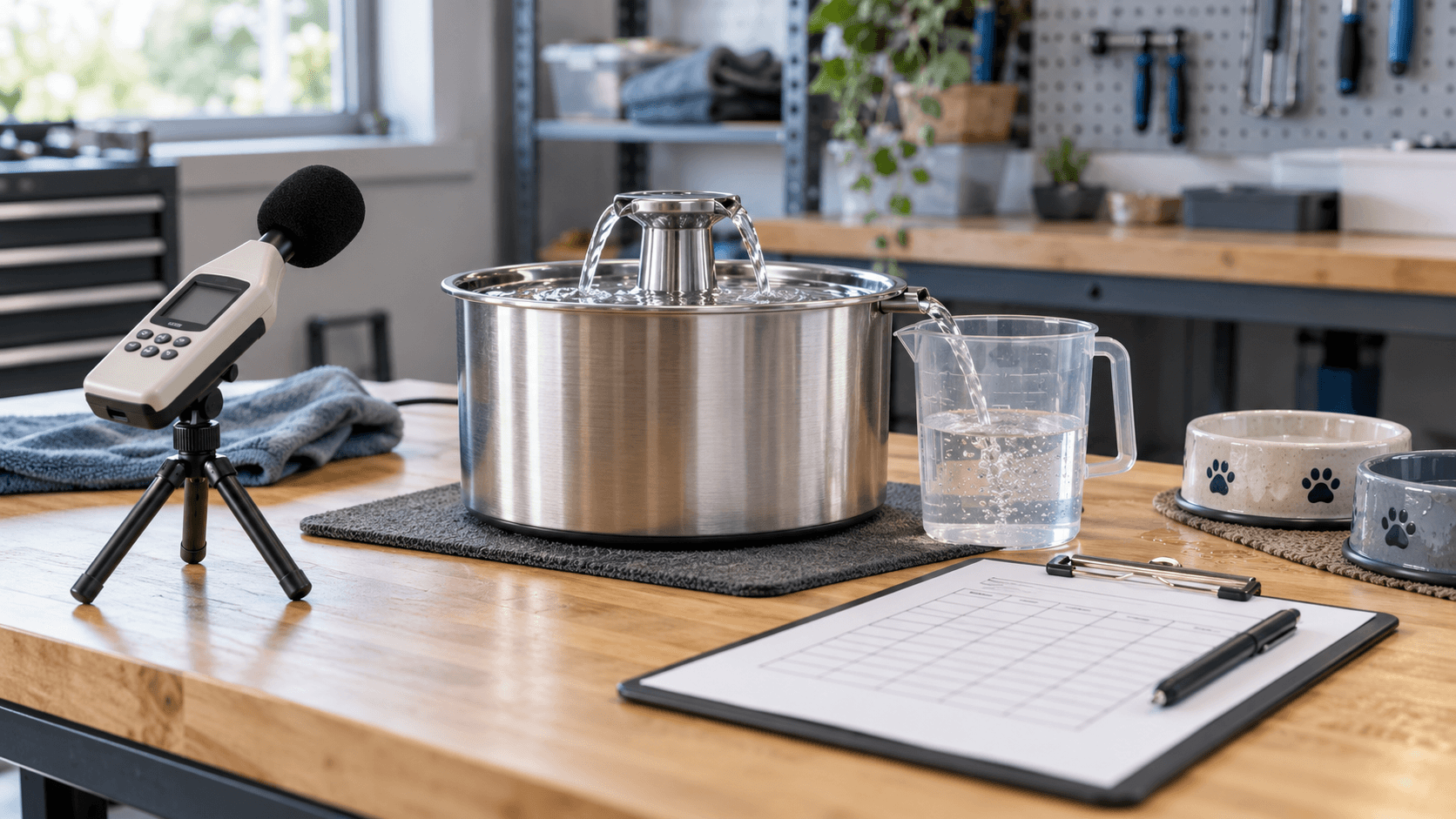
Pet water fountain pump noise is often discussed as a single decibel claim, while distributors and Amazon sellers experience it as returns, reviews and replacement requests. This guide turns that claim into a repeatable sourcing test. It also separates nominal tank capacity from usable multi-pet capacity, and records flow loss before a customer notices an empty-looking outlet. The methods are proposed buyer acceptance procedures, not reported results for Haolinchen products.
1. Define the Multi-Pet Use Case Before Choosing a Fountain
Start with the channel promise. A bedroom-focused listing emphasizes sound, light and stable night operation. A multi-cat household needs enough simultaneous drinking access and a refill routine that works when several animals use the same unit. A retail chain may prioritize a water-level window that staff can demonstrate. Record species, number of pets, placement, expected unattended period, outlet preference, cleaning frequency and whether a second water source will remain available.
Do not convert a reservoir label directly into “days of water.” Pets’ intake varies with diet, temperature, health and behavior; some water is also lost to splashing, evaporation or cleaning. The important number is usable water above the level at which the pump loses prime or switches off. Ask the supplier for the exact minimum-fill mark and test it on the production configuration.
The water fountain category shows current platforms. For wider sourcing context, see the OEM and wholesale fountain guide.
2. Measure Pet Water Fountain Pump Noise Fairly
Use a calibrated sound meter if a contractual limit is needed. Put the assembled fountain on the supplied base or a specified hard surface in a quiet room, record the background level, and measure from a fixed position and distance that represents where a person will hear it. Note room dimensions, ambient noise, meter settings, mains supply and mounting surface. Phone apps are useful for screening, but they should not be the sole evidence behind a numerical claim.
Measure at the maximum fill line, normal mid-level and the lowest permitted running level. Repeat with a new approved filter, a conditioned filter and any alternative outlet supplied in the retail box. Listen for impeller whine, intermittent contact, lid vibration, dripping and water-fall sound; a single total sound reading cannot identify the source. Let each state stabilize, take several observations and retain short audio records. Compare like with like across suppliers.
3. Diagnose Why a Quiet Sample Becomes Noisy
A pump can sound different after shipment, cleaning or low-water operation. Check whether the pump is seated fully, the impeller cover is latched, the cable or connector is routed as instructed, and the lid rests without rocking. Remove air trapped in the pump according to the manual. Compare sound with the filter installed and removed only as a diagnostic step, never as a recommended operating configuration if the product requires filtration.
Test the low-water alert and restart sequence. Record whether the unit stops before air is drawn, whether a refill restores normal flow without manual priming, and whether a repeated restart creates new rattles. If sound rises as the water level falls, distinguish pump cavitation from splash at the outlet. The remedy may be a clearer minimum-fill mark, a revised outlet, better pump seating or an updated cleaning instruction, rather than a different motor.
For the full service-life and consumables question, see the existing pump-life and filter-cost guide. Today’s sample test focuses on measurable operating behavior under changing water conditions.
4. Measure Delivered Flow, Not Only Pump Rating
A pump’s nominal rating may describe an isolated component under a different head height. Buyers need the water that reaches the drinking outlet after the actual filter, tubing, spout and reservoir are assembled. Define a safe collection method that does not run the pump dry. Collect outlet water for a fixed time into a measuring jug, convert the collected volume to a per-minute value, and note any bypass or spill that makes the measurement incomplete. Repeat at full, mid and minimum permitted water levels.
Record the outlet pattern as well as volume: a pet may prefer a visible stream, a shallow pool or both. Note dead zones where water remains still. Make a short video from the same angle for each sample. For models with modes or multiple outlets, measure each mode separately. If the retail promise depends on continuous circulation, verify that the selected power setting and filter actually support it.
Use the sample-testing checklist for the broader leak, assembly and cleaning review. The test sheet for this article adds a comparable timed outlet measurement and a flow-recovery step.
5. Simulate Flow Decline and Recovery
Begin with a clean, correctly assembled production sample and the approved filter. Save the baseline output. Introduce a controlled, documented loading challenge representing hair and ordinary debris expected for the target pets; do not use a random amount that different suppliers cannot reproduce. Run the agreed duty cycle and measure output at set intervals. Note whether debris collects on the filter, in the pump chamber or at the outlet, and whether water bypasses the intended filter path.
Then clean the unit exactly as an owner would using the supplied instructions and tools. Measure output again. If flow recovers, the issue may be maintenance burden or an unclear cleaning interval. If it does not, inspect the impeller, filter fit, outlet and power connection. Log both absolute output and percentage decline from baseline. Agree the acceptable decline, test duration and failure definition before samples are sent; no universal threshold suits every architecture.
For a batch gate, repeat on more than one randomly selected production unit, not only a polished showroom sample. Save the filter lot, pump identifier and manufacturing revision so a later change can be traced. A supplier should not silently substitute a pump, filter medium or outlet geometry after approval.
6. Calculate Usable Multi-Pet Capacity
Nominal reservoir volume is a useful catalog comparison, but the pet cannot necessarily drink all of it while the pump operates normally. Fill to the stated maximum, then measure how much water can be removed before the unit reaches its minimum operating level, alert or shutdown. The result is usable circulation volume for that setup. If water remains accessible in a tray after shutdown, record it separately; do not blend it into the powered capacity claim.
For a household trial, record water added, water remaining, cleaning removals and spills every day. Estimate total observed daily draw from those measurements rather than assuming an intake per animal. Divide usable volume by a conservative observed daily draw to plan a refill interval, then shorten the interval for absence, warm rooms or uncertain observation. Keep a separate backup water source available during the trial.
Capacity also has a social dimension. Watch whether one cat blocks the drinking point, whether a second pet can approach without crowding, and whether the fountain remains stable when pets drink at once. A larger reservoir does not solve a single-point access problem. A second fountain may be a better answer than a bigger tank for households with separated rooms or territorial pets.
7. Run a Realistic Multi-Pet Trial
Use the same placement, water source and cleaning schedule intended for the customer. Observe the pets without forcing interaction. Record use by each animal, bowl preference, conflict, splashing, top-up frequency, sound complaints and any dry-run or low-water events. Recheck outlet flow and sound after routine cleaning. A short bench test finds defects; the home trial shows whether the chosen design fits the household.
For Amazon sellers, translate those observations into honest listing language. Say which capacity is nominal, show the actual refill indicator and explain cleaning and filter replacement. Avoid “silent,” “maintenance-free” or “suitable for all multi-pet homes” unless the precise claim has evidence and clear conditions. A realistic product video can demonstrate flow more effectively than an unsupported adjective.
8. Compare Current Haolinchen Fountain Directions
The following public product pages support only the listed model attributes. Pump acoustics, flow and practical multi-pet refill interval still require sample testing for the ordered configuration. Compare the exact product revision, not just the family name.
| Platform | Published attributes | Best buyer question to test |
|---|---|---|
| TY09 | 2.2 L, 304 stainless steel, visible level window, quiet circulation, triple filtration and detachable design | Does the compact reservoir meet the intended refill interval at the tested minimum level? |
| TY08 | 3 L, 304 stainless steel drinking surface, quiet pump, triple filtration and detachable water-contact parts | How does actual outlet flow change as the filter loads and after owner cleaning? |
| TY10 round-window faucet | 3.2 L, 304 stainless steel body, faucet outlet, round level window, triple filtration and detachable design | Does the larger nominal capacity translate into a suitable usable reserve and acceptable splash sound? |


For OEM changes to housing, pump, packaging or instructions, review the OEM/ODM service and quality process. The factory page provides context for production discussions; request model-specific evidence before making market claims.
9. Put the Acceptance Criteria in the Purchase Order
A useful acceptance sheet names the model, pump and filter revision, power supply, water source, room conditions, meter, distance, sample count, operating duration and test operator. Set numerical limits from the buyer’s channel requirement and an agreed, repeatable pilot, then use the same procedure for pre-shipment inspection. Define what counts as failure: stopped pump, outlet below the minimum flow, abnormal tone, leak, dry-run behavior or inability to restart after refilling.
| Gate | Record | Decision rule to agree |
|---|---|---|
| Acoustics | Background and operating readings at three water levels; rattles and tones | Maximum observed sound and no unacceptable intermittent noise |
| Hydraulics | Timed outlet output clean, loaded and after cleaning | Minimum output, maximum decline and recovery requirement |
| Capacity | Maximum fill, minimum operating level and measured usable volume | Refill interval based on target household trial |
| Continuity | Pump and filter identification, replacements, change notice | No unapproved component substitution in production |
Keep signed videos, measurements, inspection forms and retained samples with the order. If the supplier proposes a new pump or filter, rerun the affected gates. Ask for destination-market documents and claims review rather than assuming one model’s paperwork covers another configuration.
10. Prepare Support Before the First Wholesale Shipment
Most support tickets start with a symptom, not a root cause: “too loud,” “no water,” or “needs refilling every day.” Give customer service a decision tree: check water above minimum, assembly, filter seating, debris at the impeller, power connection, outlet blockage and restart procedure. Include a short cleaning video and a clear replacement-pump path. Define which parts can be stocked locally and how the buyer identifies the correct revision.
Review packaging and manual language with the destination team. State that a fountain requires regular washing and that filters do not replace cleaning. Explain where it can be placed, how to avoid vibration against a wall and what owners should do when the low-water indicator appears. These small details reduce preventable returns and help retailers make accurate claims.
If a buyer needs a private-label assortment, send Haolinchen the target market, estimated order size, household profile, desired outlet, acceptable acoustic method and refill goal. That lets the team quote a specific configuration and sample plan rather than a generic capacity claim.
Ready to test a fountain for your channel?
Share your target market and sample acceptance sheet with Haolinchen.
