
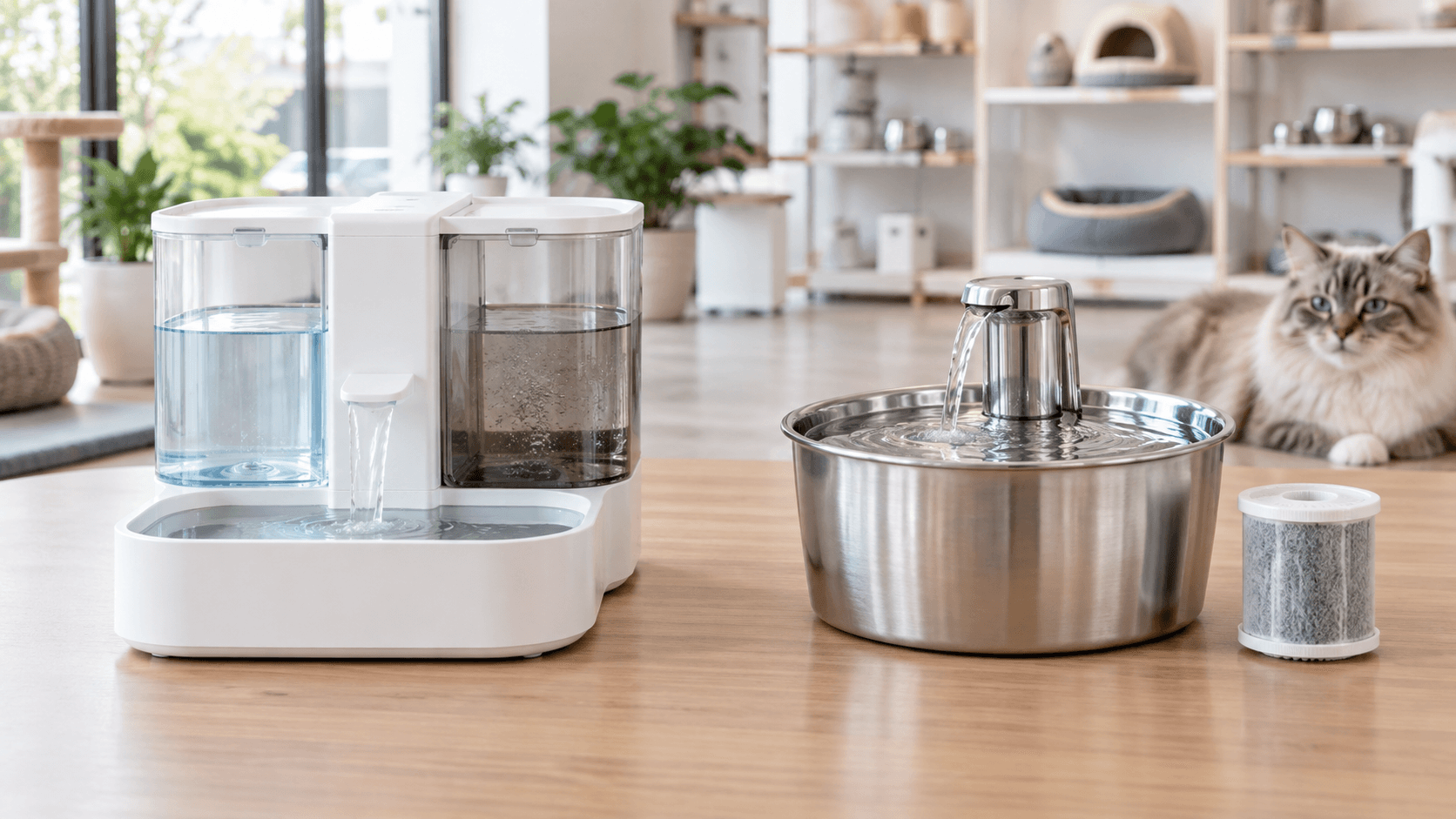
“Do customers still want replacement filters?” is becoming a practical assortment question for pet brands and distributors. The answer is not universal. Some buyers value multi-stage filtration and recurring filter sales; others want fewer consumables, easier replenishment and a simpler maintenance promise. This guide converts that tension into a B2B decision framework.
| Decision factor | Filtered circulation fountain | Filter-free dispenser |
|---|---|---|
| Retail explanation | Moving water plus replaceable filtration stages | No cartridge purchases; architecture must explain water handling |
| Recurring revenue | Potential filter-pack sales | Lower consumable revenue but fewer refill-SKU obligations |
| After-sales inventory | Filters, pumps and model-specific accessories | Pumps/battery or water-path parts, depending on design |
| Customer maintenance | Clean fountain and replace/rinse filters as instructed | Clean reservoirs, channels and separation components thoroughly |
| Supply-chain risk | Filter availability, media changes and pack MOQ | Architecture-specific parts and cleaning education |
| Evidence needed | Filtration fit, bypass, flow resistance and replacement plan | Clean/used separation, debris path, dispensing control and hygiene test |
1. Decide Whether Consumables Are Revenue or Friction
A filtered fountain creates two product lines: the hardware and the replacement cartridge. That can generate repeat revenue, but only if filter packs remain available, correctly matched and acceptably priced in the destination market. If customers cannot find filters, they may delay replacement, buy an incompatible part or blame the fountain.
A filter-free fountain removes that cartridge cycle. This can reduce support and simplify a marketplace listing, but the buyer gives up recurring filter revenue and must explain how water handling works without implying that “no filter” means “no cleaning.”
| Commercial question | Filtered option | Filter-free option |
|---|---|---|
| What does the owner reorder? | Model-specific filter packs at a validated interval | No filter cartridges; other service parts may still be needed |
| What must the distributor stock? | Hardware, filters, pumps and selected accessories | Hardware and architecture-specific service parts |
| What can create complaints? | Filter price, availability, odor, flow loss or poor fit | Unclear separation logic, cleaning workload or residue path |
| What supports margin? | Repeat consumable sales if supply is dependable | Lower ownership-cost story and simpler replenishment |
Use the pump-life and filter-cost guide to model hardware and consumables together rather than comparing unit price alone.
2. Compare the Water Path, Not Just the Filter Slot
A conventional fountain usually recirculates reservoir water through a pump and filter back to a drinking surface. The buyer should inspect the pump chamber, filter seat, bypass gaps, outlet, return path and every wet seam. The filter may capture selected debris, but the complete fountain still needs washing.
The PTM-663 filter-free 3 L dispenser uses separate clean-water and used-water areas with timed quantitative dispensing. Its B2B story is not “a filtered fountain without a filter”; it is a different water-path architecture. Buyers should verify that separation remains effective under normal use, foreseeable incorrect assembly and the intended cleaning routine.
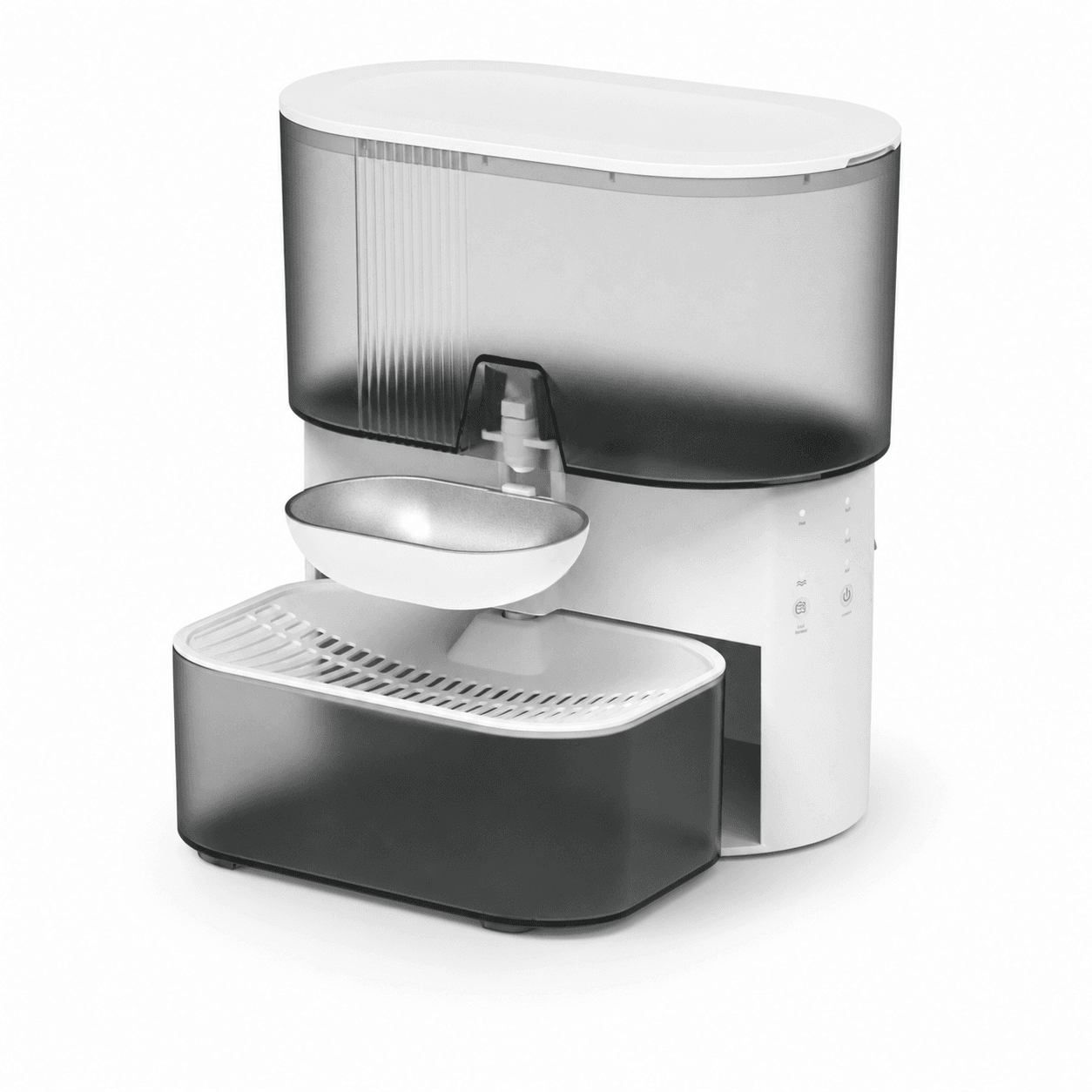
A third direction is the gravity-fed clean/used-water separation dispenser, which removes recirculation and filter cartridges. Compare all three architectures in the wireless, wired and pumpless sourcing guide.
3. Calculate the Full Consumable Economics
For filtered fountains, request the filter specification, pack quantity, packaging MOQ, shelf/storage conditions, landed cost, normal lead time and change-control process. Calculate owner cost per replacement and annual cost under a clearly stated usage assumption. Do not publish a universal interval without evidence from the approved product and conditions.
- Will filters ship with the first fountain order or from a separate supplier?
- Can the distributor maintain stock in the destination warehouse?
- Does the filter SKU remain compatible after a fountain revision?
- Who owns filter-pack artwork and barcode files?
- What happens if media, dimensions or suppliers change?

For filter-free products, move the cost analysis to the clean/used reservoirs, dispensing mechanism, battery or power system and any wear components. No filter cartridge does not mean zero after-sales inventory.
4. Measure the Customer’s Actual Cleaning Work
Give each sample and proposed manual to a first-time user. Ask them to empty, disassemble, clean, rinse, dry and reassemble it. Record time, number of parts, tools, inaccessible areas and errors that affect operation.
| Cleaning checkpoint | Filtered circulation | Filter-free separation |
|---|---|---|
| Routine action | Rinse surfaces and service filter per approved instructions | Empty used-water area and refill clean-water area |
| Deep clean | Pump inlet/impeller area, filter seat, channels and reservoir | Both reservoirs, dispensing path, bowl and separation interfaces |
| Reassembly risk | Filter reversed, pump/cable misrouted or tray not seated | Tanks exchanged, seals misaligned or path incompletely seated |
| Post-clean check | Flow, noise, leakage, filter fit and restart | Dispensing quantity, separation, leakage and power behavior |
Use the pet water fountain hygiene and cleaning-design guide to map dead zones, material scope and instruction requirements. Do not market either architecture as maintenance-free.
5. Control Filtration, Freshness and Hygiene Claims
A filter description should identify its media and supported function without turning marketing language into a medical claim. The buyer should review media containment, flow resistance, debris capture, bypass, initial rinsing and what happens as the filter loads.
For filter-free products, avoid implying that separated water paths automatically eliminate all contamination. Verify the defined separation, clean reservoir protection, used-water capacity, cleaning access and customer behavior. Terms such as “fresh,” “cleaner” or “hygienic” should match the tested architecture and qualified legal/compliance review.

The US and EU smart pet product certification guide can organize document questions, but the exact destination-market scope must be confirmed for the final configuration.
6. Compare Reliability, Power and After-Sales Risk
Filtered circulation fountains depend on pump restart, stable flow, dry-run handling, cable routing and filter resistance. Filter-free timed dispensers may shift risk toward dispensing control, tank seating, battery behavior and separation components. Neither architecture is automatically more reliable; the failure map changes.
- Define customer-safe diagnostics by symptom.
- Separate cleaning issues from component failures.
- List customer-replaceable, service-center and factory-only parts.
- Forecast pumps, seals, batteries or dispensing parts from verified data and lead time.
- Require notification before a critical component or firmware change.
Test the exact sample using the smart pet water fountain bulk-order checklist.
7. Match the Architecture to the Retail Channel
Marketplace shoppers often respond to a concise, visible benefit. “No replacement filters” and “separate clean and used water” can be easier to explain than a complex cartridge claim—provided product images and instructions make the mechanism clear. Specialty retail may support education around multi-stage filtration and replacement packs, while subscription-oriented brands may value consumable revenue.
For distributors, the choice also affects warehouse slots, purchase forecasting and local customer support. A multi-SKU filter system may be attractive at scale but inefficient in a small market. A filter-free hero product can simplify inventory but may need more demonstration content during launch.
8. Review Current Product Platforms
PTM-663 filter-free
3 L visible reservoir, separate clean/used water, timed dispensing and a 2000 mAh rechargeable configuration. Verify separation, dispensing, cleaning and battery behavior.

TY09 filtered stainless steel
2.2 L capacity, visible window and triple-filtration direction. Verify window sealing, filter fit, pump noise and residue access.

TY10 filtered faucet platform
3.2 L stainless-steel configuration with faucet outlet and water-level window. Verify splash, cartridge supply and hidden channel cleaning.
PTM-6131 rechargeable platform
A differentiated rechargeable and thermostatic direction. Confirm pump, charging, filter and market-claim scope on the quoted version.
9. Run the Same Comparative Sample Protocol
- Freeze the exact pump, battery/power, filter or separation components, materials and firmware.
- Use the same test water, pet-hair/debris challenge and environment.
- Record setup time, operating behavior, sound, splash and low-water response.
- Measure cleaning and reassembly time with a first-time user.
- Inspect hidden water paths before and after cleaning.
- Calculate hardware, consumable, freight and support cost using the same sales volume.
- Run final-pack vibration/drop checks and repeat operation/leak inspection.
- Document claims and instructions supported by each result.
The goal is not to force one winner. It is to identify which system produces the best combination of sell-through, owner effort, support cost and repeat-order stability for the target channel.
10. Put Consumable and Component Continuity in Writing
Filtered platform terms
Filter specification, pack MOQ, price-review mechanism, lead time, compatibility, media changes, artwork ownership and end-of-life notice.
Filter-free platform terms
Reservoir/separation components, dispensing parts, battery/power configuration, cleaning documentation and revision compatibility.
Both architectures
Golden sample, inspection criteria, warranty responsibility, spare-parts list, change notice, packaging approval and final-buy opportunity.
Connect these terms to Haolinc’s OEM/ODM service, factory process, quality and compliance controls and private-label planning guide. More buyer checklists are available in the resource center.
