
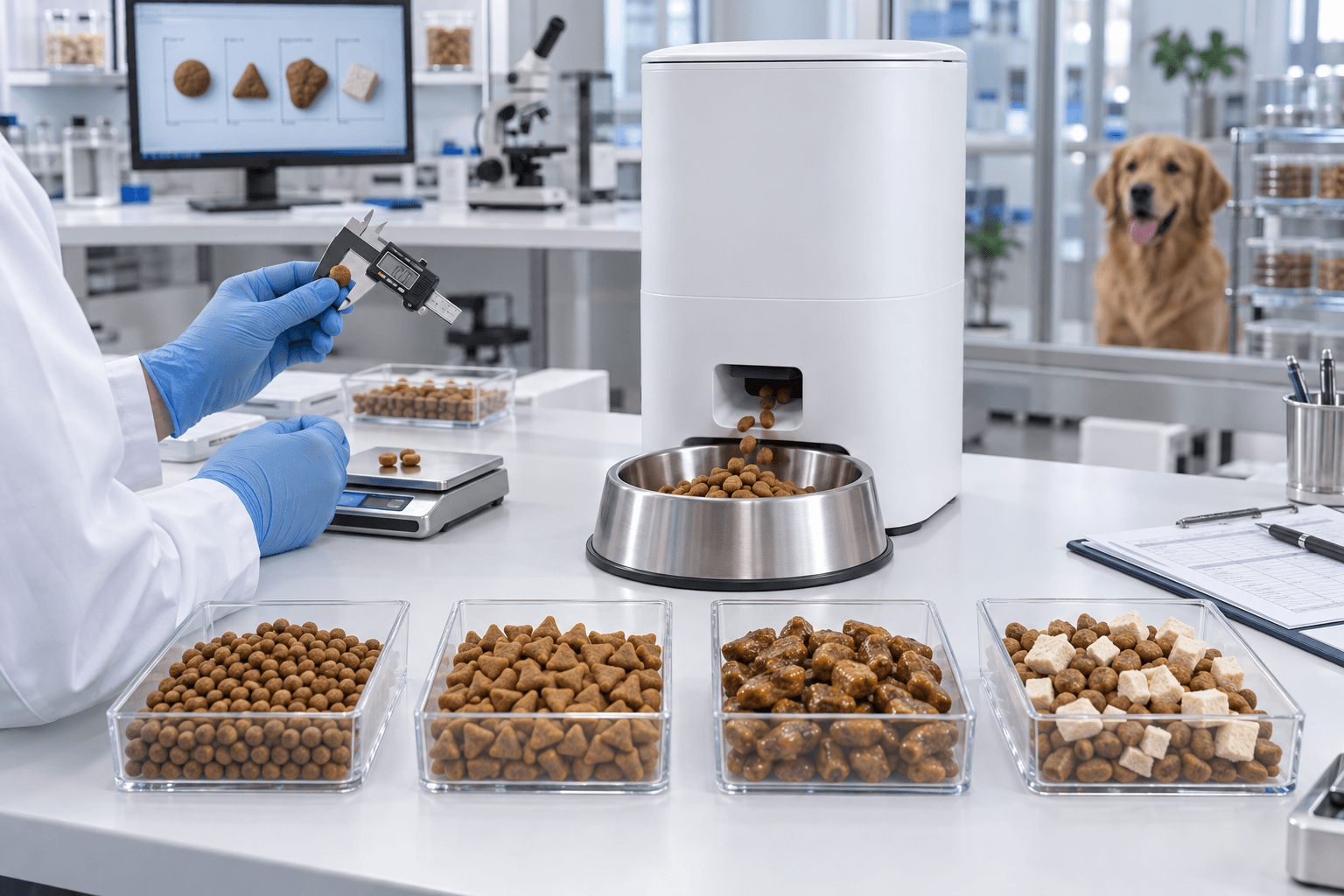
A feeder can dispense one round kibble reliably and struggle with another product that has the same nominal diameter. Irregular pieces can bridge across an outlet, oily surfaces can collect fines, and lightweight freeze-dried cubes can produce a very different portion weight from dense kibble. Mixed foods can also separate inside the hopper, so the ratio delivered to the bowl may not match the ratio poured into the container.
This guide helps distributors, private-label brands and Amazon sellers turn the question “What food works?” into a repeatable sample test. It complements the broader portion-accuracy and anti-jam test and the automatic pet feeder manufacturer evaluation guide.
| Food variable | Possible failure | What the buyer should measure |
|---|---|---|
| Particle width and length | Bridging, outlet blockage or rotor pinch | Actual size distribution, not only the average diameter |
| Shape | Irregular flow and changing pieces per portion | Round, triangular, flat and elongated samples separately |
| Bulk density | Same volume produces a different gram weight | Grams per fixed volume and portion-weight variation |
| Surface oil and fines | Residue, adhesion, sensor contamination and odor | Food-path residue before and after repeated cycles |
| Brittleness | Broken pieces and dust change later portions | Fines generated after transport and dispensing |
| Freeze-dried blend ratio | Large light pieces separate from dense kibble | Delivered ingredient ratio as well as total weight |
| Moisture sensitivity | Softening, sticking and microbial risk | Storage duration, sealing and target-climate exposure |
1. Replace “Dry Food” With a Measurable Specification
“Dry food” can include dense extruded kibble, air-dried pieces, freeze-dried cubes and mixed products. These foods do not behave identically. Begin with the final commercial SKUs intended for the target market and retain samples from identified batches.
For each food, record the maximum width, maximum length, thickness, shape, bulk density, visible oil, fines percentage and breakage after handling. A manufacturer may provide a recommended particle range for a specific model, but the buyer must confirm that the real distribution—including outliers—fits that range.

2. Test Particle Size and Shape as a Distribution
A round 10 mm pellet may roll through a chute that traps a flat or triangular 10 mm piece. Long pieces can align with an outlet in one cycle and bridge across it in the next. Use digital calipers and a simple sieve or image grid to document the range rather than an average.
Build at least four challenge groups: the normal production mix, the largest permitted particles, the most irregular pieces and a fines-rich sample from the bottom of the bag. Run each at high, medium and low hopper levels because pressure and flow angle change as the hopper empties.
| Test group | Purpose | Watch for |
|---|---|---|
| Normal bag mix | Represents ordinary customer use | Portion repeatability and gradual residue |
| Largest particles | Challenges outlet and rotor clearance | Bridging, pinch damage and motor retries |
| Irregular shapes | Challenges orientation sensitivity | Intermittent flow and high portion variation |
| Fines-rich sample | Represents bag-bottom and transport breakage | Dust, leakage, adhesion and inaccurate output |
3. Oil, Fines and Moisture Change Performance Over Time
Oily kibble may pass a clean sample test and leave a film after repeated cycles. That film can hold dust, change friction, create odor and make cleaning difficult. Moist air can soften some foods or cause particles to adhere to the hopper wall. These are accumulation problems, not one-cycle problems.
- Photograph the hopper, rotor, outlet, chute and bowl before testing.
- Run repeated portions without wiping the food path between every cycle.
- Weigh residue and fines where practical.
- Repeat after storage under the target market’s expected temperature and humidity.
- Time disassembly, washing, drying and correct reassembly.

4. Freeze-Dried Food Creates a Blend-Control Problem
Freeze-dried pieces are often lighter, larger and more fragile than ordinary kibble. When mixed in one hopper, vibration and repeated rotor movement can separate the foods by size and density. The first meals may contain a different ratio from the last meals.
Test pure freeze-dried pieces only if the model’s approved food range permits them. For a blend, define the starting ratio by mass, then separate and weigh the components delivered in early, middle and late portions. Also measure breakage, because a cube that enters the hopper intact may become fines after transport and repeated agitation.
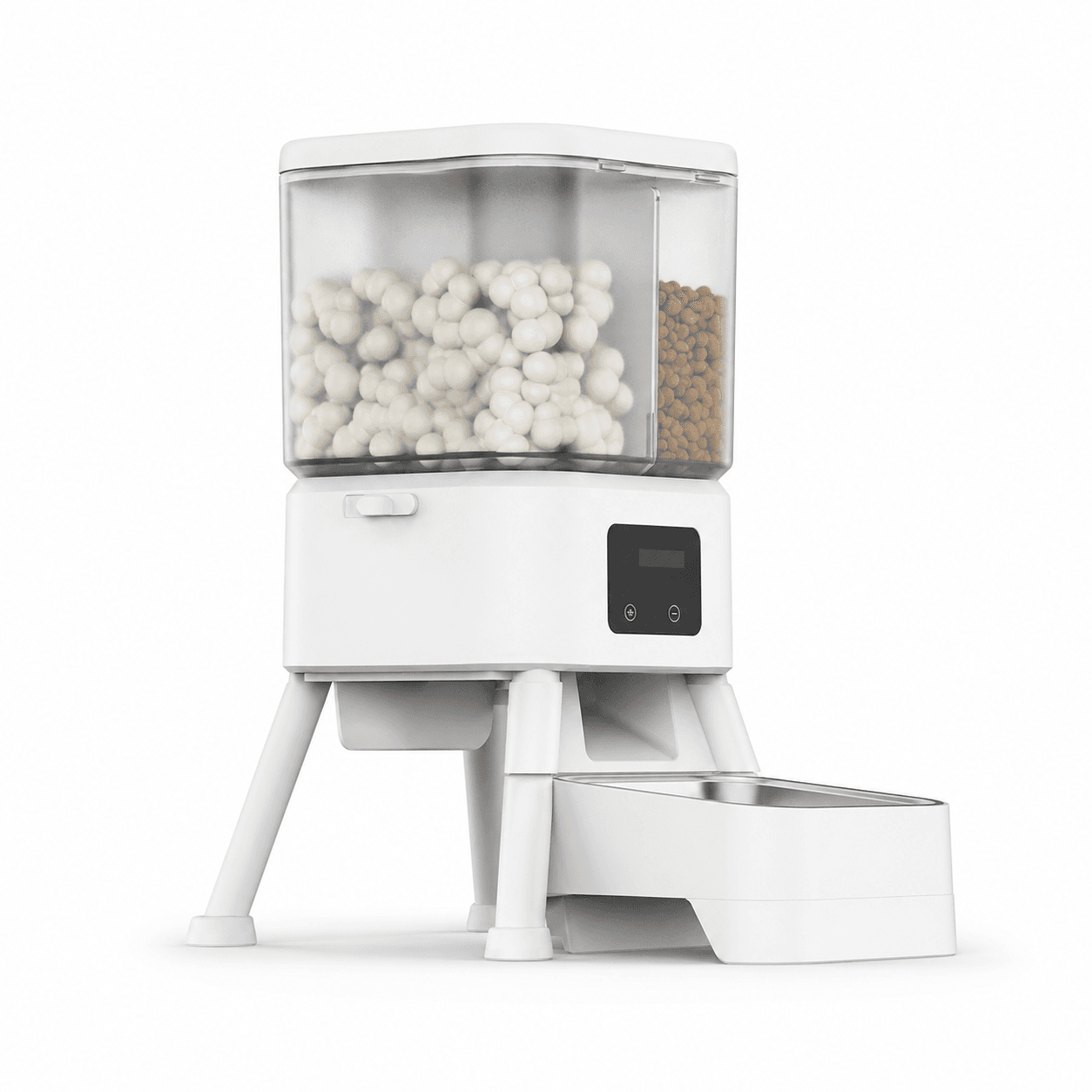
A two-compartment platform can keep different foods separate until dispensing, allowing the buyer to test each path and ratio independently. That architecture still needs validation; it does not automatically guarantee identical grams or ingredient ratios.
5. Inspect the Complete Food Path, Not Only the Outlet
Failures can begin at the hopper wall, agitator, rotor, gate, chute or bowl. A wide outlet does not help if food bridges above the rotor. A successful motor turn does not prove that food reached the bowl.
- Fill the hopper to the approved maximum and verify lid closure.
- Run portions at high, middle and near-low food levels.
- Observe where particles pause, rotate, break or accumulate.
- Check whether the design detects low food, blockage or empty output.
- Measure food remaining in corners after the usable hopper is considered empty.
- Repeat after cleaning and reassembly by a new tester.
Connected functions should be evaluated separately using the Wi-Fi and power-failure guide. A feeder must not hide a mechanical failure behind a successful app command.
6. Measure Portion Accuracy in Grams for Every Food
Many feeders meter by rotor volume or movement rather than by weighing the food. The same programmed portion can therefore produce different gram weights when food density, shape or oil level changes. Marketing a universal gram value without a defined test food creates support risk.
For each food, collect and weigh at least a meaningful repeated series at low, normal and high meal settings. Report average, range and any zero or partial portions. Also measure cumulative daily output because small errors can accumulate across several meals.
| Result | Meaning | Buyer action |
|---|---|---|
| Stable volume, changing grams | Food density differs | Provide food-specific calibration guidance |
| Occasional zero portion | Intermittent bridge or path failure | Investigate mechanism and recovery, not only average output |
| Large early/late difference | Hopper level affects flow | Test usable capacity and low-food warning threshold |
| Blend ratio drift | Foods segregate by size or density | Change blend, path design or customer claim |
7. Challenge Jams Without Damaging the Test
An anti-jam claim should describe detection and recovery, not merely a strong motor. Use controlled oversized particles and representative bridges. Record motor retries, reversal, alarms, app notifications, manual clearance and whether the next scheduled meal still occurs.
Do not overload the mechanism beyond the intended food range to create a dramatic demonstration. The useful test establishes the boundary between compatible, conditionally compatible and incompatible foods. Use the detailed anti-jam and portion test method for a repeatable sequence.

8. Match the Platform to the Food Strategy
The models below illustrate different test priorities. Confirm final food range, firmware, accessories, voltage and packaging on the approved sample and quotation.
PFF015
Compact button feeder for dry food. Focus on basic portion repeatability, food-pushing behavior, low-hopper output and battery switchover.
PTM-20A1/20A3
Two 2 L compartments and separate paths support projects that want staple food and snacks or supplements held separately before dispensing.

PTM-103
Test the 4 L button-controlled platform for portion consistency, two-bowl distribution, cleaning and competition between pets.
PT03S
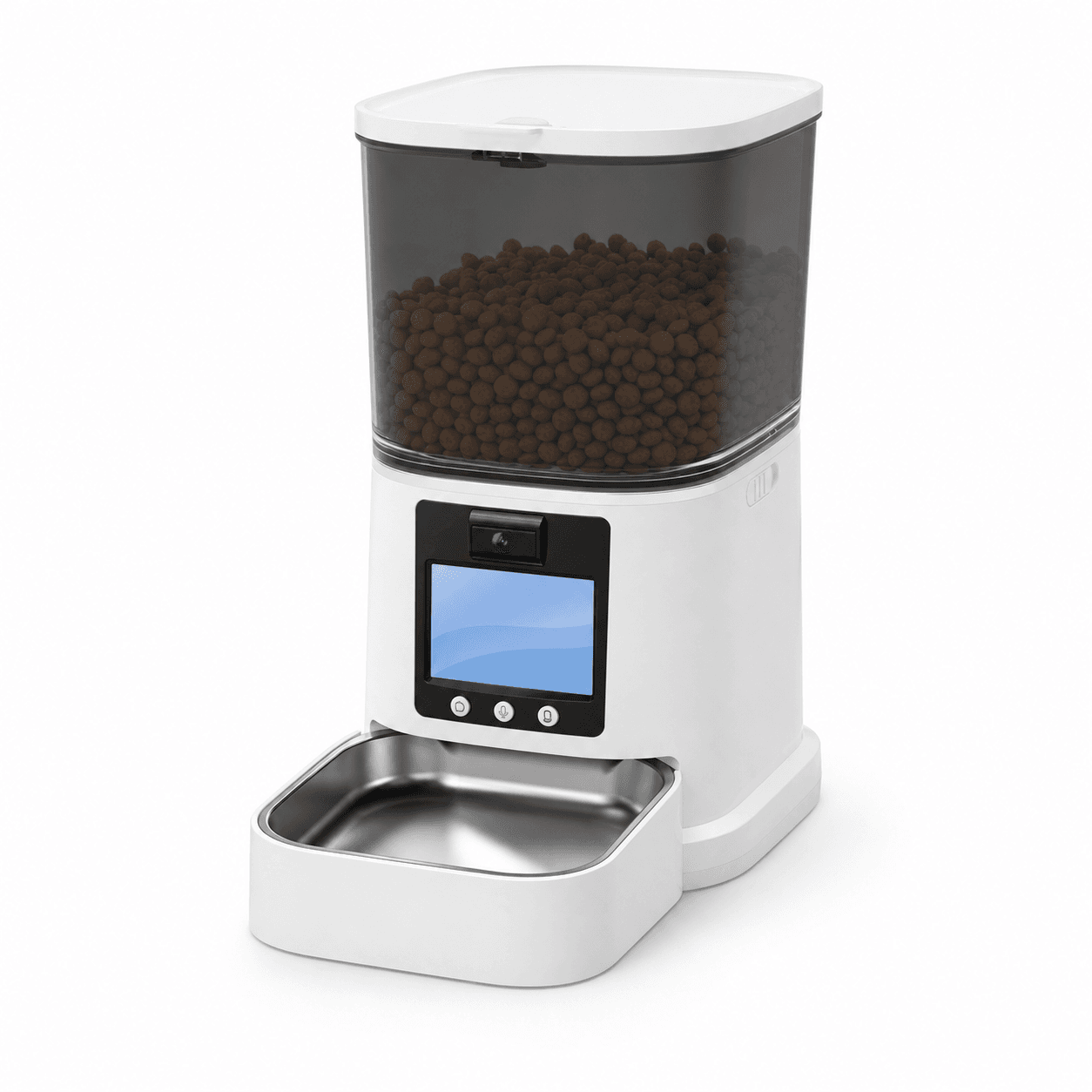
Combine mechanical food testing with camera framing, app behavior, two-way interaction and privacy-aware connected-service review.
Browse the full automatic pet feeder range, including the PTM-90A1 RFID controlled-access feeder, then compare the intended food with the actual product path rather than choosing by hopper capacity alone.
9. A Seven-Day Food Compatibility Sample Plan
Day 1 — Document food and feeder
Record feeder hardware and firmware, hopper, rotor and outlet; measure each food and retain labeled samples.
Day 2 — Establish clean baseline
Run normal food at several portion settings and hopper levels. Weigh every output and photograph the clean path.
Day 3 — Challenge size and shape
Test the largest and most irregular permitted particles, then document bridging, breakage, retries and recovery.
Day 4 — Test oil and fines accumulation
Run repeated portions without cleaning between cycles. Inspect residue, dust and portion drift.
Day 5 — Test freeze-dried blend stability
Measure early, middle and late meal composition, total output and particle breakage.
Day 6 — Test failures and offline behavior
Introduce controlled blockages, low food, Wi-Fi loss and power interruption. Verify alarms, recovery and the next scheduled meal.
Day 7 — Clean, reassemble and repeat
Have an unfamiliar tester follow the final instructions, then repeat critical portions to confirm correct reassembly.
10. Put Food Compatibility Into the Purchase Order
The technical agreement should identify approved food SKUs or measurable particle limits, excluded food types, portion-test method, acceptable zero-feed rate, jam recovery, cleaning interval and change notification. A signed sample without this information is difficult to reproduce in production.
| PO item | Evidence | Commercial purpose |
|---|---|---|
| Approved food range | Dimensions, shapes, density, oil/fines and exclusions | Supports accurate product-page wording |
| Portion acceptance | Repeated gram results by food and setting | Prevents universal gram claims from one test food |
| Jam acceptance | Detection, retries, alarm, manual clearance and recovery | Reduces missed-meal and return risk |
| Cleaning requirement | Residue limit and verified disassembly procedure | Controls hygiene complaints and long-term drift |
| Change control | Rotor, motor, chute, firmware and food-range changes needing approval | Keeps mass production equivalent to the sample |
Connect the approved test with Haolinc’s quality and compliance process, factory controls, automatic feeder customization guide and spare-parts planning guide. Buyers preparing a project can also review the OEM and private-label guide, MOQ and customization guide, manufacturer question checklist and FAQ.
Conclusion: Approve the Food–Feeder Combination
Reliable dispensing depends on the food and feeder together. The strongest compatibility statement names the tested size, shape, density, surface condition and blend—not just “dry food.” By measuring portion weight, accumulation, blend separation and recovery, buyers can turn a vague product claim into a production acceptance standard.
This approach improves product-page accuracy, helps customer support identify unsuitable food and reduces the chance that a visually attractive sample becomes an unreliable bulk order.
