
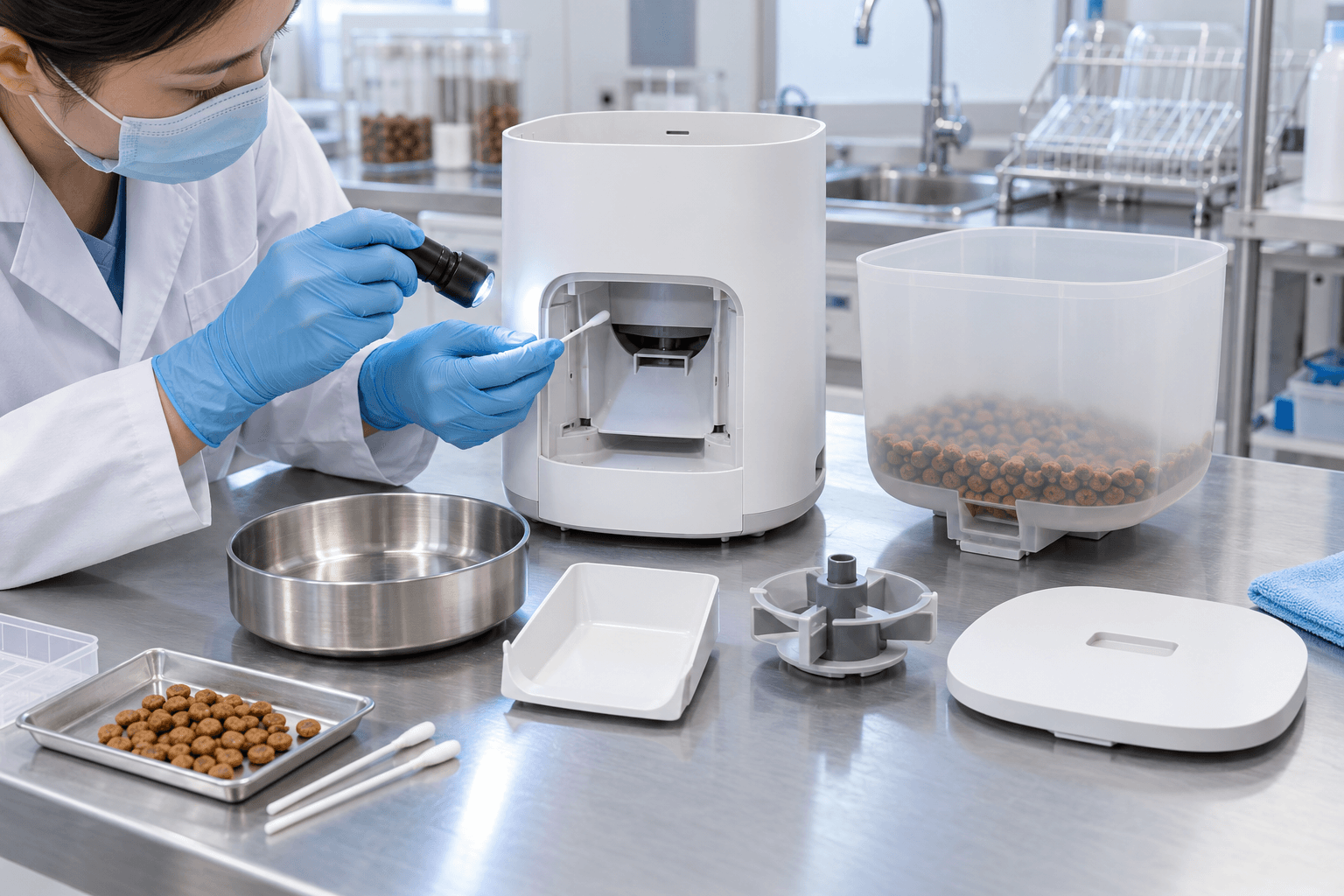
Cleaning design is a commercial issue as much as a hygiene issue. Oil film, kibble dust and crumbs can accumulate in hidden areas, change odor, attract pests, make portions less consistent and trigger negative reviews. A product may be technically washable but still frustrate customers if parts are difficult to remove, cannot dry completely or are easy to reinstall incorrectly.
This guide explains how distributors and brands should evaluate automatic pet feeder hygiene design, pet feeder food-contact materials and a washable automatic cat feeder before bulk approval. It complements the kibble and freeze-dried compatibility guide because food composition directly affects residue and cleaning frequency.
| Hygiene question | What buyers often see | What should be verified |
|---|---|---|
| Which parts contact food? | Only the bowl is described | Hopper, rotor, gate, chute, seals, fasteners and bowl |
| Which parts are removable? | “Detachable design” without a part map | Tool-free removal, access, wash method and reassembly controls |
| Can parts dry fully? | Water remains in ribs or hollow sections | Drainage, orientation, drying time and trapped-water inspection |
| Are materials documented? | Generic “food-grade” wording | Material identity, supplier documents and intended-use conditions |
| Does cleaning affect output? | Product works before washing | Portion and anti-jam performance after repeated cleaning cycles |
| Can foods cross-contaminate? | Two foods share hidden surfaces | Separate paths, carryover, allergen/diet management wording |
| Can support diagnose errors? | Customer reports “not dispensing” | Correct assembly indicators, photos and troubleshooting flow |
1. Map Every Pet Feeder Food-Contact Material
Start with the complete path from storage to serving. Food can contact the lid underside, hopper, agitator, rotor, gate, chute, bowl and small seals or fasteners. Surfaces next to the path may receive dust or oil even when they do not touch every portion.
Ask the automatic pet feeder manufacturer for an exploded view or part list identifying material, colorant or coating, supplier and intended cleaning method. “ABS housing” or “stainless steel bowl” does not describe the complete food-contact article.
| Zone | Typical function | Buyer evidence |
|---|---|---|
| Lid and seal | Limits moisture and unauthorized access | Material, removable seal, crevice inspection and cleaning method |
| Removable food tank | Stores the full food load | Material identity, surface finish, corners and drying access |
| Rotor or agitator | Meters or moves food | Removal process, hidden cavities, wear and correct orientation |
| Outlet and chute | Transfers food to the bowl | Reachability, oil film, fines and splash-back exposure |
| Bowl and tray | Direct eating surface | Material, finish, edge quality, retention features and wash method |

2. Find Hygiene Dead Zones Before Customers Do
A hygiene dead zone is an area where food, oil or wash water can enter but normal cleaning cannot reach or dry. Common risk locations include sharp hopper corners, ribs, screw bosses, overlapping plastic, non-removable seals and the underside of a chute.
Use a flashlight, white swab and inspection mirror after repeated dispensing. Disassemble only as far as the consumer manual permits; if residue remains beyond that level, the product may require a design change or a clearly defined service procedure.
3. “Removable” and “Washable” Need Separate Definitions
A part can be removable but not suitable for immersion, dishwashing or hot water. A washable part can still have a temperature, detergent or drying limitation. The manual should identify the method for every component and show which electrical or motorized modules must stay dry.
- Record whether tools are required and how many actions removal takes.
- Check sharp edges, pinch points and the force needed to unlock parts.
- Test hand washing with the stated detergent and water conditions.
- Verify whether dishwasher claims are supported for the exact material and cycle.
- Measure drying time and inspect hollow ribs, seals and joints.
- Repeat removal and installation to check wear, deformation and looseness.

4. Review Food-Contact Documents by Intended Use
Food-contact compliance is tied to the actual substance, finished material and conditions of use. A generic statement such as “FDA approved” is not a complete file. Buyers should identify the target market, food type, contact duration, temperature and whether the food surface contains free oil or fat.
For the United States, review the regulatory basis for each relevant food-contact material and the conditions or limitations that apply. For the EU, Regulation (EC) No 1935/2004 establishes the general framework, while material-specific measures and supporting documentation may also apply. The exact file depends on the final material and market.
Use the smart pet product certification guide to organize broader electrical, wireless and market-document questions alongside the food-contact file.
5. Test Oily Kibble, Fines and Odor Accumulation
Dry kibble can contain surface oil, and bag-bottom fines can adhere to that film. A clean feeder may look acceptable after one meal and develop residue after many cycles. Run the target food repeatedly before judging automatic pet feeder easy-to-clean performance.
Photograph defined inspection points before and after testing. Use a consistent white-swab method, record visible residue and odor, and time the complete cleaning task. Repeat with the most oily compatible kibble in the intended product line and with a fines-rich sample.

The automatic feeder food-compatibility guide explains how particle shape, oil and freeze-dried mixtures change dispensing behavior.
6. Control Food Carryover and Cross-Contamination Claims
Two foods in one feeder may share a rotor, chute or bowl. Even a dual-hopper feeder can create carryover downstream. This matters when households separate prescription diets, supplements, age-specific foods or ingredients that one pet should not receive.
Test one food with a visible or measurable marker, empty and clean the system according to the customer instructions, then run the second food. Record residual pieces and fines. Do not advertise allergen isolation or medical-diet protection unless the complete design and cleaning process support that exact claim.
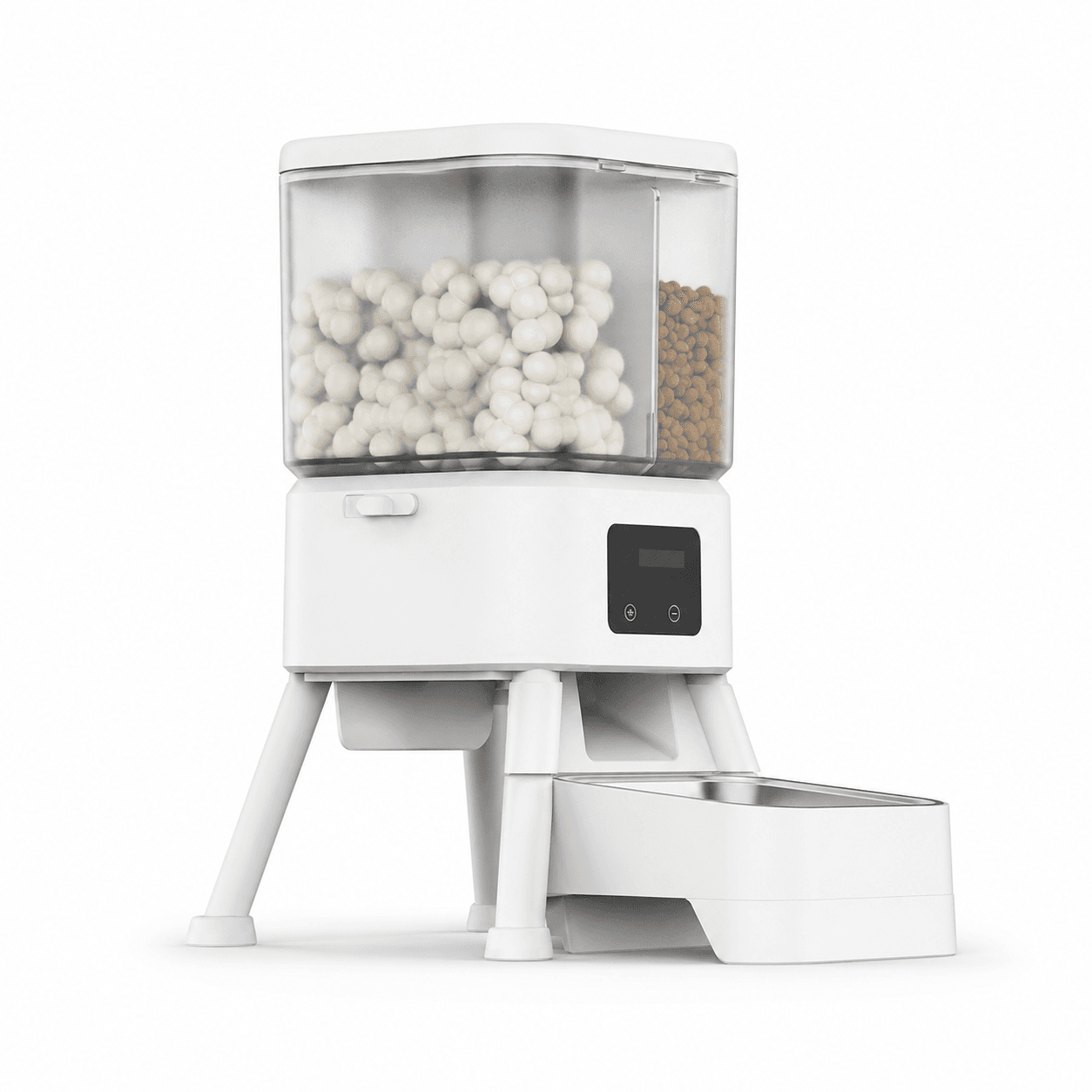
Where pet-specific access is the primary goal, compare a controlled-access model such as the PTM-90A1 RFID feeder. Access control and food-path isolation are different functions and should be tested separately.
7. Cleaning Is Not Complete Until the Feeder Works Again
Incorrect reassembly can cause leaks, jammed rotors, open lids, false low-food warnings or portions that miss the bowl. A washable automatic cat feeder therefore needs clear alignment features and error-proof assembly, not only removable parts.
- Give the final manual to a tester who has not seen the product.
- Time disassembly without coaching.
- Apply only the stated cleaning method.
- Measure drying time and inspect retained water.
- Reassemble the feeder and record uncertain steps.
- Run portion, jam and power-recovery tests again.
- Repeat several cleaning cycles to evaluate wear.
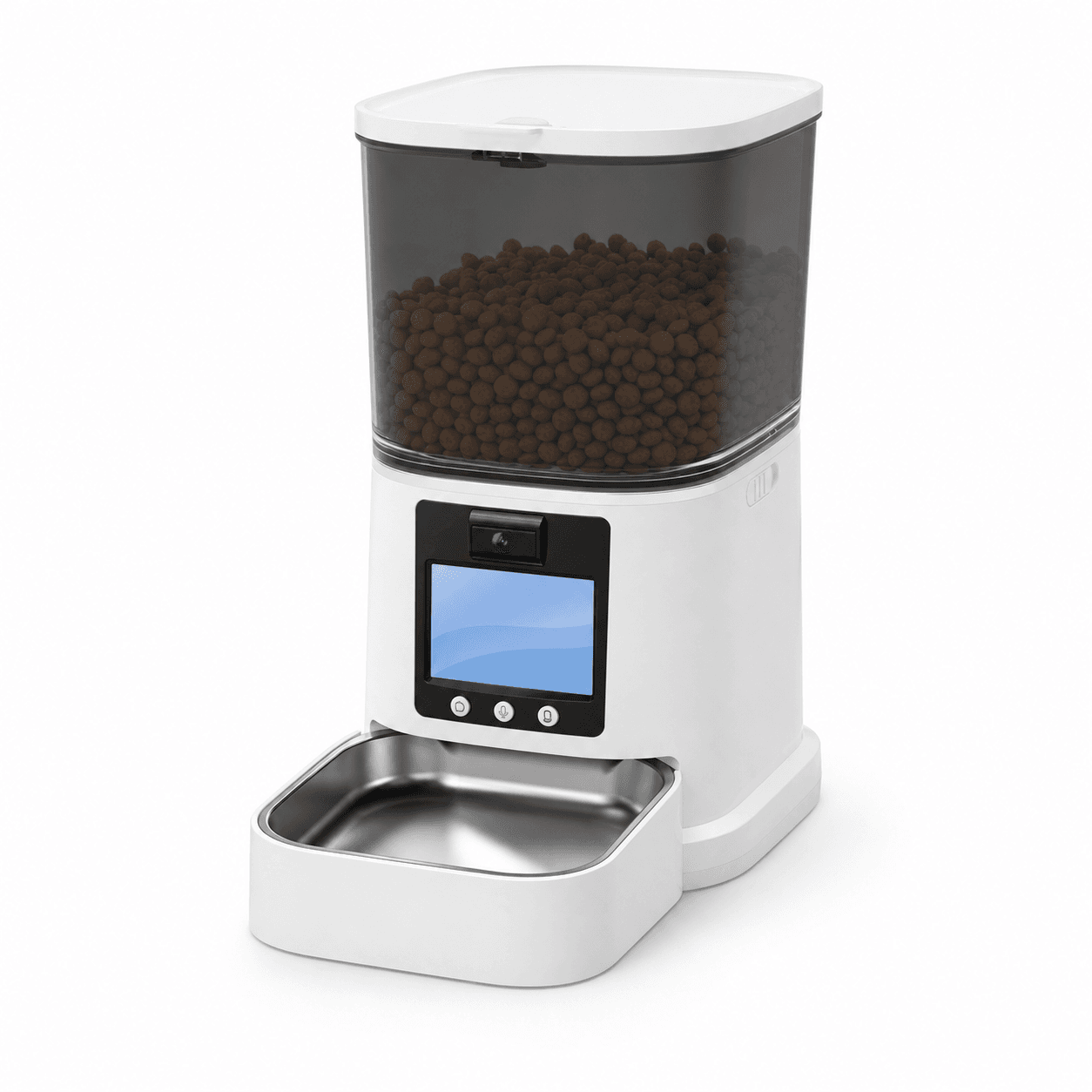
Use the portion and anti-jam test after reassembly and the offline and power-failure guide to confirm that cleaning has not disturbed essential operation.
8. Compare Automatic Feeder Cleaning Priorities by Platform
These examples show different inspection priorities. Confirm final materials, wash instructions, accessories and functions on the approved sample and purchase specification.
PFF015
Inspect the compact dry-food path, bowl, anti-jam pushing area and reassembly after hand cleaning.
PTM-20A1/20A3
Review both 2 L compartments, separate paths, downstream carryover, SUS304 component information and independent control.
PTM-103
Evaluate its detachable food-contact components, two-bowl serving area, chute cleaning and correct bowl placement.
PT03S
Separate washable food-contact parts from camera and electrical modules, then verify the bowl remains visible after reassembly.
Browse the complete automatic pet feeder range and compare platform selection with the private-label and wholesale buying guide.
9. Run a Five-Stage Automatic Feeder Cleaning Test
Stage 1 — Freeze the sample
Record model, hardware, food-contact parts, materials, firmware, food SKU and the exact cleaning instructions.
Stage 2 — Soil the real food path
Run target kibble, an oily compatible sample and bag-bottom fines through repeated scheduled portions.
Stage 3 — Inspect before cleaning
Photograph fixed points, swab seams and score residue, odor, trapped particles and inaccessible areas.
Stage 4 — Clean and dry as a customer
Use only the manual, permitted detergent, water conditions and tools. Record time, uncertainty and retained moisture.
Stage 5 — Reassemble and function-test
Repeat portion accuracy, anti-jam, low-food, lid closure and scheduled feeding checks. Cycle the process to assess wear.
10. Put Hygiene Requirements Into the Supplier Agreement
| Requirement | Evidence to approve | Why it protects the buyer |
|---|---|---|
| Food-contact part map | Part number, material, supplier and intended use | Prevents undocumented material substitution |
| Cleaning matrix | Hand wash, immersion, dishwasher and dry-only instructions by part | Reduces misuse and damage claims |
| Residue acceptance | Defined inspection points and repeatable test food | Controls odor, dust and long-term dispensing drift |
| Reassembly verification | Alignment, lock, error detection and portion retest | Reduces post-cleaning support tickets |
| Change control | Buyer approval for food-contact material, coating, seal or tooling changes | Keeps mass production equivalent to the approved sample |
A private label automatic pet feeder project should connect these requirements with Haolinc’s quality and compliance process, factory controls, automatic feeder customization guide and spare-parts plan. Buyers can also use the OEM/private-label guide, MOQ and customization guide, 12 manufacturer questions and FAQ when preparing an RFQ.
Conclusion: Cleanability Must Be Designed and Tested
The strongest automatic pet feeder hygiene design combines documented food-contact materials, reachable surfaces, removable washable parts, complete drying and error-resistant reassembly. A removable bowl is helpful, but it does not prove that the hopper, rotor, chute and seals are easy to maintain.
For distributors and brands, a timed real-food cleaning test is more valuable than a general “easy to clean” claim. It reveals support risk before the product reaches customers and converts hygiene into a measurable purchase-order requirement.
